

A recent study featured in The Astrophysical Journal Letters, led by scientists from Penn State University and NASA’s Jet Propulsion Laboratory (JPL), reveals that Earth’s radio transmissions may be more apparent to extraterrestrial observers than once believed. By examining 20 years of broadcast data from NASA’s potent Deep Space Network (DSN), researchers have identified spatial zones where Earth’s radio signals are most likely to leak and be detectable beyond our solar system.
How Planetary Alignments Amplify Earth's Signal Visibility
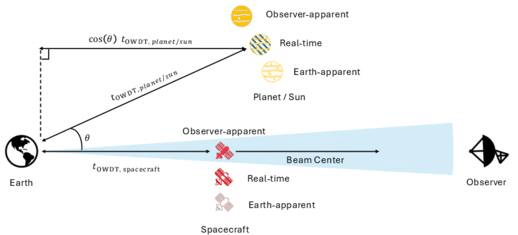
The study highlights that specific planetary alignments play a significant role in increasing the chances that alien civilizations could intercept transmissions from Earth. Many high-powered signals intend to reach spacecraft orbiting planets such as Mars. However, these signals don’t get fully absorbed by the target. Instead, a fraction of the broadcast extends past the intended recipient, streaming through space as narrow beams. If an alien world or probe is aligned with Earth and Mars during these transmissions, it might detect these unintended signals, effectively turning Earth into a beacon.
“Our communications primarily target spacecraft exploring planets like Mars,” explained Pinchen Fan, the study’s lead author and graduate astronomy researcher at Penn State. “Mars doesn’t entirely block our transmissions, so any distant observer situated along these interplanetary transmission paths during planetary alignments could potentially pick them up. This suggests that looking for interstellar planetary alignments might be key in searching for extraterrestrial contacts.”

By modeling planetary geometries over two decades, the team estimated a 77% probability that alien civilizations situated in the right alignment with Earth and Mars would intercept Earth’s signals, alongside a 12% chance linked to alignments involving other planets. Outside of these periods, the detection chances drop dramatically.
Implications for SETI: A New Way to Target Technosignature Searches
This research offers SETI (Search for Extraterrestrial Intelligence) initiatives a novel approach by reversing the traditional viewpoint. Instead of merely scanning for alien technosignatures such as radio bursts or laser emissions, scientists now analyze Earth’s own transmission patterns to infer where extraterrestrials might be listening.
“Detecting technological signs from elsewhere relies on understanding where intelligent beings might be paying attention,” said Fan. “By mapping the trajectories and timings of our strongest signals, we refine our search strategies to focus on regions more likely to yield responses.”
The study advocates prioritizing star systems that have had clear line-of-sight access to Earth’s transmissions during these planetary alignments. These vantage points represent the best prospects for establishing contact or receiving signals in return.
Navigating Earth’s Most Powerful Radio Emissions with the Deep Space Network
Central to this research is NASA’s Deep Space Network, an extensive antenna network communicating with distant probes such as New Horizons and the James Webb Space Telescope. These publicly accessible logs chronicle Earth's most intensive cosmic transmissions over two decades, including data on direction, strength, and timing. “The DSN is integral for sending commands and receiving data from spacecraft beyond our solar system,” noted Joseph Lazio, project scientist at JPL and co-author. “Its transmissions constitute some of the most consistent and robust radio signals Earth has broadcasted into space, allowing us to analyze their spatial and temporal footprints.”
The study observes that the bulk of DSN signals remain within five degrees of Earth's orbital plane. This pattern means signals predominantly travel along a relatively flat solar system plane—akin to radio dishes aligned on a tabletop—focusing potential detection zones.
Enhancing the Search with Next-Generation Telescopes
Looking ahead, the arrival of telescopes like the Nancy Grace Roman Space Telescope promises to drastically broaden our understanding of exoplanets—likely adding hundreds of thousands of additional planets, especially those sharing orbital planes aligned with Earth's viewpoint. This will expand the list of potential worlds that might be aware of our broadcasts.
“Considering how few multi-planet systems with transiting exoplanets we’ve discovered so far,” Fan pointed out, “the Roman Telescope’s upcoming surveys could greatly amplify our target zones for intelligent life searches.”
Improved instrumentation means we could focus on specific planetary systems known to have had opportunities to receive Earth's transmissions, offering optimal locations to intercept responses.
The Crucial Role of Alignment in Interstellar Communication
While often overlooked, the spatial alignment of planets and observers is a pivotal factor for both sending and receiving interstellar signals. If extraterrestrial civilizations rely on strategies similar to ours, their transmissions may also spill out preferentially during certain celestial alignments.
“Our data show that extraterrestrial observers positioned to see the Earth-Mars alignment have a 77% chance of intercepting our transmissions—far higher than random chance,” emphasized Fan. “Other planetary alignments present a 12% chance, while off-alignment periods offer almost no chance for interception.”
This insight suggests that random scanning efforts could be significantly less effective than observing strategic alignment events, underscoring the importance of timing and geometry in cosmic communication.
- Categories:
- News













0 comments
Sign in to Comment