

Scientists at Loughborough University in the United Kingdom have transformed the saying “playing the world’s smallest violin” into a tangible scientific achievement. Traditionally a sarcastic phrase aimed at mocking exaggerated complaints, this time it signifies a genuine microscopic violin carved with nanotechnology advances. This innovative breakthrough holds promise far beyond its playful origins.
A Violin Beyond Normal Dimensions
The miniature violin fabricated by the team measures just 13 microns across, making it significantly slimmer than a typical human hair, which can be up to 180 microns thick. This isn’t a musical instrument for any living being to perform with, but rather a meticulously etched design crafted using state-of-the-art nanolithography methods. While it’s too tiny for practical use in playing music, the technique used to construct it signals remarkable new possibilities in materials science.
Demonstrating the tiniest violin highlights the remarkable progression possible with nanotechnology. Kelly Morrison, an experimental physicist at Loughborough University, states, “As we deepen our understanding of material behaviors at this scale, the door opens to innovations in computing, energy capture, and other technologies.”

Steps to Sculpting the Miniature Instrument
The process to realize this tiny violin involved four key stages. Initially, a heated ultra-fine needle was used to trace the violin pattern onto a polymer-coated chip. The etched pattern was then chemically removed, creating a hollow impression.
Next, that hollow was infused with platinum, which formed the structural element of the violin. Afterward, the remaining polymer was stripped away, revealing the delicate platinum sculpture. This meticulous approach resembles screen printing, but on an incredibly minuscule scale and utilizing far more advanced tools.
Precision Through Advanced Nanolithography
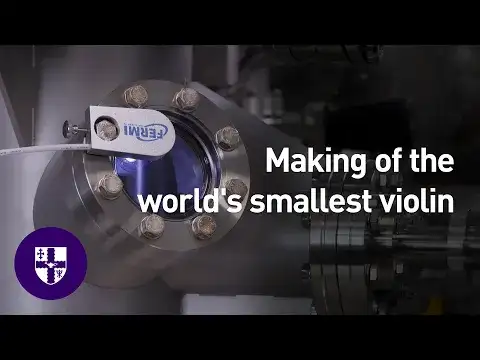
The violin’s creation hinged on cutting-edge nanolithography technology, employing specialized machinery maintained within a dust-free controlled environment. The NanoFrazor, a precision sculpting instrument, operates inside a glovebox to ensure impeccable cleanliness. This level of accuracy requires a dedicated, fully equipped laboratory space to maintain spotless conditions.
Morrison shares her enthusiasm: “I’m energized by how precisely we can manipulate materials with this system. I eagerly anticipate the discoveries my team and others will make using this technology.”
What This Means for Nanotech Advancements
Though the tiny violin might seem lighthearted, the underlying science is profound. Morrison notes, “While building the world’s smallest violin started as an intriguing challenge, the insights gained have provided a foundation for exciting future investigations.”
The project enables unprecedented exploration of materials at ultra-small scales, letting researchers apply stimuli such as light, magnetic fields, or electrical currents to study responses. These insights could catalyze breakthroughs in computing performance and renewable energy solutions.
- Categories:
- News













0 comments
Sign in to Comment