
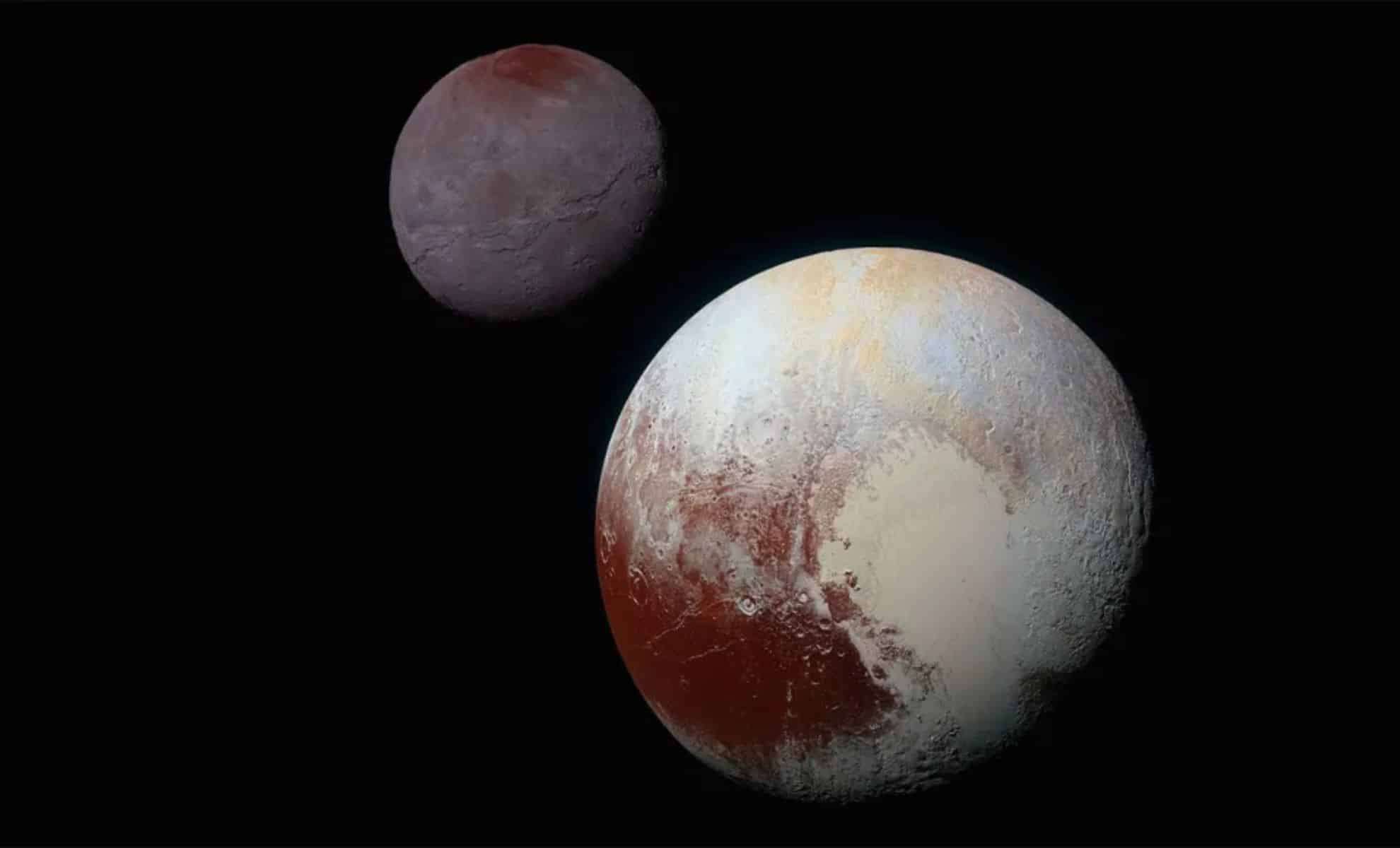
Researchers at the University of Arizona have revealed a groundbreaking explanation for the origin of Pluto and its moon. Published in Nature Geoscience, their study challenges existing models, proposing a gentle "kiss and capture" event as the key to how these celestial bodies became a binary pair.
Pluto and Charon: A Unique Orbital Partnership
The intriguing duo of Pluto and Charon has long defied conventional understanding. Unlike typical planet-moon pairs, they orbit a mutual center of gravity, creating a distinctive binary system. This characteristic makes them the largest binary configuration in the distant trans-Neptunian region of the solar system. The discovery of a “kiss and capture” scenario offers fresh perspectives on gravitational dynamics among far-flung planetary bodies.
Historically, scientists believed their binary relationship resulted from a high-energy impact, akin to the giant collision thought to have formed Earth’s moon. This hypothesis held that such a violent event melted both worlds or generated debris from which Charon coalesced. Yet, this theory assumed Earth-like compositions, which are markedly different from the icy-rocky nature of Pluto and Charon.

The Gentle Embrace: Understanding ‘Kiss and Capture’
Using cutting-edge computer models and simulations, the study proposes that Pluto and Charon didn’t collide violently. Instead, their trajectories brought them so close they essentially "brushed" each other, temporarily adhering through gravitational forces. This "kiss and capture" process then established their enduring orbital lock, maintaining much of their original material.
Pluto and Charon’s composition—primarily a mixture of rock and ice—made it possible for them to endure this low-speed, glancing encounter without catastrophic damage, leading to their binary pairing.
Simulations Shed New Light on Binary Formation
Advanced simulations incorporating the physical properties of icy materials were critical to this revelation. The models demonstrated that when Pluto and proto-Charon encountered each other at shallow impact angles between 50 and 70 degrees, the collision speed was sufficiently low for them to briefly cohere.
Adeene Denton, a NASA postdoctoral fellow and one of the study’s senior researchers, noted that they focused on how this initial capture event influenced Pluto’s geological development. The energy from the impact combined with tidal interactions likely contributed to shaping Pluto’s surface as observed today.
Previous assumptions, which envisioned collisions resulting in total melting or debris ejection, did not account for the robustness of icy bodies. The new findings align well with the observed sizes and orbital behavior of Pluto and Charon, offering a more accurate and realistic view of their shared history.
- Categories:
- Astronomy








0 comments
Sign in to Comment