

A groundbreaking lightning event has been recorded, with a single bolt streaking an incredible 515 miles across the United States. This extraordinary "megaflash" eclipses all previous records, revealing the immense scale and force of natural lightning strikes. Researchers from the Georgia Tech Research Institute spearheaded the analysis, shedding light on the mechanisms behind such rare phenomena. The findings, published in the Bulletin of the American Meteorological Society, emphasize both the awe-inspiring nature and the potential threats posed by extreme lightning events.
Exploring the Unprecedented Lightning Megaflash
During a notably powerful storm, an exceptional lightning flash spanned a remarkable 515 miles across the central U.S. Unlike typical strikes that descend or spread locally, this megaflash moved horizontally, connecting cloud areas across multiple states. Defined as a megaflash when exceeding 62 miles, this event sets a new benchmark illustrating nature’s spectacular capacities.
Originating within a mesoscale convective system—a vast network of thunderstorms—this lightning was fueled by enormous reservoirs of electric charge. Such large-scale storm complexes create ideal conditions for extensive lightning displays. The horizontal reach of this megaflash challenges conventional views on lightning behavior, making it a significant meteorological breakthrough.

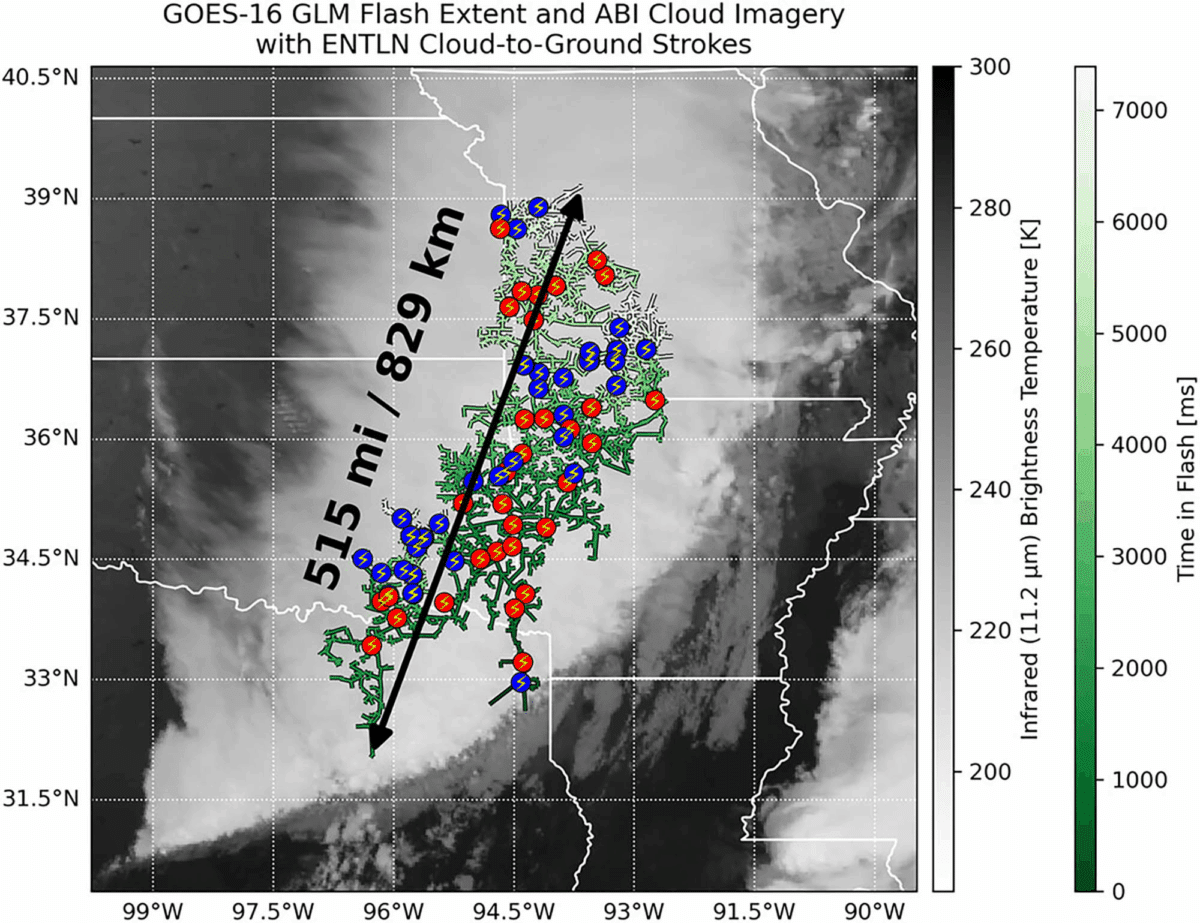
Satellite Technology Enables Tracking of This Massive Lightning Event
Traditional ground radar systems would have struggled to capture this unprecedented lightning flash in its entirety. Instead, the Geostationary Lightning Mapper (GLM) aboard satellites provided a comprehensive vantage point, continuously observing lightning activity across the hemisphere and documenting the enormous stretch of the megaflash.
Employing sophisticated algorithms and geodesy-based analysis, researchers confirmed that the megaflash was a single, unbroken discharge rather than a collection of separate strikes. This technological advancement allows scientists to fully appreciate how lightning can span vast regions far beyond typical storm cores. Such innovations are revolutionizing atmospheric observation techniques.
The Importance of Lightning Megaflashes in Earth's Electrical Balance
Lightning plays a pivotal role within the Earth's global electrical circuit, a vast system regulating charge between the surface and upper atmosphere. Each megaflash transfers significant electrical energy, influencing weather systems and atmospheric dynamics.
Beyond electrical effects, these massive flashes generate nitrogen oxides, which are critical for ozone layer chemistry. Although individual megaflashes might seem isolated, their cumulative effect is integral to climate models and weather forecasting on a global scale.
The 515-mile megaflash has provided researchers unparalleled data to study these processes at an extensive scale, enhancing our grasp of lightning’s contribution to Earth's climate systems, thanks to detailed satellite observation.
Recognizing the Hazards Linked to Lightning Megaflashes
While lightning often mesmerizes from afar, its risks are substantial. Lead researcher Michael J. Peterson emphasizes, “A single strike can potentially impact a lot of people.” This reminder underscores lightning's ability to strike far outside immediate storm areas.
This particular megaflash struck regions potentially unaffected by the storm’s core, illustrating that lightning hazards aren’t confined to turbulent thunderstorm zones. Staying cautious and seeking shelter remain essential practices even when storms seem distant.
Satelites Paving the Future of Lightning Studies
This record megaflash signifies a leap forward in lightning research, highlighting the growing relevance of satellite-based monitoring for atmospheric science. Satellites not only track extraordinary events but also supply critical data for improving warnings and protective measures.
With advancing technology, more unprecedented lightning occurrences are likely to be discovered within satellite archives. Enhanced data processing and refined algorithms are reshaping our understanding of lightning phenomena, aiding scientific research and public safety alike.
Documented in the Bulletin of the American Meteorological Society, this work exemplifies how novel approaches are expanding the horizons of meteorological observation beyond previous limits.
- Categories:
- News









0 comments
Sign in to Comment