
In early 2026, a bird species missing from Singapore’s skies for nearly 40 years made an unexpected and captivating reappearance. The Eurasian hoopoe, easily recognized by its vivid crest and distinctive wing patterns, was observed near a temple in the eastern district of Tanjong Katong, lingering in the area for several days.
Initial sightings shared on birdwatching platforms quickly fueled widespread excitement. Locals welcomed photographers into their gardens, while experts engaged in discussions about where the bird had come from. The online conversation ranged from genuine enthusiasm to humorous remarks, including one Reddit user’s quip labeling the bird “foreign talent.”
Beyond the social buzz, the sighting pointed to a larger ecological story: a species absent from Singapore since October 1987 emerged right within the Asian migratory season. Whether it was a rare navigational mishap or a response to environmental shifts is yet to be determined, but its confirmed presence renews interest in bird migration pathways across Southeast Asia.

Singapore’s First Verified Hoopoe in Almost Four Decades
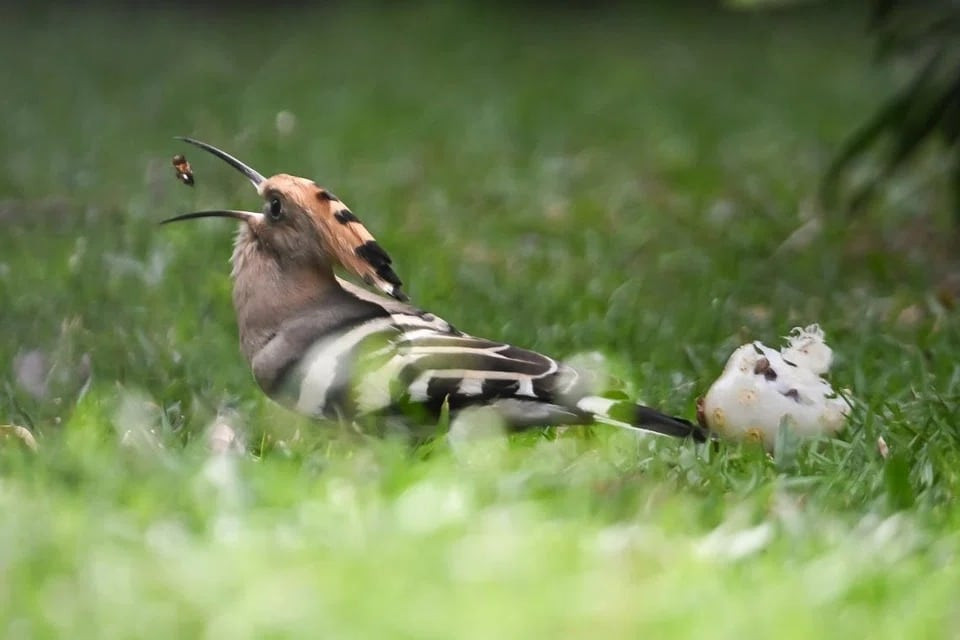
On the morning of January 19, wildlife photographer Andy Chew spotted the bird while cycling through Tanjong Katong after hearing the news on a birding chat. At about 10 a.m., near the Katong Gurdwara Sikh Temple, he saw the unmistakable bird rest on a tree branch. “It was unforgettable,” Chew recalled, noting the hoopoe’s long, curved bill, its striking zebra-like wing pattern, and its crest.
The bird was subsequently seen resting in a mango tree within a private yard where the owners welcomed birdwatchers for better viewing. Numerous observers submitted documentation to the Bird Society of Singapore, which officially registered the sighting as the first in close to 40 years.
Reports from The Cool Down confirmed the dates and highlighted the rarity of this event, emphasizing that such a sighting hadn’t been recorded locally since 1987.
A Migratory Bird with a Wide Range
The Eurasian hoopoe (Upupa epops) breeds broadly across Europe, Asia, and North Africa, steering clear of dense tropical jungles, deserts, and mountain peaks. In the boreal winter, it migrates south with regular stops in Thailand, Peninsular Malaysia, and some parts of Indonesia. Occasionally, migratory overshoots have led to rare sightings as far afield as Japan, Australia, and Alaska, documented in the Birds of the World's profile.
Dr. Yong Ding Li of BirdLife International Asia remarked that the reappearance was plausible. “Migratory birds do not respect national borders,” he told The Straits Times, explaining how wind patterns or disorientation can push long-distance migrants hundreds of kilometers off route.
While the exact origin of this Singapore hoopoe remains uncertain, expert opinion suggests it most likely arrived through natural migration rather than escape from captivity. Still, Richard White, chair of the Bird Society’s records committee, noted the species does appear in the regional caged-bird trade. “Regardless of where it came from, it’s a stunning bird that has delighted many local observers,” he added.
Unique Features and Adaptations of the Eurasian Hoopoe
The hoopoe is instantly recognizable due to its distinctive traits described on Ornithology.com, including a reddish body, a fan-shaped crest, and a curved bill specialized for foraging on the ground. Its characteristic call, “oop, oop, oop,” inspired both its common and scientific names.
Known as a secondary cavity nester, it doesn’t build nests but rather inhabits holes in trees, crevices in walls, or abandoned structures, lining them with organic debris. During breeding, females secrete a bactericidal substance from preen glands to coat their eggs, protecting them against bacteria and fungi. This secretion has a strong smell thought to deter predators.
Worldwide populations are estimated at between 5 and 10 million, according to Birds of the World. However, ongoing threats include intensified farming practices, decline in nesting habitats, and widespread use of insecticides affecting their food sources.
Importance of This Rare Sighting for Monitoring Bird Migration
The hoopoe’s appearance in Tanjong Katong adds to a growing list of infrequent yet significant bird encounters in Singapore, such as the flock of Himalayan vultures recorded in Clementi in 2025. Such observations might reflect shifting migration routes, increased participation in citizen science, or a mix of these factors.
No direct conservation measures have resulted from this sighting, but groups like the Bird Society of Singapore remain vital in confirming unusual records. Experts caution that solitary events don’t establish trends, yet rare visits like this can provide vital clues about environmental transformations.
The hoopoe has since departed, with no further reports. Whether this event signals an isolated wanderer or a broader pattern remains unknown. Continued documentation of such anomalies is crucial for ornithologists tracking species adaptability and environmental changes amid a shifting climate.
- Categories:
- News











0 comments
Sign in to Comment