
An advanced 3D electromagnetic model has offered unprecedented insight into the subterranean dynamics beneath the Marmara Sea, shedding light on probable initiation points for a significant earthquake close to Istanbul. By analyzing the rock formations underground, this analysis identifies key zones where stress accumulation may be occurring along the North Anatolian Fault.
Turkey is uniquely positioned at the intersection of the Eurasian, African, Arabian, and Anatolian tectonic plates. This complex junction has historically been associated with devastating seismic events, such as the 1939 Erzincan earthquake that resulted in over 30,000 fatalities.
Researchers have observed a westward propagation pattern of large earthquakes along the North Anatolian Fault (NAF) over time. This trend has placed intense focus on the section beneath the Marmara Sea, which remains untouched by major earthquakes for more than 250 years.

A Supposedly Quiescent Section May Harbor Hidden Tension
While the Marmara Sea area of the fault appears stable on the surface, findings published in Geology suggest a prolonged state of quiet could actually indicate underwater stress buildup.
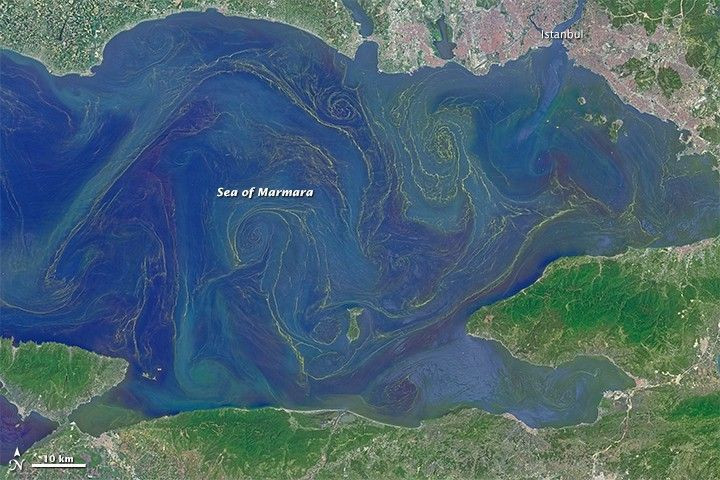
Due to the difficulty of obtaining detailed data for this offshore fault system, researchers have faced challenges in pinpointing the likely origin points of upcoming seismic events and assessing their potential impacts on urban centers like Istanbul. This uncertainty has loomed over the region for decades.
Decoding the Earth’s Natural Electromagnetic Signals to Visualize Subsurface Layers
To tackle this challenge, a collaborative team led by Dr. Yasuo Ogawa of Science Tokyo, alongside Dr. Tülay Kaya-Eken from Boğaziçi University, developed a detailed three-dimensional electromagnetic representation of the fault zone.
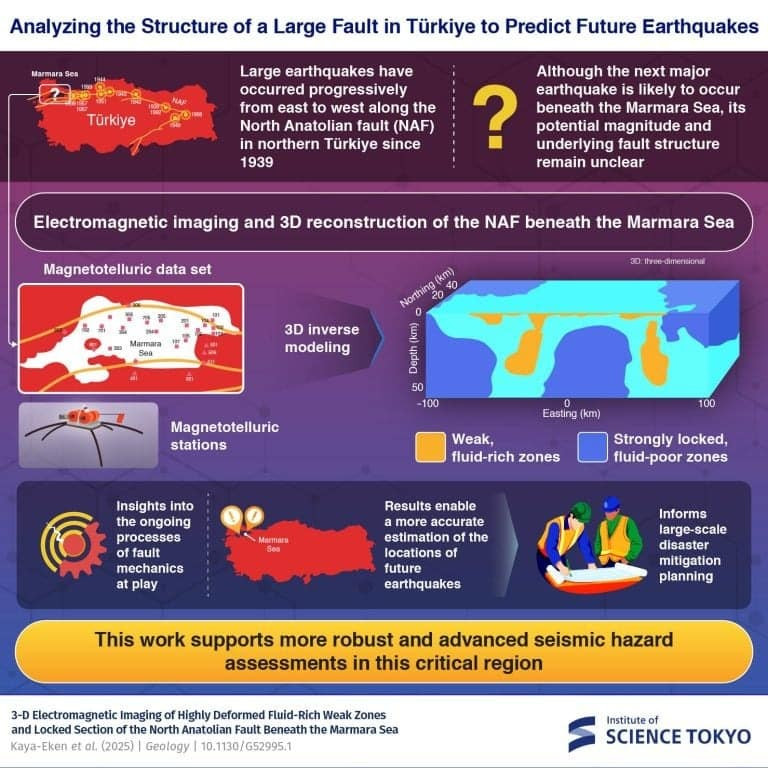
Their approach involved gathering information from over 20 magnetotelluric stations that detect natural fluctuations in the Earth’s electrical and magnetic environments. By applying 3D inversion techniques, these data were transformed into a resistivity map revealing structures tens of kilometers below the ocean floor.
“The first three-dimensional inverse modeling performed on a magnetotelluric dataset of the MS (Marmara Sea)has unveiled localized weak and locked fault segments along this shear deformation zone,” the authors said.
Although this is not a direct visual image, it presents a remarkably nuanced perspective on underground formations otherwise undetectable.
Interface of Rigid and Fluid-Rich Zones Marks Points of Tectonic Stress
The model reveals an interspersing pattern of low-resistivity and high-resistivity regions. As Ogawa notes, the low-resistivity zones likely contain fluids, making them more deformable, while the high-resistivity areas represent stronger, locked rock blocks.
“We believe the resistive anomalies observed signify regions of stress accumulation, shedding light on the ongoing processes of fault mechanics at play in this critical region,” he said.
According to the analysis, the boundaries between these contrasting zones and the perimeters of the strongest sections are the most probable sites where future earthquakes might initiate. These areas seem to act as focal points for tectonic stress along the fault line.
“Our results can be used to estimate the location and potential magnitude of future megathrust earthquakes, with significant implications for disaster prevention and mitigation,” he added.
However, this study does not provide a precise timeline for when the next large quake will strike. Pinpointing the exact rupture point remains a notoriously difficult task, especially within fault systems as intricate and underexplored as this one.
- Categories:
- Science






0 comments
Sign in to Comment