
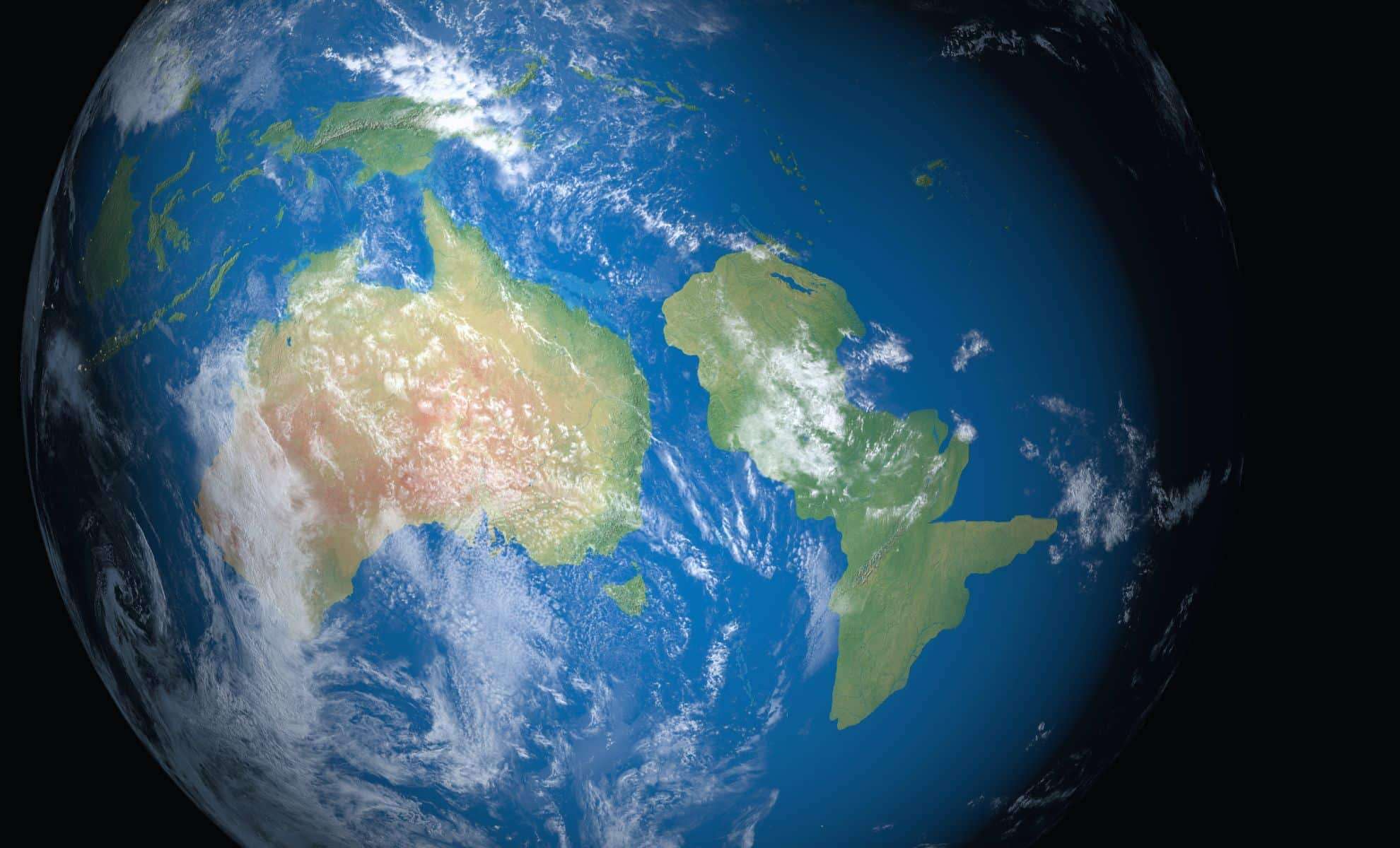
Groundbreaking new research is transforming our comprehension of Earth’s primordial geology, challenging the traditional narrative of how the planet’s earliest continents emerged. Scientists at The University of Hong Kong (HKU) have shared their findings in Science Advances, proposing that powerful mantle plumes deep within the Earth, rather than moving tectonic plates, were instrumental in the creation of the initial continental crust. This paradigm shift offers a fresh framework for understanding ancient geological processes.
Contrary to the conventional plate tectonics model—which attributes the formation of continental crust to subduction and collision of plates—the HKU team has identified a distinct mechanism. Dr. Dingyi Zhao, the principal investigator, explains, “Our findings strongly indicate that the Archean continental crust was not necessarily the product of subduction. Instead, a two-step process characterized by mantle plume ascent and gravitational sagduction of greenstone sequences provides a more comprehensive explanation for the geochemical and geological attributes present in the Eastern Block.” This revelation bears significant importance for geosciences and planetary studies alike.
Reevaluating How Continents Came to Be
The origins of Earth’s distinctive continental crust have sparked long-standing debates within geoscience circles. Historically, the plate tectonics theory has dominated, suggesting that subduction zones where one lithosphere plate dives beneath another facilitated the formation of early continental masses. These interactions were thought to have progressively shaped the Earth’s crust.

However, the investigation led by Dr. Zhao challenges this perspective by studying primordial rocks from northern China, emphasizing a role for mantle plumes—vigorous upwellings of molten mantle material—to account for the crust’s genesis. This hypothesis asserts that the first continents were formed as hot mantle materials reached the surface, cooled, and solidified into crust, independent of tectonic collisions.
To substantiate this theory, the researchers examined ancient granitoid samples, specifically TTGs (tonalite–trondhjemite–granodiorite), which compose some of the planet’s oldest crustal sections. Dating back roughly 2.5 billion years, these rocks contain zircon minerals encoding chemical data from their formation era. Analysis of these zircons revealed signatures more consistent with mantle plume activity rather than subduction-induced conditions.
Introducing the Two-Phase Mantle Plume-Sagduction Hypothesis
The HKU team proposes a novel two-phased mechanism for the assembly of the earliest continental landmasses. Initially, approximately 2.7 billion years ago, thick accumulations of basalt developed on the ocean floor as a result of mantle plume-driven activity. These basalt layers, abundant in iron and magnesium, constituted the primary material for continental crust formation.
The subsequent stage, about 2.5 billion years ago, saw another mantle plume event triggering partial melting of these dense basalt layers. This process generated more buoyant, felsic rocks—TTGs—that are fundamental building blocks of continental crust. This two-step sequence elucidates how basaltic materials transitioned into granitic rocks, eventually constituting the planet’s continents.
Dr. Zhao reiterates the transformative nature of these results, stating, “Our results provide strong evidence that Archean continental crust did not have to be formed through subduction. Instead, a two-stage process involving mantle plume upwelling and gravitational sagduction of greenstones better explains the geochemical and geological features observed in the Eastern Block.”
Broader Consequences for Early Earth Dynamics
This research not only reshapes our understanding of the origin of Earth’s first continents but also enhances insights into the geodynamic mechanisms at play during Earth’s formative eons. Highlighting mantle plumes as a dominant factor challenges preexisting models, underscoring the importance of deep internal Earth activity in surface evolution.
Significantly, the study sheds light on sagduction—a gravitational process wherein denser rock masses descend into the Earth’s interior. Coupled with mantle plume upwelling, this mechanism could explain the unique geochemical patterns evident in ancient geological samples. Professor Fang-Zhen Teng from the University of Washington, co-author of the paper, remarks, “This work is a great contribution to the study of early Earth geodynamics. Our uses of zircon water and oxygen isotopes have provided a powerful new window into the formation and evolution of early continental crust.”
Beyond Earth, these discoveries carry implications for understanding other worlds. Deciphering Earth’s early crust formation equips scientists to better interpret the geological evolution of exoplanets and bodies within our solar system, broadening the horizon of planetary science.
- Categories:
- News





0 comments
Sign in to Comment