
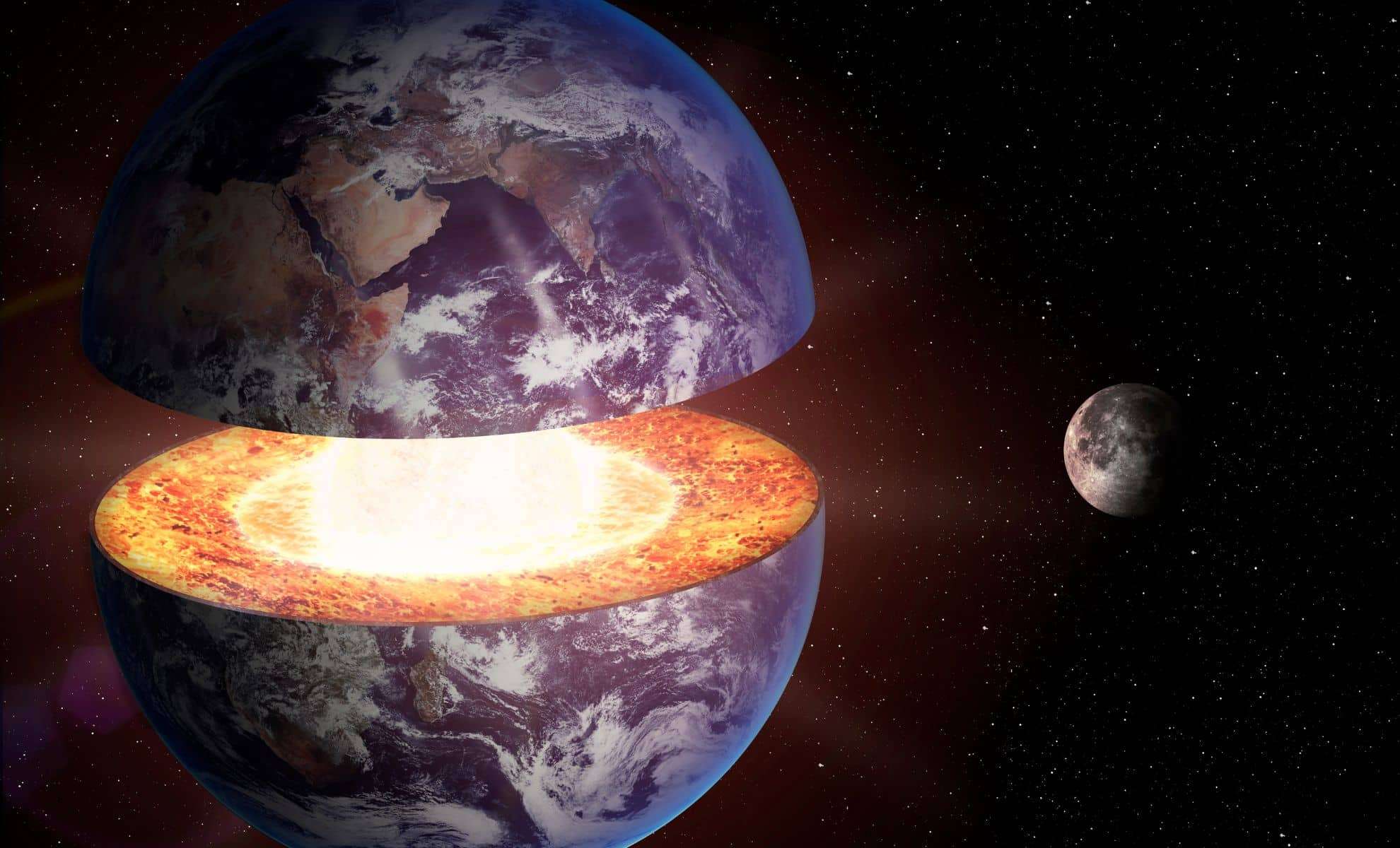
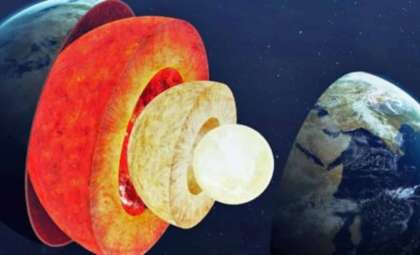
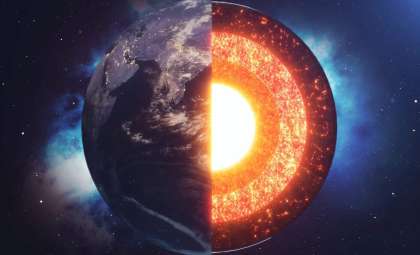
Located approximately 2,700 kilometers beneath Earth's surface, a perplexing region known as the D” layer has baffled researchers for over fifty years. This zone is notable for causing seismic waves to accelerate unexpectedly, a phenomenon previously unexplained. Recent advances by ETH Zurich scientists have now provided a compelling explanation for this long-standing geological mystery.
Slow Movement of Solid Rock in the Mantle
The breakthrough comes from recognizing that solid rock within the Earth's mantle flows gradually rather than remaining static. Unlike molten magma, this solid-state flow causes the minerals inside the mantle to realign over time.
It is this mineral realignment that contributes to the increased speed of seismic waves passing through the D” layer. Led by Professor Motohiko Murakami, an expert in experimental mineral physics, the team’s research reveals how this deep mantle movement finally resolves a geological puzzle that has intrigued scientists for decades.

Their findings, published in Communications Earth & Environment, demonstrate that mantle convection involves solid rock flowing horizontally under immense pressures and temperatures. This flow aligns the post-perovskite crystals uniformly, which is the critical factor behind the seismic wave speed-up detected in the D” layer.
Unraveling the D” Layer Enigma
Positioned near the interface between Earth's mantle and core, the D” layer has intrigued geoscientists since the 1960s. Seismic waves display unusual acceleration when traversing this boundary, as though encountering a fundamentally different material. Past studies indicated that the mineral perovskite transforms into post-perovskite under extreme conditions, but the mechanism for the observed seismic increase was unclear.
In 2007, scientists suggested that the directional alignment of post-perovskite crystals could be responsible. They theorized that this consistent orientation would facilitate faster seismic wave propagation, though definitive experimental evidence was lacking until now. Researchers at ETH Zurich simulated the D” layer's environment in lab experiments, confirming this hypothesis. Murakami states, “We have finally found the last piece of the puzzle.”
Confirmation of Mantle Convection Dynamics
The identification of mantle convection was a pivotal moment in geoscience. While it was long suspected that solid rock in the mantle flows like slowly boiling liquid, direct observation had remained elusive. The experiments by Murakami's group provide the first concrete proof that solid mantle rocks move steadily at the core-mantle boundary.
This motion is responsible for the uniform alignment of post-perovskite crystals, causing seismic waves to quicken. “Our discovery reveals that Earth's internal activity extends well beyond surface phenomena,” Murakami explains.
Beyond resolving seismic curiosities, this insight offers new opportunities for mapping mantle movements. Understanding these currents could unveil the forces that govern volcanic activity, tectonic shifts, and the generation of Earth’s magnetic field.
- Categories:
- News




0 comments
Sign in to Comment