
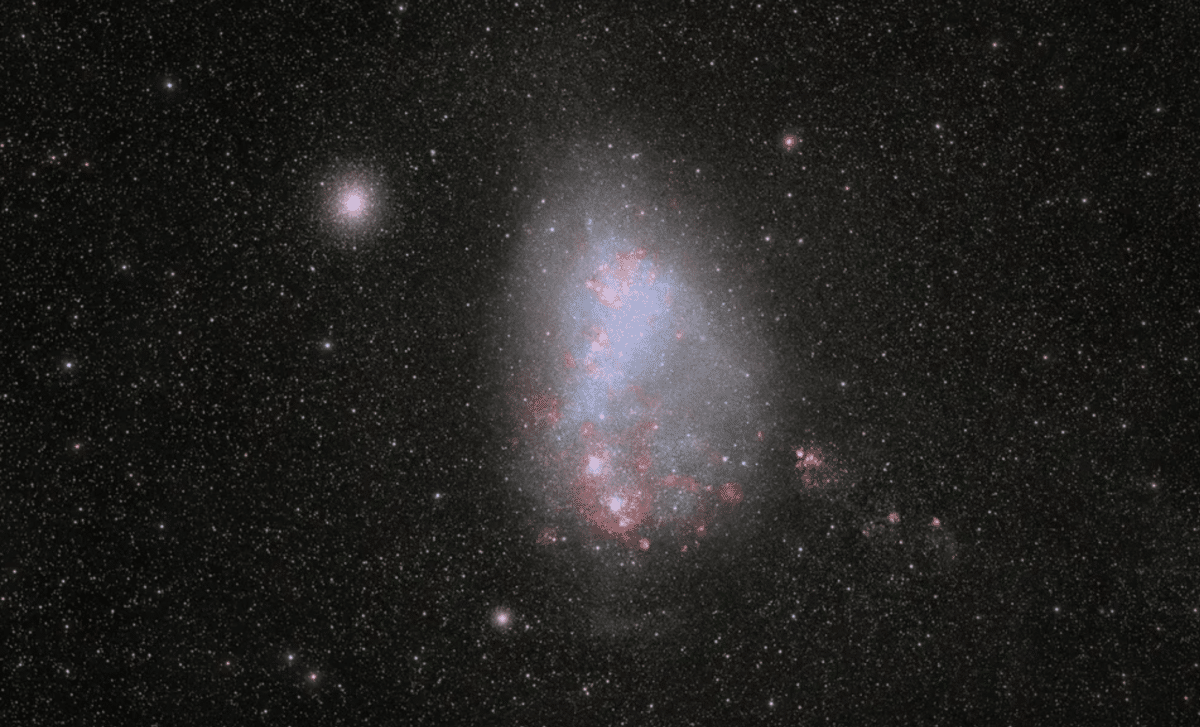
A recently unveiled photo from NOIRLab Audiovisual showcases a remarkably detailed view of the Small Magellanic Cloud that was taken not from space, but right here on Earth using a telephoto lens. This breakthrough challenges traditional views on the capabilities of terrestrial astrophotography.
A Close Galaxy Seen with Unprecedented Clarity
The Small Magellanic Cloud (SMC), a dwarf galaxy that orbits near our Milky Way, has fascinated scientists exploring galaxy formation and evolution. Sitting about 200,000 light-years away, the SMC hosts hundreds of millions of stars packed in an irregular formation. From certain vantage points in the Southern Hemisphere, it appears faintly as a blurry spot to the naked eye. However, the fresh image reveals a wealth of detail, including star clusters, dust lanes, and subtle brightness shifts, typically expected only from professional observatories.
What is truly remarkable is not just the target but the technique. The clarity and depth of the image might suggest usage of high-end space instruments, yet it was achieved from the ground, proving that atmospheric conditions and modern optics can rival space-based imaging—a revelation that broadens the horizons of accessible astronomy.

Captured Using Modest Gear from Earth
This striking photograph was taken by Petr Horálek, a NOIRLab ambassador, at Cerro Pachón in Chile, a renowned site for its pristine night skies with little light pollution. Employing a standard camera combined with a fast telephoto lens, Horálek spent four hours gathering light from the distant galaxy. This long exposure process allowed faint features of the SMC to come into sharp relief, illustrating an advanced technique more typical of professional observatories but achieved here with simpler equipment.
The success underscores the critical role of favorable natural factors such as altitude, clear skies, and minimal atmospheric disturbance. This accomplishment reflects a broader movement in astronomy where enthusiasts with more accessible technology are making significant contributions alongside traditional research institutions.
NOIRLab Audiovisual’s Mission to Connect Science with Society
This remarkable image forms part of the outreach efforts of NOIRLab Audiovisual, a project that aims to link complex astronomy with the public through stunning visuals. Connected with the Vera C. Rubin Observatory, the program supports ambassadors like Horálek who translate intricate scientific concepts into engaging, viewer-friendly content.
By combining scientific accuracy with striking imagery, NOIRLab Audiovisual fosters wider appreciation and understanding of space science. This photo exemplifies the idea that astronomy is not limited to labs or large observatories—it can be explored and shared from diverse locations worldwide. This accessibility could inspire more stargazers to deepen their curiosity and participation in observing the universe.
Changing Perspectives on Astronomy Imaging
Such images blur the traditional boundaries between amateur and professional astronomy. Though instruments like Hubble telescope still provide unparalleled views, this ground-based photo demonstrates that with the right conditions, terrestrial efforts can achieve stunning clarity and detail. This evolution illustrates how advances in technology, skill, and location are democratizing astronomical imaging beyond elite institutions.
The Small Magellanic Cloud remains a key object of study due to its interaction with the Milky Way and its insights into galaxy formation. While this image does not replace data from major observatories, it offers a complementary and visually impressive perspective. As imaging technologies advance and knowledge expands within communities, the line separating observer and scientist continues to fade, transforming the practice of astronomy today.
- Categories:
- News





0 comments
Sign in to Comment