
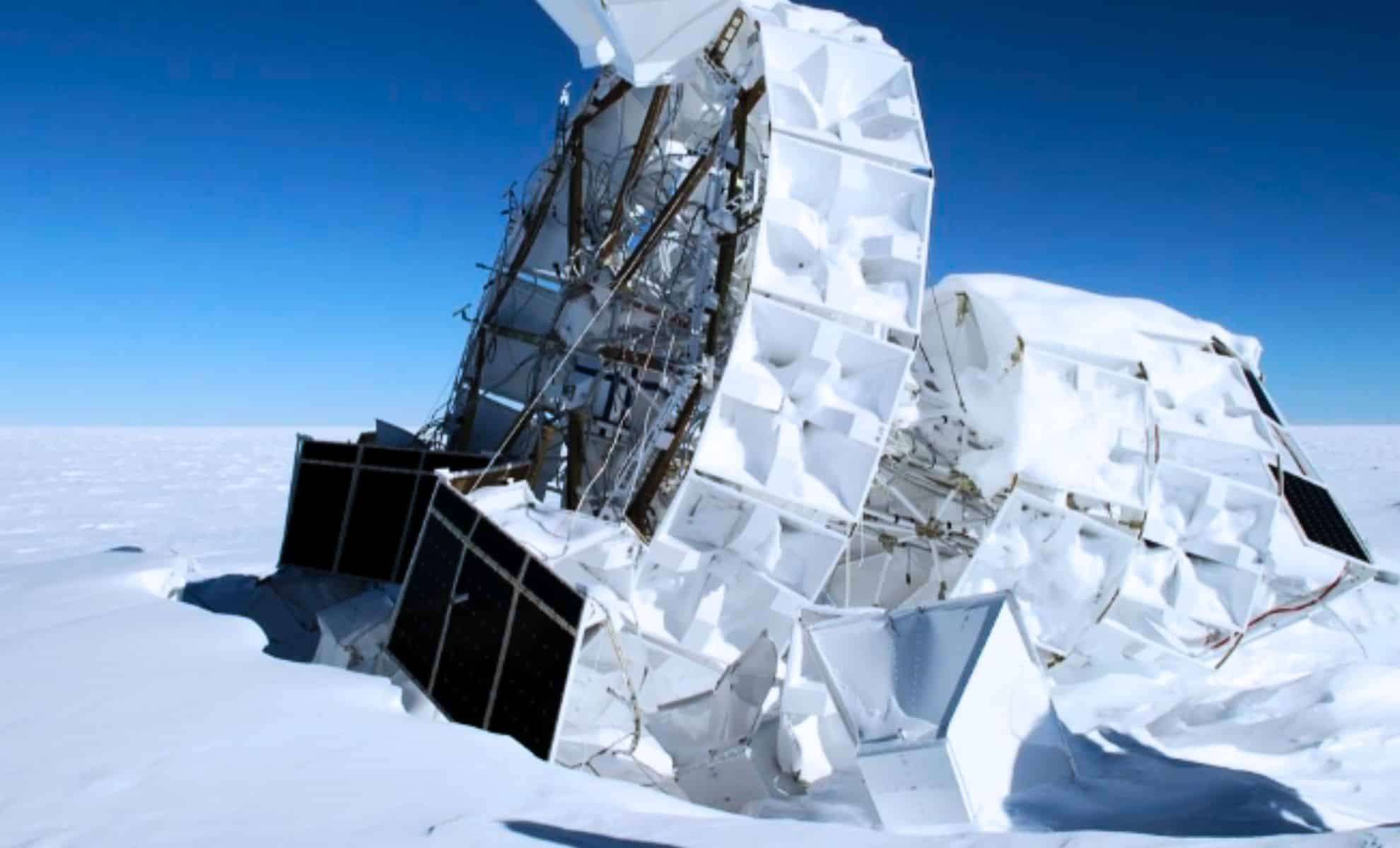
A remarkable scientific discovery has emerged from the icy expanses of Antarctica, captivating researchers who are now questioning established cosmic theories. What was initially presumed to be the capture of elusive neutrinos has instead revealed perplexing radio signals that contradict conventional physics frameworks. These transmissions, identified by the ANITA (Antarctic Impulsive Transient Antenna) experiment, hint at phenomena that challenge current scientific understanding.
Unexpected Radio Waves from the Antarctic Ice
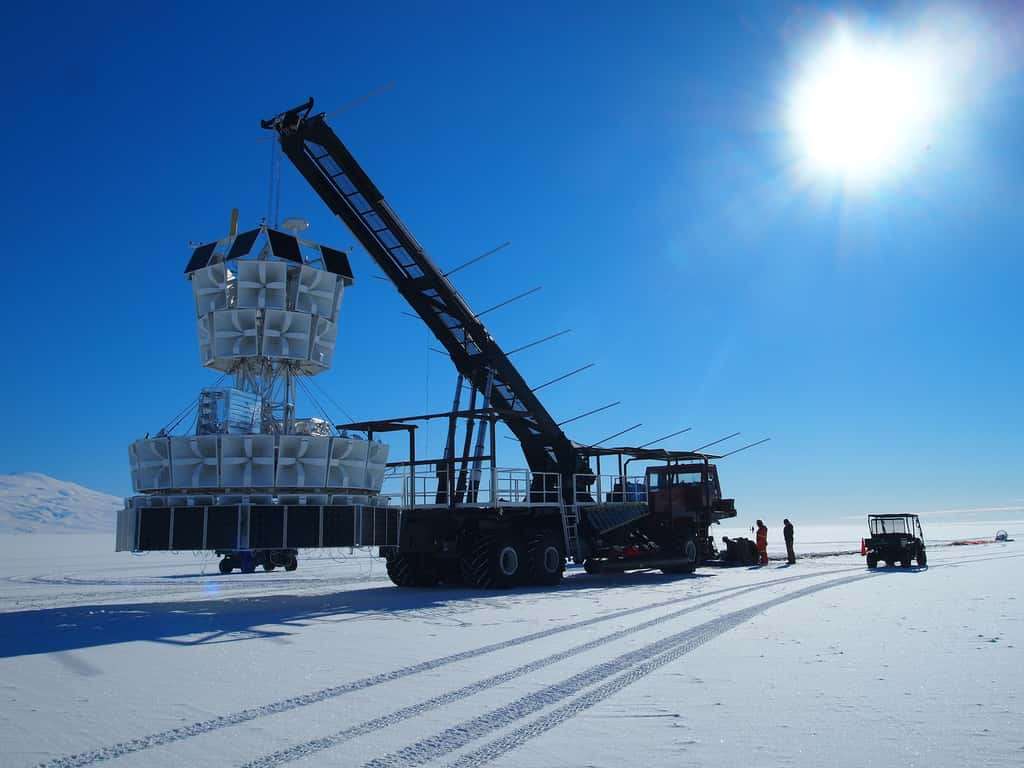
In 2020, researchers from around the globe deployed the ANITA instrument, a balloon-borne antenna designed to detect neutrinos—subatomic particles that rarely interact with matter. The team aimed to register signals produced when these particles collided with Antarctica’s ice sheets. However, the data revealed unexpected radio emissions seemingly originating from beneath the planet’s surface, defying known physical behavior of neutrinos.
“The arrival angles of these signals are totally unanticipated,” explained Stephanie Wissel, a professor specializing in physics and astrophysics at Penn State University. According to existing theories, neutrinos wouldn’t generate signals from such steep trajectories. This anomaly has led to debates about the true cause of the signals, with speculation growing that they may not be neutrino-related.

The Puzzle Deepens
Neutrinos are notoriously elusive, passing undeterred through matter due to their minimal interactions. Produced by colossal cosmic phenomena like supernovae and the Big Bang, these particles are difficult to detect. The research team expected to observe the brief radio signals that result from neutrino collisions in the ice, yet the recorded horizontal polarization of the signals suggested a source anomalously located beneath the ice, not high in the atmosphere.
Wissel and her team acknowledge the challenge this presents. “We currently lack a concrete explanation for these signals, and it’s unlikely they’re from neutrinos,” she said. With existing models unable to clarify the phenomenon, the discovery opens the possibility for new particle types or unknown cosmic processes.
Emerging Hypotheses and Obstacles
One possibility put forth is that the signals arise from interactions involving tau neutrinos, a higher-energy neutrino variant, within the Earth’s crust. This would involve tau neutrinos generating tau leptons, which then break through the surface and create atmospheric particle cascades that produce the radio signals detected by ANITA. Nevertheless, this explanation faces significant scrutiny.
According to particle physics, for neutrinos to create such signals, they would have to traverse large amounts of Earth’s rock—a scenario considered highly improbable. Moreover, other observatories like the Pierre Auger Observatory in Argentina and Antarctica’s IceCube experiment have not observed supportive evidence. “These neutrinos should have been detected by other instruments if this theory were correct,” Wissel remarked in the Physical Review Letters publication, emphasizing the lack of confirmation from complementary detection methods.
Advancing Toward Answers
The scientific community is now focusing on next-generation technologies to investigate further. The Pueo detector, being developed at Penn State University, aims to deliver enhanced observations of ultra-high-energy particles and may help decode these baffling signals.
Though the anomalous findings from ANITA challenge existing particle physics paradigms, they also present an exciting opportunity to uncover new cosmic phenomena. Wissel and her collaborators remain optimistic that with upgraded tools like Pueo, the mystery of these Antarctic radio pulses will come into sharper focus, potentially shedding light on unexplored facets of the universe.
- Categories:
- Physics











0 comments
Sign in to Comment