

Recent studies have shed light on the extinction of the enormous prehistoric kangaroos that once inhabited what is now central eastern Queensland, Australia. These ancient marsupials flourished in the region's thriving rainforests but ultimately succumbed due to their restricted movement and habitat reliance.
Exploring the Giants of a Forgotten Rainforest
At Mount Etna Caves National Park, north of Rockhampton, researchers examined fossilized teeth to gain insights into these past giants.
In contrast to contemporary kangaroos that migrate over long distances across arid lands to find resources during droughts, the ancient Protemnodon species lived within a very limited area.

Scientists utilized strontium isotope measurements from tooth enamel to reveal that these giant kangaroos foraged closely around the limestone formations near the caves.
This limited foraging pattern likely evolved due to a long-standing, stable food supply provided by the rainforest environment.
This pattern stands in stark contrast to the broader foraging habits observed in modern large mammals.
From Lush Rainforest to Arid Plains: A Changing World
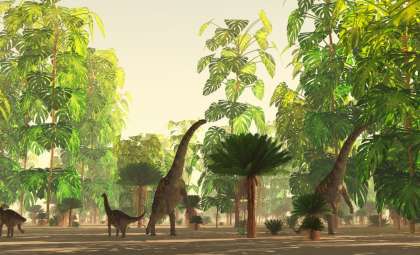
Approximately 500,000 years ago, the landscape surrounding Mount Etna was similar to present-day New Guinea, dense with rainforests and vibrant ecosystems.
Gradual climate changes over several hundred thousand years ushered in drier conditions and more distinct seasonal shifts. By around 280,000 years ago, the once thriving rainforest gave way to drier environments, erasing the habitat essential for Protemnodon’s survival.
Published in PLOS ONE, the findings note that “Protemnodon thrived for hundreds of thousands of years in the stable rainforest environment.” Their extinction was largely due to their inability to adapt or move across increasingly fragmented landscapes.
The kangaroos were unable to cross expanding open areas between forest patches or seek out new food resources beyond their familiar range.
The research underscores that Protemnodon vanished in this region long before human arrival.

Adaptations That Once Thrived, But Ultimately Failed
Intriguingly, fossil evidence hints that some Protemnodon forms may have moved by walking on all fours, unlike modern kangaroos that rely on hopping.
This mode of movement would have worked well within dense forests but severely limited their ability to cover large distances when food became scarce.
Scientists suggest that their large stature was likely an ecological adaptation suited to the rainforest environment, rather than a uniform trait among all ancient kangaroo species.
Comparable restricted foraging habits have been observed in Protemnodon populations near Bingara and Wellington Caves in New South Wales, suggesting such behaviors were common across eastern Australia’s rainforests.
Being so territorially bound was sustainable for thousands of years but eventually became a critical vulnerability as environmental conditions transformed.
Rethinking Extinction Through a Local Lens
This study highlights the necessity of examining local ecological conditions when interpreting extinction processes. The conventional belief that all Australian megafauna responded uniformly to climate changes is being reconsidered.
By employing advanced techniques such as uranium-series and luminescence dating, alongside detailed isotopic studies, researchers can now trace how individual populations reacted to environmental pressures with greater precision.
This shift from broad continental explanations to focused local analysis offers a more accurate understanding of extinction dynamics, revealing how each unique ecosystem shaped the fate of its resident species.
- Categories:
- Science








0 comments
Sign in to Comment