
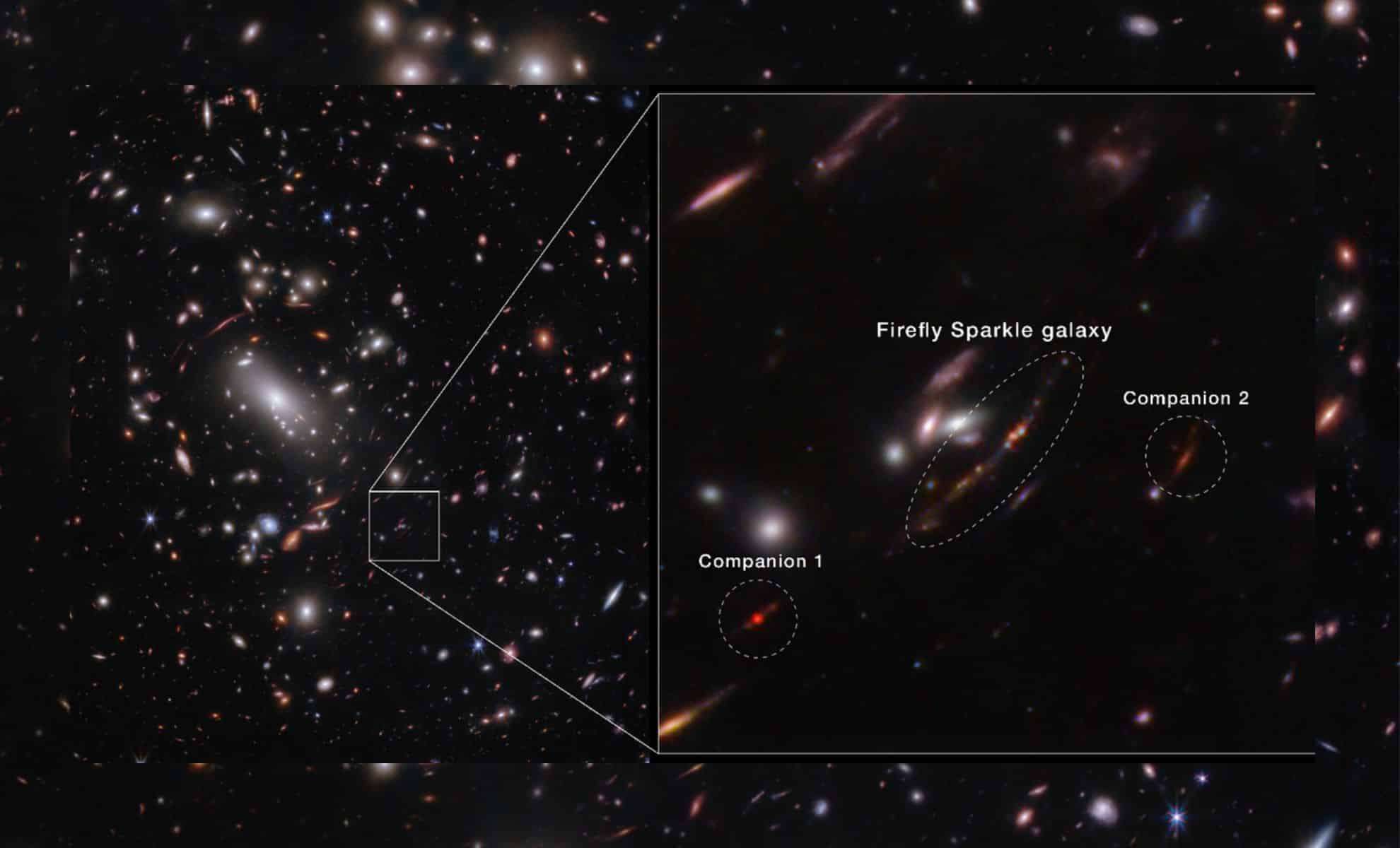
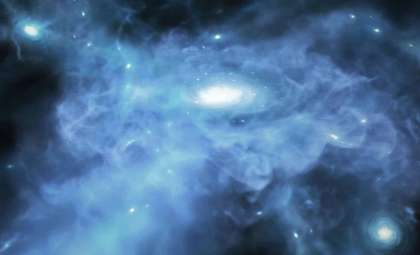
NASA’s James Webb Space Telescope has achieved a remarkable milestone by detecting a galaxy ablaze with nascent stars, granting scientists an extraordinary view into the earliest phases of galaxy development. The focus of this finding is Firefly Sparkle, a galaxy actively assembling its stars just 600 million years after the Big Bang. This ancient relic from the dawn of time offers astronomers invaluable clues that could revolutionize our comprehension of the formation of galaxies like the Milky Way. This groundbreaking observation represents a significant advance in cosmic research, as Webb’s advanced instruments enable researchers to explore a galaxy in its formative years, shedding light on the mechanics behind galactic creation.
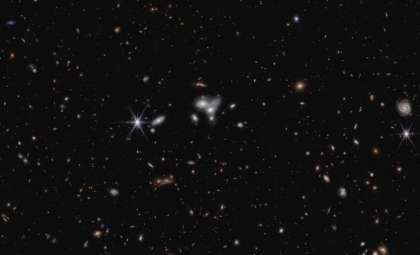
This Firefly Sparkle galaxy stands out as a unique specimen in the infant universe. Utilizing Webb’s powerful infrared vision, astronomers have unveiled intricate details that were previously beyond reach. Through the effect of gravitational lensing—where the gravity of a massive galaxy cluster bends and amplifies light from objects positioned behind it—scientists have glimpsed Firefly Sparkle with remarkable clarity, revealing young star clusters at diverse growth stages. The synergy between Webb’s cutting-edge technology and gravitational lensing has granted a rare opportunity to analyze a galaxy undergoing active formation, producing insights that might redefine our understanding of the early cosmos.
An Unparalleled Insight into the Universe’s Early Epoch
The identification of Firefly Sparkle presents a precious chance to investigate galaxy formation during the era known as the Cosmic Dawn, when the universe’s primordial gases began coalescing into the first galactic structures following the Big Bang. As Lamiya Mowla, lead author and assistant professor at Wellesley College, remarks: “I didn’t think it would be possible to resolve a galaxy that existed so early in the Universe into so many distinct components, let alone find that its mass is similar to our own galaxy’s when it was in the process of forming. There is so much going on inside this tiny galaxy, including so many different phases of star formation.” This exceptional discovery reinforces the idea that early galaxies were intricate assemblages growing and interacting with their surroundings, rather than simplistic, uniform entities.

By examining Firefly Sparkle, researchers peer back in time to envision how galaxies like our own Milky Way might have appeared during their infancy. These nuanced observations enable scientists to chart the multifaceted stages of star formation and galactic evolution, offering critical information about the origins of galaxy structures. Continued research on Firefly Sparkle will enrich our understanding of the universe’s earliest galactic development and its transformation into present-day cosmic landscapes, detailed further in this NASA report.
The Celestial Glow That Travels Through Eons
Firefly Sparkle captures attention due to its similarity to a juvenile version of the Milky Way, representing a galaxy still in the midst of growth and transformation. Unlike many early-universe galaxies, which tend to be massive and fully formed, Firefly Sparkle displays a relatively low mass, providing a more accurate analog for our galaxy’s early history. This challenges pre-existing notions of galactic evolution and reframes how scientists perceive early cosmic development. Dr. Kartheik Iyer, co-lead author and NASA Hubble Fellow, explains, “We knew to expect it based on current physics, but it’s surprising that we actually saw it.” This youthful galaxy offers critical insight into the developmental stages that culminate in mature galaxies like the Milky Way.
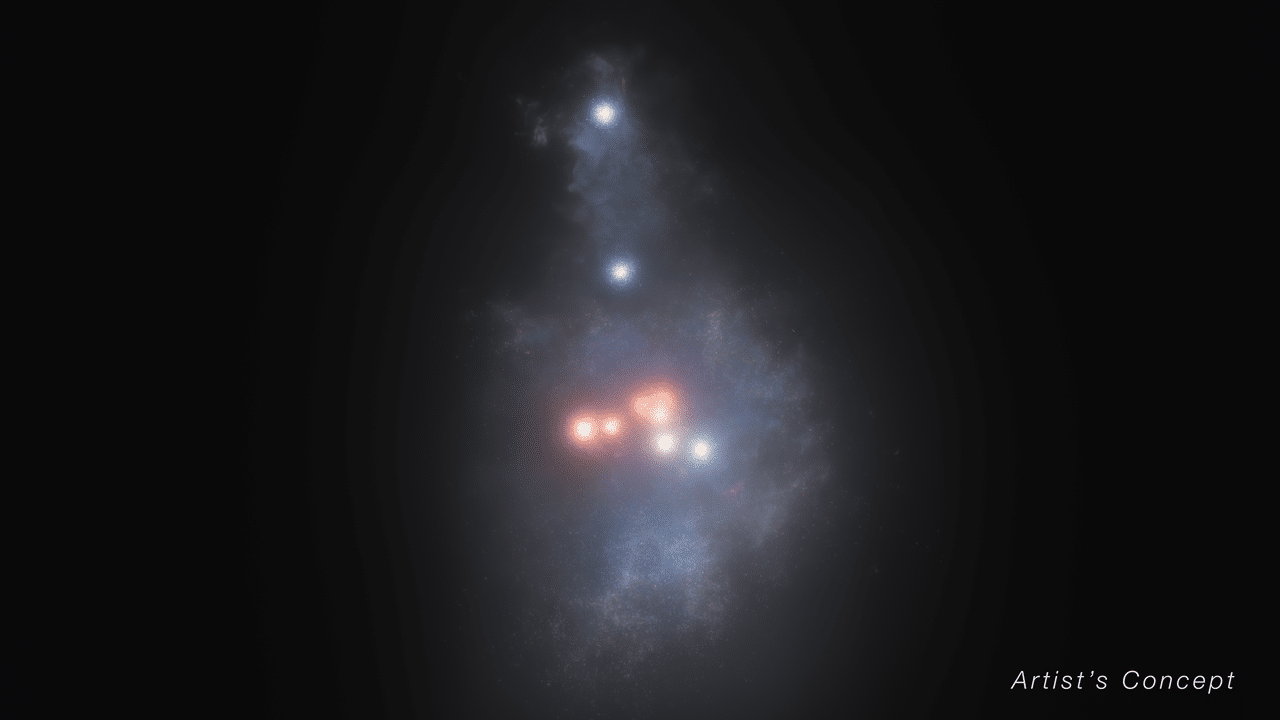
The name Firefly Sparkle was inspired by the galaxy’s brilliant clusters of stars, a defining characteristic of this extraordinary discovery. Each star cluster within demonstrates varying stages of formation, contrasting sharply with the simultaneous star birth often observed elsewhere. This staggered star creation is instrumental in helping scientists comprehend how star clusters mature and eventually coalesce into larger galactic assemblies.
Detailed Views of Star Clusters Illuminate Early Galactic Growth
A particularly impressive aspect of the Firefly Sparkle observation is the identification of ten distinct star clusters, each exhibiting a unique phase of stellar formation. These clusters emit light across the color spectrum, with some glowing bright blue, others deep red, and some softly to intermediate hues, reflecting different ages and stages of evolution. Webb’s infrared precision has resolved these clusters with extraordinary clarity, offering a fresh perspective on how stars form at varying times within a single galaxy. As Chris Willott, astronomer at the National Research Council of Canada’s Herzberg Astronomy and Astrophysics Centre, notes, “Each clump of stars is undergoing a different phase of formation or evolution.”
This revelation not only uncovers the complexity within Firefly Sparkle but also provides key insight into the staggered and dynamic nature of galaxy development. The fact that these star clusters form asynchronously suggests that the galaxy’s growth is a gradual and multifaceted process, contradicting earlier models proposing a single burst of star formation. This finding helps clarify how stellar populations evolve and how galaxies mature over cosmic timescales.
Harnessing Gravitational Lensing as a Natural Telescope
The discovery hinges on gravitational lensing, a cosmic effect wherein the gravitational pull of massive objects bends and amplifies light from objects behind them. The Firefly Sparkle galaxy lies behind a colossal galaxy cluster that serves as a natural lens, magnifying this faraway galaxy’s light and enabling astronomers to detect details impossible to observe on their own. Without this lensing phenomenon, Firefly Sparkle would remain too dim for Webb’s instruments to examine with such precision. Gravitational lensing thus acts as a powerful tool that enhances faint celestial signals, highlighting features like star clusters that would otherwise be invisible.
Coupling Webb’s advanced capabilities with gravitational lensing has sparked a new era of exploration, granting researchers the ability to study faint, distant galaxies with remarkable accuracy. This synergy not only empowers the analysis of Firefly Sparkle but also promises breakthroughs in understanding numerous other remote galaxies.
What Lies Ahead: Interaction with Nearby Galaxies?
Though intrinsically fascinating, Firefly Sparkle is not alone in its cosmic neighborhood. Two smaller galaxies lie nearby, at distances of approximately 6,500 and 42,000 light-years. These neighboring galaxies might influence Firefly Sparkle’s growth through gravitational forces or eventual mergers—phenomena believed to be instrumental in galactic evolution. Whether Firefly Sparkle will collide or combine with these companions remains uncertain, yet their proximity provides a valuable context for studying how galaxies evolve over time.
As noted by Yoshihisa Asada, co-author and doctoral researcher at Kyoto University, “It has long been predicted that galaxies in the early Universe form through successive interactions and mergers with other tinier galaxies. We might be witnessing this process in action.”
- Categories:
- Astronomy ,
- News ,
- Nasa

0 comments
Sign in to Comment