
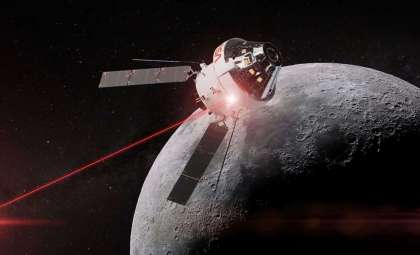
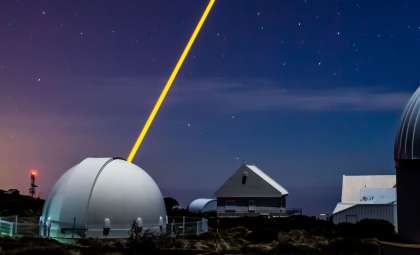
After traveling through 36,000 kilometers of turbulent atmosphere above southwestern China, the laser beam that arrived at Lijiang Observatory was far from pristine. The atmosphere scattered the light, transforming the signal from a focused pulse into a faint, diffuse glow stretching across the chilly mountain air.
Despite this enormous challenge, the receiver detected a gigabit-per-second data stream within the noisy signal. Remarkably, the laser consumed only 2 watts of power—less than a typical LED bulb’s brightness. Spanning a distance equal to Earth's circumference, this link transferred data at speeds exceeding those of common Starlink connections by a factor of five.
The test involved systems designed for very different environments. While Starlink satellites orbit relatively close to Earth, transmitting via radio waves to consumer terminals, the Chinese experiment used a geostationary satellite stationed 36,000 kilometers away, 60 times farther out. The receiver was a 1.8-meter telescope paired with sophisticated signal processing, rather than a simple rooftop dish. This demonstration confirmed that a laser downlink from geostationary orbit can exceed gigabit speeds within a modest power envelope, leaving capacity for other payload needs.

Atmospheric Turbulence Distorts the Beam Rapidly
During the experiment, the air over Lijiang Observatory was far from calm. The layered atmosphere over Yunnan’s mountain peaks varies in temperature, density, and refractive properties, causing the laser beam to bend, spread, and fragment as it passes through. These distortions fluctuate every few milliseconds, turning a sharply defined beam into an unstable, shimmering pattern by the time it reaches the telescope.
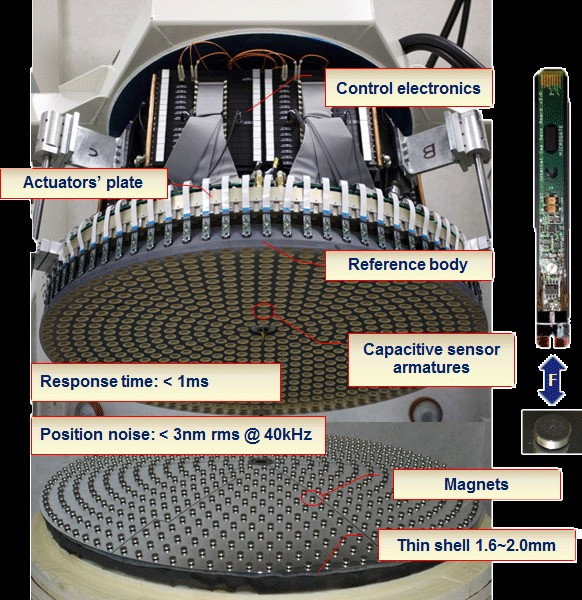
Engineers have developed two main strategies to mitigate these effects. Adaptive optics uses a deformable mirror composed of hundreds of tiny segments that continuously adjust to correct wavefront distortions caused by the atmosphere. However, when turbulence is intense, the system struggles to keep up and can lose effectiveness.
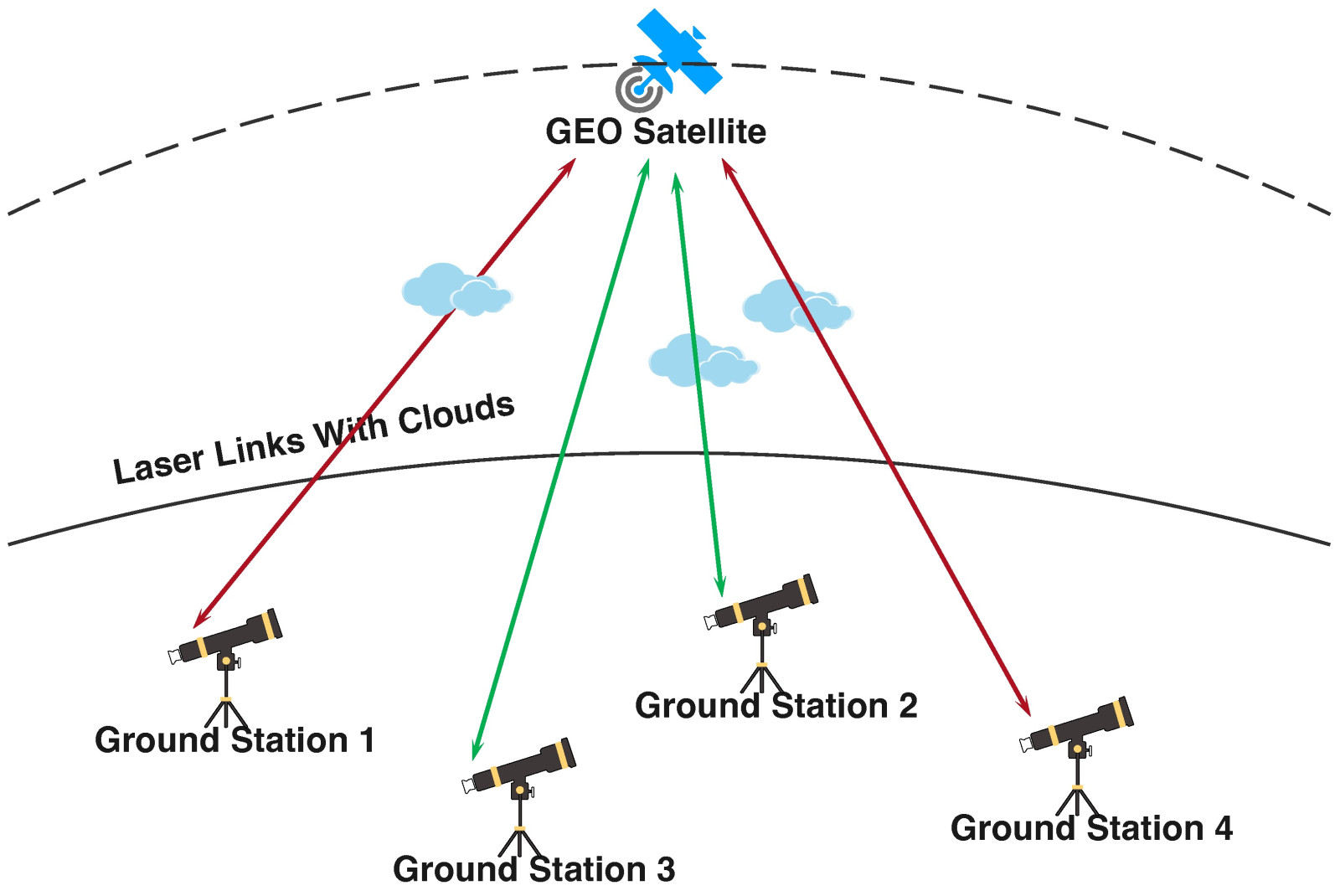
On the other hand, mode diversity reception accepts the beam’s distortions and searches for undamaged fragments by splitting the signal into multiple spatial channels. Some channels capture clearer portions of the signal, and the receiver reconstructs the original data by combining the best signals. This approach handles strong atmospheric turbulence better than adaptive optics by itself, though some signal quality is still lost.
Previously, neither technique alone had enabled a geostationary optical link at gigabit speed with such low transmitter power. The Chinese research team, led by Wu Jian from Peking University of Posts and Telecommunications and Liu Chao from the Chinese Academy of Sciences, successfully combined both methods to overcome this barrier.
Receiver Selected the Three Most Reliable Signals From Eight Channels
Upon reaching the telescope, the incoming beam first passed through a stage equipped with 357 micro-mirrors that dynamically adjusted in response to real-time atmospheric distortions. The purpose was not to restore a perfect beam but to reduce chaos sufficiently for subsequent processing to succeed.
The beam was then sent through a multi-plane light converter, dividing it into eight distinct spatial channels. A digital system evaluated all channels, selecting the three strongest and discarding the noisier five before decoding the combined signal.
This strategy raised the signal’s utility from 72% to 91.1%, enabling the 1 Gbps rate at a mere 2-watt laser power. Despite the dim light, the extreme distance, and atmospheric interference, the ground receiver’s adaptive approach reclaimed the signal’s strongest elements and achieved remarkable data throughput.
The South China Morning Post highlighted that this speed could deliver a high-definition movie from Shanghai to Los Angeles in less than five seconds. Nonetheless, this was a single successful demonstration under certain experimental conditions, representing measured performance rather than a steady service level.
Geostationary Orbit’s Fixed Position Justifies the Challenge
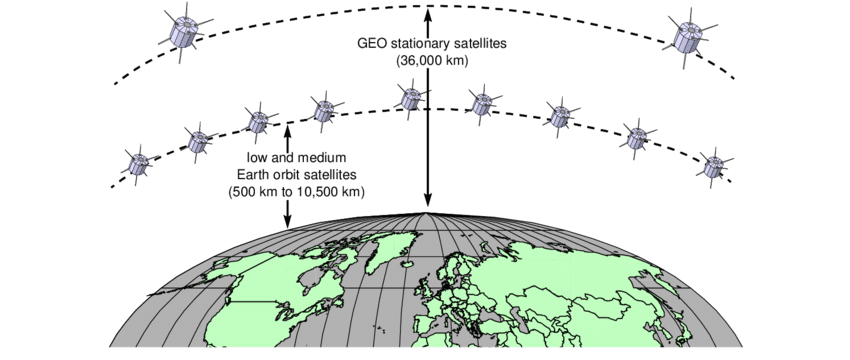
Satellites orbiting closer to Earth benefit from shorter distances, simplifying communication. Conversely, a satellite fixed at 36,000 kilometers must transmit through the entire turbulent atmospheric layer below. The resulting signal attenuation and distortion make the engineering hurdles significantly greater.
The advantage is constant coverage. A geostationary satellite remains locked over one point, maintaining an uninterrupted connection to a single ground station. This is invaluable for applications that cannot tolerate service interruptions, such as disaster response communications, secure military links, and continuous, high-volume data transfers.
Laser communication carries vastly more information than radio waves and is less vulnerable to interception or jamming. However, the combination of atmospheric effects and distance has previously limited geostationary optical links to modest demonstrations. The success at Lijiang indicates that an advanced ground receiver can bridge this gap without demanding an impractically powerful space transmitter.
The Key Innovation Occurred on the Ground
The satellite’s laser output was modest; 2 watts is low power for space instruments. The real breakthrough lay in the receiver’s ability to recover a signal impaired by atmospheric turbulence. This shifts the typical focus in space communications from transmitter strength to ground-based signal recovery technology.
The Lijiang installation is not intended for everyday consumers. Its telescope, deformable mirror, multi-plane light converter, and real-time digital processors occupy an entire research facility. Such infrastructure is ideal for a backbone network role, with a limited number of high-capacity ground stations providing reliable satellite connectivity to terrestrial fiber-optic communication systems.
- Categories:
- News




0 comments
Sign in to Comment