
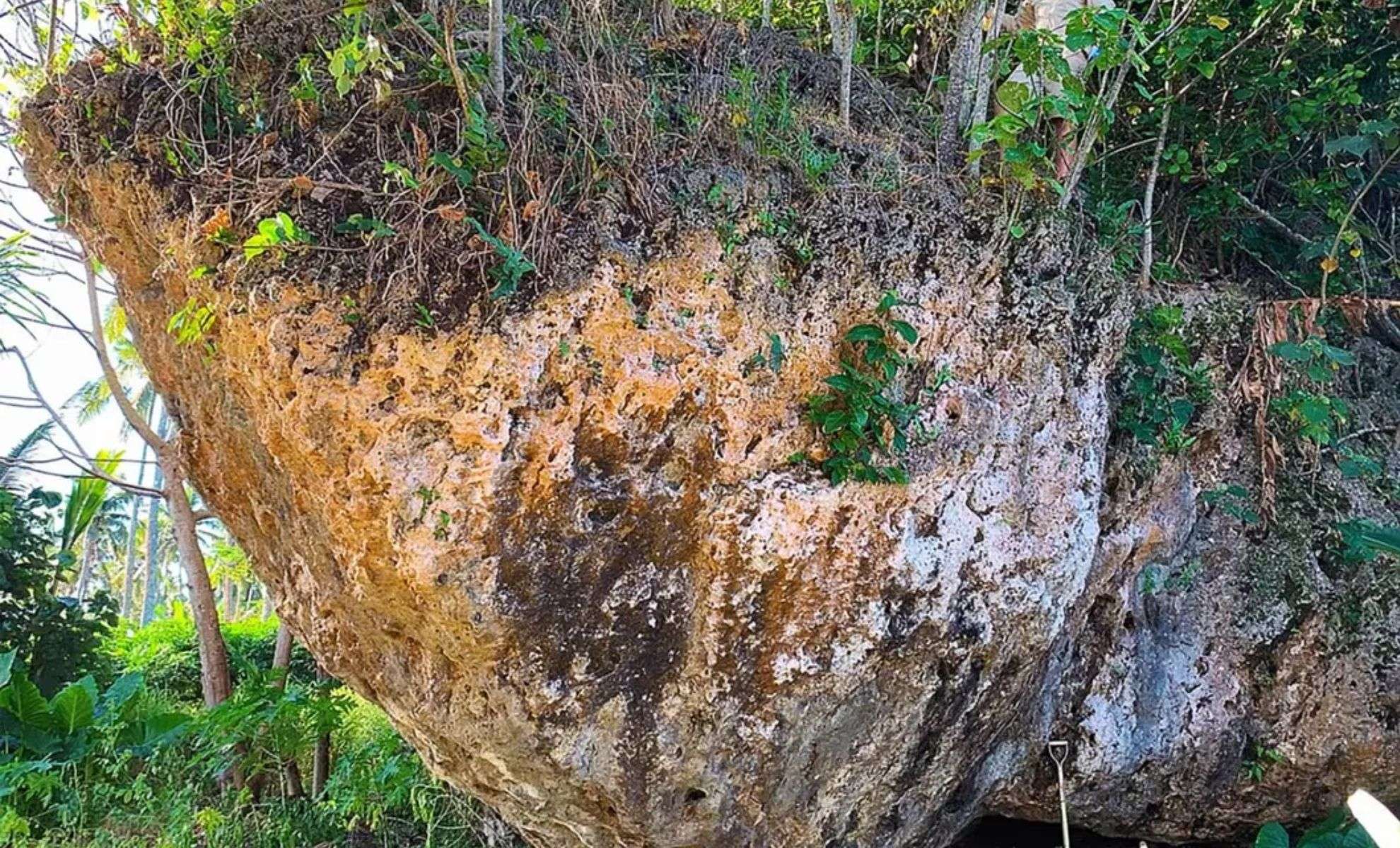
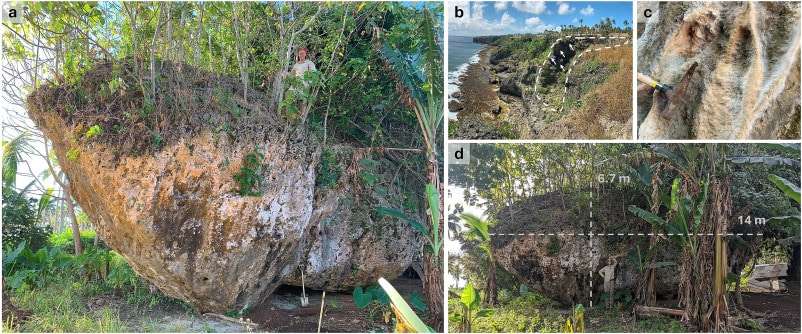
Deep within the lush landscape of southern Tongatapu, a monumental limestone boulder known as Maka Lahi—meaning “Big Rock” in Tongan—stands as a silent witness to a cataclysmic event from thousands of years ago.
Enormous Boulder Found Far From Shore Indicates Tsunami Origin
During a coastal expedition on Tongatapu's southern edge, University of Queensland PhD student Martin Köhler uncovered this astounding rock. While surveying sea cliffs for traces of ancient wave actions, local farmers guided him to a hidden site obscured by dense vegetation well inland.
“I was astonished by the location; it lies far from the coastline and outside our target survey area, implying it was moved by a massive tsunami,” Köhler shared. The massive stone towered over the surrounding forest, defying expectations for inland geology.

Estimated to weigh around 1,180 tons and situated more than 200 meters inland, this immense boulder is now recognized by scientists as proof of an ancient tsunami that struck roughly 6,900 years ago.
Measuring about 14 meters in length, 12 meters across, and nearly 7 meters tall, its size surpasses that of three loaded Boeing 747 jets combined. Its limestone chemistry matches a coral reef formation atop a cliff over 30 meters above sea level, confirming it was torn from the coast and transported by an extraordinary surge.
Simulations Suggest a 50-Meter-High Tsunami Wave
Researchers dismissed storms and cyclones as potential causes. Using computational wave-flume models, they demonstrated that even a Category 5 cyclone lacks the energy needed to shift such a massive rock. The only plausible explanation is a tsunami triggered by a landslide, unleashing a water wall exceeding 50 meters in height lasting roughly 90 seconds.
This hypothesized tsunami, traveling faster than 20 meters per second, would have impacted the limestone cliff, prying loose the boulder and carrying it to its current position over 39 meters above today’s sea level. Uranium-thorium dating of calcite deposits on the rock's shaded side supports an Early Holocene timing for this event.
Implications for Understanding Tsunami Hazards
Annie Lau, a coastal geomorphologist and co-author from the University of Queensland, highlighted the discovery’s role in modern hazard evaluation. “The 2022 tsunami in Tonga caused six fatalities and widespread destruction. Examining past extreme waves is essential for current and future risk assessments,” she explained.
The existence of Maka Lahi indicates that Tonga has experienced tsunamis potentially more than double the height of the recent 2022 waves, which peaked near 20 meters.
Findings suggest the ancient tsunami may have originated from a large underwater landslide or a volcanic flank collapse along the tectonically active Tofua arc. These same geological forces likely contributed to the 2022 Hunga Tonga eruption, which unleashed powerful shockwaves globally and spawned massive Pacific waves.
- Categories:
- News



0 comments
Sign in to Comment