
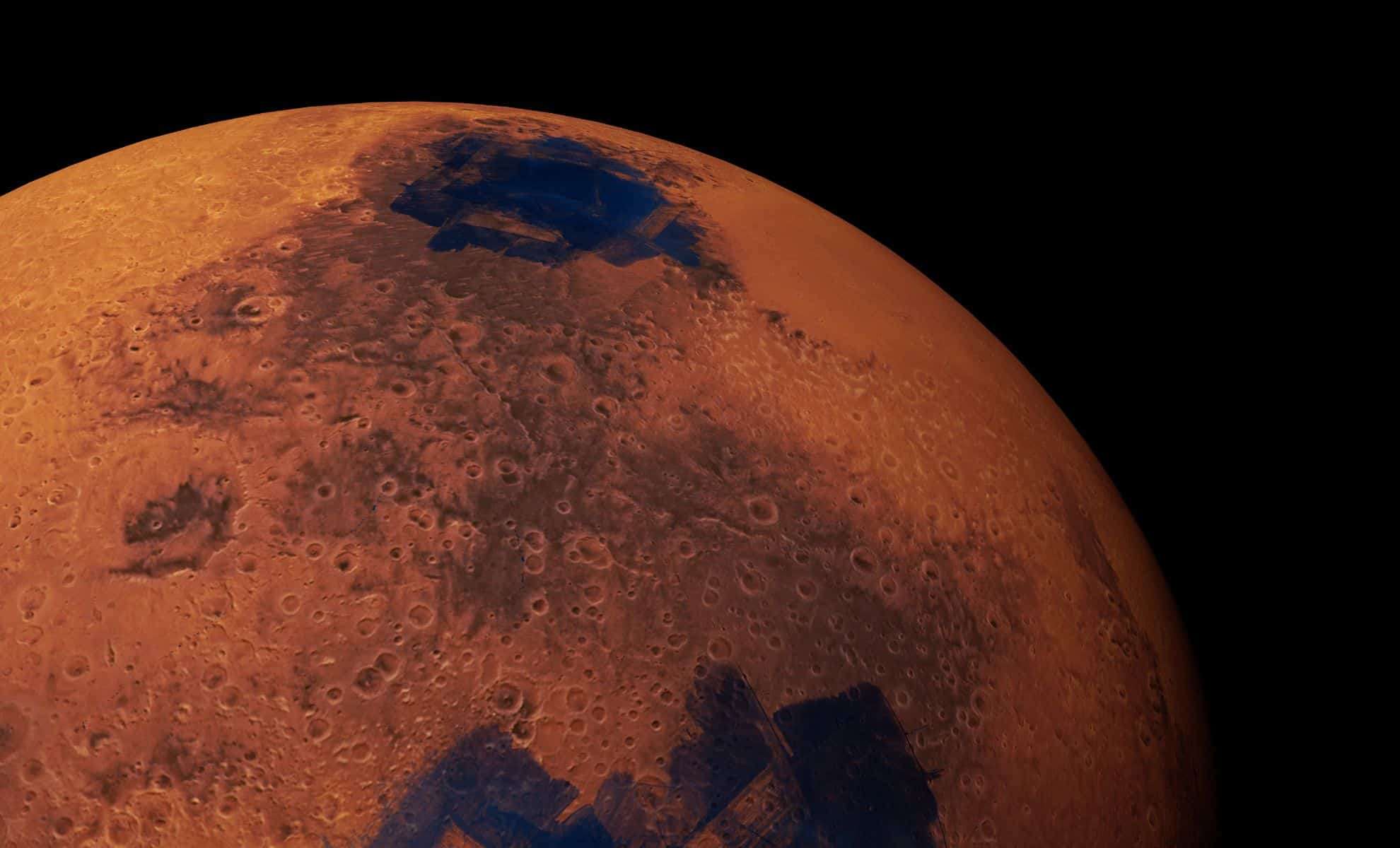
Mars is known for its harsh conditions—freezing nights, barren terrain, and relentless dust storms. Yet, scientists are considering the possibility that life might exist below the planet’s surface, where conditions are less extreme.
A recent paper published on arXiv introduces Acidalia Planitia as a candidate underground habitat for ancient methanogenic microbes. Led by Andrea Butturini from the University of Barcelona, the research proposes that these organisms could dwell between 4.3 and 8.8 kilometers beneath the Martian crust, in zones where temperatures rise moderately thanks to internal heat sources.
The Potential for Life-Friendly Conditions Deep Within Mars’ Soil
Acidalia Planitia spans over 3,000 kilometers across Mars’ northern region. Scientists hypothesize that liquid water reservoirs may exist within the soil at depths between 4.3 and 8.8 kilometers, maintained by radioactive heat and insulated from the planet’s surface extremes.

Such conditions might sustain methanogens—microbes that thrive in Earth's oxygen-free environments such as marshes and deep ocean sediments. These organisms metabolize using hydrogen and carbon dioxide, emitting methane as a metabolic byproduct. Butturini and his team point out that certain saline, anoxic environments on Earth closely resemble this imagined Martian subsurface habitat.
Mars’ Methanogens Would Live at an Extremely Slow Pace
The microbial life hypothesized on Mars would not flourish like typical Earth bacteria that divide rapidly. According to Jon Telling, a Newcastle University geochemist, these microbes might have division cycles stretching over centuries, much slower than the twenty-minute intervals observed in lab-grown bacteria.
This sluggish growth is due to limited energy resources. While subsurface warmth and moisture might be present, nutrients and fuel are scarce. Telling remarks that despite these constraints, there could be enough energy available to sustain life at a minimal rate. The concept that life may persist away from surface conditions is gaining ground in scientific discussions.
The Challenge of Detecting Subsurface Life
Identifying the precise location and actually reaching it pose significant hurdles. Drilling down to depths approaching 8 kilometers on Mars far exceeds current technological and logistical capabilities. As Telling notes, accomplishing this on Earth alone is difficult and expensive, let alone on another planet.
The European Space Agency’s ExoMars mission, featuring the Rosalind Franklin rover slated for launch in 2028, will attempt to penetrate only about 2 meters beneath Mars’ surface. Whether evidence of life from such shallow depths could originate from lifeforms deeper underground remains unclear. As Kevin Olsen of the University of Oxford puts it, “It’s really unknown.”
Tracking Methane: An Ongoing Quest
One might ask why researchers don’t simply seek methane in Mars’ atmosphere, since methanogens produce this gas. ESA’s Trace Gas Orbiter has been searching for biologically generated methane, but its detections have been inconsistent. Olsen notes, “The methane observations are sporadic. It’s hard to say where they’re coming from.”
Despite the challenges, mapping regions like Acidalia Planitia helps direct future exploration toward the most promising areas. If subsurface life exists on Mars, it likely dwells far beneath its surface. As Telling concludes, “If you want to look for life alive today on Mars, you’ve got to look deep down.”
- Categories:
- News










0 comments
Sign in to Comment