

Between 2006 and 2008, researchers observed a slight yet detectable alteration in Earth’s gravitational field that has remained unexplained until now. Recent studies propose that this anomaly stems from dynamic activity occurring thousands of kilometers beneath the surface, right at the interface between the mantle and the outer core.
Presented in the journal Geophysical Research Letters, the research utilized data from the GRACE satellite mission – a joint effort between Germany and the US – which monitored subtle variations in Earth’s gravity by measuring the changing distance between two satellites orbiting from 2002 to 2017. The scientists propose that shifts in the crystal structure of rocks deep beneath the surface under intense pressure might have adjusted the density of materials near the mantle base, potentially causing deformation in the core itself.
Subtle Signals from the Planet’s Interior
The gravity change wasn't immediately apparent, as it was imperceptible to humans and lacked dramatic surface indicators. However, GRACE's sensitive instruments detected tiny fluctuations in the spacing between its spacecraft, revealing gravitational shifts below.

Initially developed to observe broad hydrological changes such as ice sheet melting and groundwater depletion, GRACE has also been instrumental in identifying anomalies likely caused by material redistribution within Earth's interior.
The research group, led by Isabelle Panet at Université Gustave Eiffel in Paris, noted that the anomaly was located near Africa’s west coast. Panet remarked to Slate.fr that "there must be, at least in part, a solid Earth origin for the signal," indicating deep internal processes rather than surface events like ocean circulation or ice mass changes.
The team suggests that a phase change within the mineral perovskite, abundant in the lower mantle, may explain the gravity shift. Under immense pressure, perovskite might transform into a denser phase, altering the distribution of mass in surrounding rocks—much like compressing a sponge causes the water inside to redistribute.
Impact on the Core and Earth’s Magnetic Field?
This redistribution of mass could have generated stress waves propagating through the surrounding layers, briefly modifying the shape of the outer core by up to 10 centimeters. While this displacement may seem small, it represents a significant structural adjustment on a planetary scale.
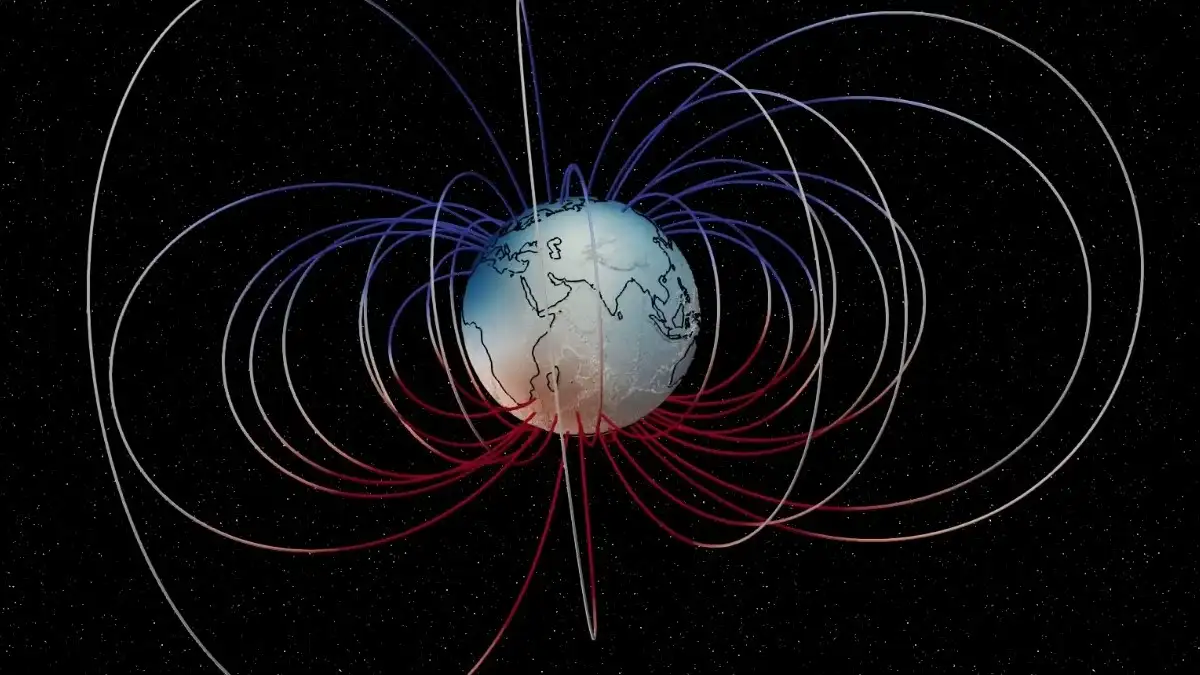
Since the outer core consists of liquid iron and nickel, even minor distortions could influence its flow patterns. Given that this flow is responsible for producing Earth’s magnetic field, such deformations could in theory induce magnetic fluctuations observed at the surface.
Although these connections remain hypothetical, they contribute to ongoing research aiming to unravel the complex interplay between mantle convection, core dynamics, and the geomagnetic field—three of Earth’s most enigmatic systems.
Seismologist Barbara Romanowicz from the University of California, Berkeley, who was not involved in the study, highlighted its significance: "This is the first time we have convincing evidence of fast dynamic processes at the base of the mantle," adding that these changes occur rapidly enough to be observed within human timescales.
Using Gravity to Unlock Secrets of Earth’s Interior
Direct observation of Earth’s deeper layers has long been impossible. Drilling cannot reach the mantle-core boundary, and seismic imaging offers limited resolution. Gravity measurements, however, provide a powerful indirect tool. By detecting minuscule gravity variations, scientists can infer ongoing processes deep underground.
The GRACE mission and its successor, GRACE-FO, have thus unveiled a new perspective on Earth's internal dynamics. Future research may focus on combining gravity data with geomagnetic readings, seismic activity, and other satellite observations to develop a more detailed understanding of how the planet’s interior moves and changes.
It remains to be seen whether such gravitational anomalies represent isolated incidents or are part of recurring cycles. Detecting further episodes, especially those related to surface or magnetic variations, could revolutionize scientific models of Earth’s internal engine.
- Categories:
- Science












0 comments
Sign in to Comment