
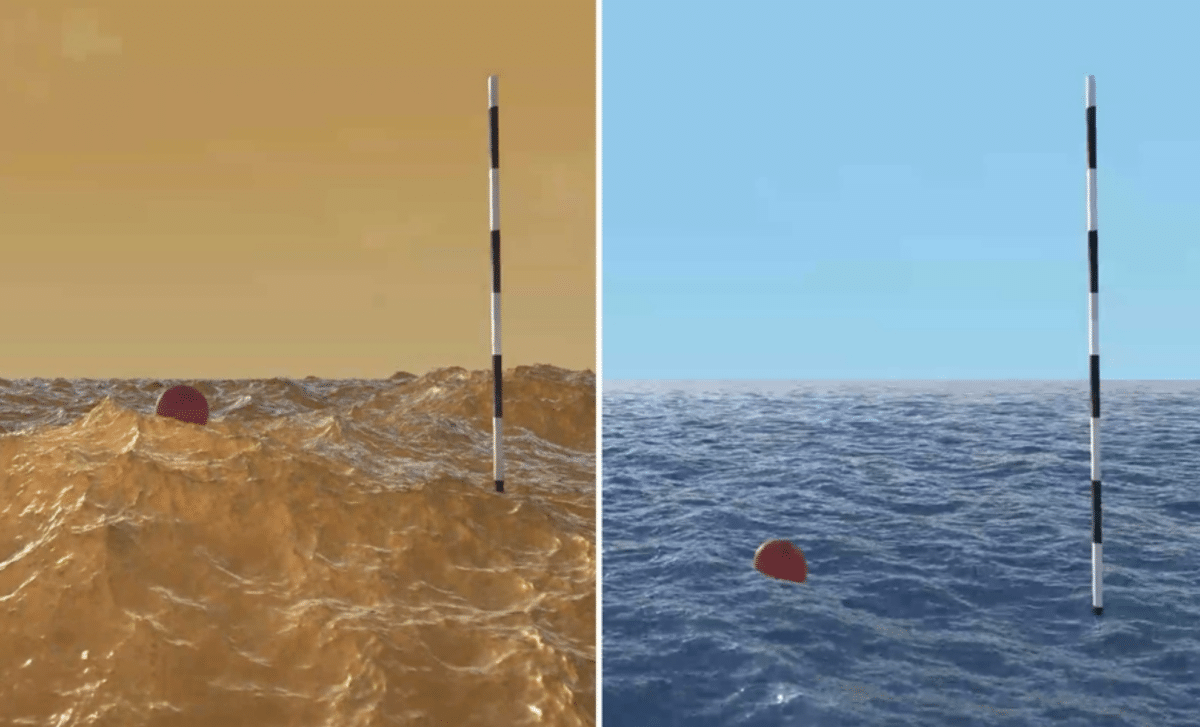
Ocean waves are a well-known characteristic of Earth’s waters, molded by wind patterns, gravity, and the unique qualities of water. However, on other worlds in the solar system—where oceans might be composed of methane and gravity varies—wave behavior could defy earthly expectations. A recent article in the Journal of Geophysical Research: Planets presents new insights into how wave mechanics might differ drastically across planetary environments, providing a fresh perspective on extraterrestrial seas and aiding mission planning for destinations like Titan.
Innovative Model Sheds Light on Wave Behavior Beyond Earth
Scientists at the Massachusetts Institute of Technology (MIT) and the Woods Hole Oceanographic Institution have crafted an advanced computational model that predicts wave dynamics under diverse planetary settings. Rather than presuming conditions similar to Earth’s oceans, this model incorporates changes in gravity, fluid makeup, and atmospheric pressure—key factors that influence wave formation and movement. This approach moves beyond conventional simplifications, enabling exploration of a broad array of planetary liquids and atmospheres.
As co-author Andrew Ashton notes,

“On Earth, we get accustomed to certain wave dynamics, but with this model, we can see how waves behave on planets with different liquids, atmospheres, and gravity, which can kind of challenge our intuition.” The model reveals that wave formation is not exclusive to Earth-like oceans, but a universal process tied to fluid surfaces interacting with wind.
As Taylor Perron, the Cecil and Ida Green Professor of Earth, Atmospheric and Planetary Sciences at MIT, puts it, “Anywhere there’s a liquid surface with wind moving over it, there’s potential to make waves.”
This comprehensive framework paves the way for studying seas made of methane, ethane, or even more unusual liquids beyond Earth.
Illuminating the Enigmatic Lakes of Titan
Saturn’s moon Titan emerges as a prime example for applying this research. Its surface is dotted with lakes and seas constituted of liquid hydrocarbons, presenting a strange yet captivating environment. However, limited direct observation leaves much about Titan’s aquatic features unknown. As Perron points out,
“For Titan, the tantalizing thing is that we don’t have any direct observation of what these lakes look like. So we don’t know for sure what kind of waves might exist there. Now this model gives us an idea.” According to the simulations, waves on Titan could appear dramatically different from those on Earth—larger, slower, and shaped by the moon’s lower gravity and thicker atmosphere. Lead author Una Schneck describes a surreal scenario: “It kind of looks like tall waves moving in slow motion. If you were standing on the shore of this lake, you might feel only a soft breeze but you would see these enormous waves flowing toward you, which is not what we would expect on Earth.”
The study implies Titan’s liquid bodies might be far more active than previously imagined, influencing both geological and atmospheric processes.
Advancing Planetary Ocean Modeling
Featured in the Journal of Geophysical Research: Planets, this research represents a pivotal advancement in how scientists model extraterrestrial liquid bodies. Prior efforts primarily addressed gravitational effects, often neglecting impacts of liquid composition on wave properties. Schneck emphasizes this novel contribution: “There have been attempts in the past to predict how gravity will affect waves on other planets, but they don’t quantify other factors such as the composition of the liquid that is making waves.
That was the big leap with this project.” By including these variables together, the model delivers unprecedented authenticity, enabling refined predictions on shoreline changes, sediment movement, and the long-term shaping of planetary landscapes. This unified approach is applicable across a spectrum of worlds, from icy satellites to far-flung exoplanets.
Impact on Upcoming Exploration Missions
Insights into alien wave phenomena hold practical value for future space exploration. Devices designed to operate in extraterrestrial seas must be engineered to cope with wave forces. Schneck comments, “You would want to build something that can withstand the energy of the waves, so it’s important to know what kind of waves these instruments would be up against.” This is especially pertinent for missions aiming to land or float on Titan’s lakes. The study also offers a fresh perspective on puzzling geological features. Perron poses an intriguing question: “Unlike on Earth where there is often a delta where a river meets the coast, on Titan there are very few things that look like deltas, even though there are plenty of rivers and coasts. Could waves be responsible for this?” Modeling wave-driven sediment transport could finally unravel mysteries behind Titan’s unusual shoreline formations.
- Categories:
- Science






0 comments
Sign in to Comment