

The depths of our planet remain a fascinating frontier, with many mysteries yet to be uncovered. A recent study featured in Geochemistry, Geophysics explores seismic anisotropy to shed light on the enigmatic behavior of the Earth's lower mantle. By analyzing how seismic waves travel at different speeds through this region, scientists gain critical insights into the characteristics of deep mantle structures. Simulating the motion of enormous, hot formations at the mantle’s base, the research enhances our understanding of mantle deformation and its evolution over time.
Understanding Seismic Anisotropy and Mantle Dynamics
Seismic anisotropy refers to the directional dependence of seismic wave velocities as they traverse Earth's interior, revealing important information about the deep material properties. Unlike areas where waves propagate consistently regardless of direction, anisotropic zones suggest that internal forces influence the mantle's silicate rock flow and deformation.
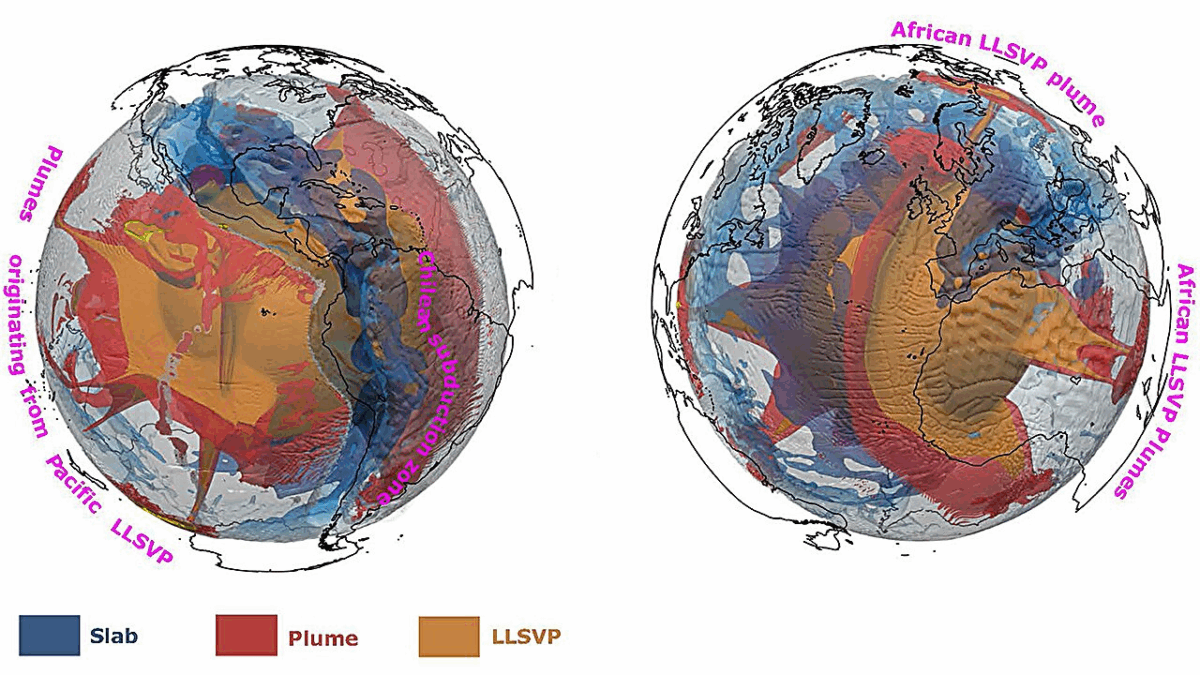
The lowermost 300 kilometers of the mantle, known as the D layer, exhibit the most significant seismic anisotropy. Scientists have theorized that the interaction of mantle plumes and massive dense structures at this depth causes this effect. These substantial, hot masses—often termed “BLOBs” (Big Lower-Mantle Basal Structures)—are thought to modulate the surrounding mantle flow, thereby impacting the patterns of seismic wave speeds. Studying these interactions helps reveal the mantle’s complex behavior and contributes to our knowledge of geological processes influencing the planet.

How BLOBs Influence Seismic Patterns
The article in Geochemistry, Geophysics delves into the contribution of core-mantle boundary BLOBs to seismic anisotropy as observed in seismic measurements. These formations, hotter and denser than their surroundings and often spanning an area larger than continents, appear to play a crucial role in altering mantle flow dynamics. The study indicates that the best match for recorded seismic data occurs when BLOBs are modeled as roughly 2% denser and one hundred times more viscous than adjacent mantle materials. The interaction between these dense structures and ascending mantle plumes leads to significant deformation around BLOBs, creating the distinctive anisotropic signatures detected by geophysicists.
Cutting-Edge Simulations Reveal Mantle Complexity
To investigate these intricate behaviors, the research team utilized advanced 3D mantle convection models using ASPECT alongside mantle fabric simulation software called ECOMAN. These sophisticated tools enabled simulations of mantle material movement and interaction over millions of years. By varying properties such as the viscosity and density of BLOBs, researchers observed how these factors impacted seismic anisotropy.
The study’s simulations also captured how tectonic plates subduct beneath the mantle while mantle plumes ascend from its base. By experimenting with different mantle configurations, the researchers refined their understanding of how the chemically distinct BLOBs influence long-term mantle flow. This approach bridges the gap between seismic observations and the mantle’s physical properties at extreme depths.
Historical Perspective: BLOBs Influencing Earth's Geological Past
Investigators, including Roy and colleagues, also examined how tectonic changes, such as the fragmentation of Pangaea and the opening of the Atlantic Ocean, might affect mantle plume dynamics and BLOB evolution. Over the past 250 million years, shifting tectonic plates have likely altered interactions between BLOBs and the mantle.
The research shows that BLOBs, originating from a 100-kilometer-thick mantle layer, have maintained relative stability throughout geological history but experienced gradual changes in density and viscosity. These shifts may correlate with the development of subduction zones and other tectonic phenomena, impacting Earth's surface evolution over vast time scales.
BLOBs’ Impact on Earth’s Internal Heat Dynamics
The study also sheds light on how BLOBs might influence Earth's thermal engine responsible for driving mantle convection and plate tectonics. By simulating heat transfer between the core and mantle, scientists gain insights into how these dense, viscous BLOBs potentially hinder heat flow, trapping thermal energy near the mantle’s base. This entrapment may affect the vigor and pattern of mantle convection currents.
These findings hold important implications for understanding seismic activity, volcanic eruptions, and Earth’s magnetic field. Improved knowledge of heat transport mechanisms within the mantle enhances our comprehensive view of Earth's internal dynamics and the forces molding our world.
- Categories:
- News












0 comments
Sign in to Comment