
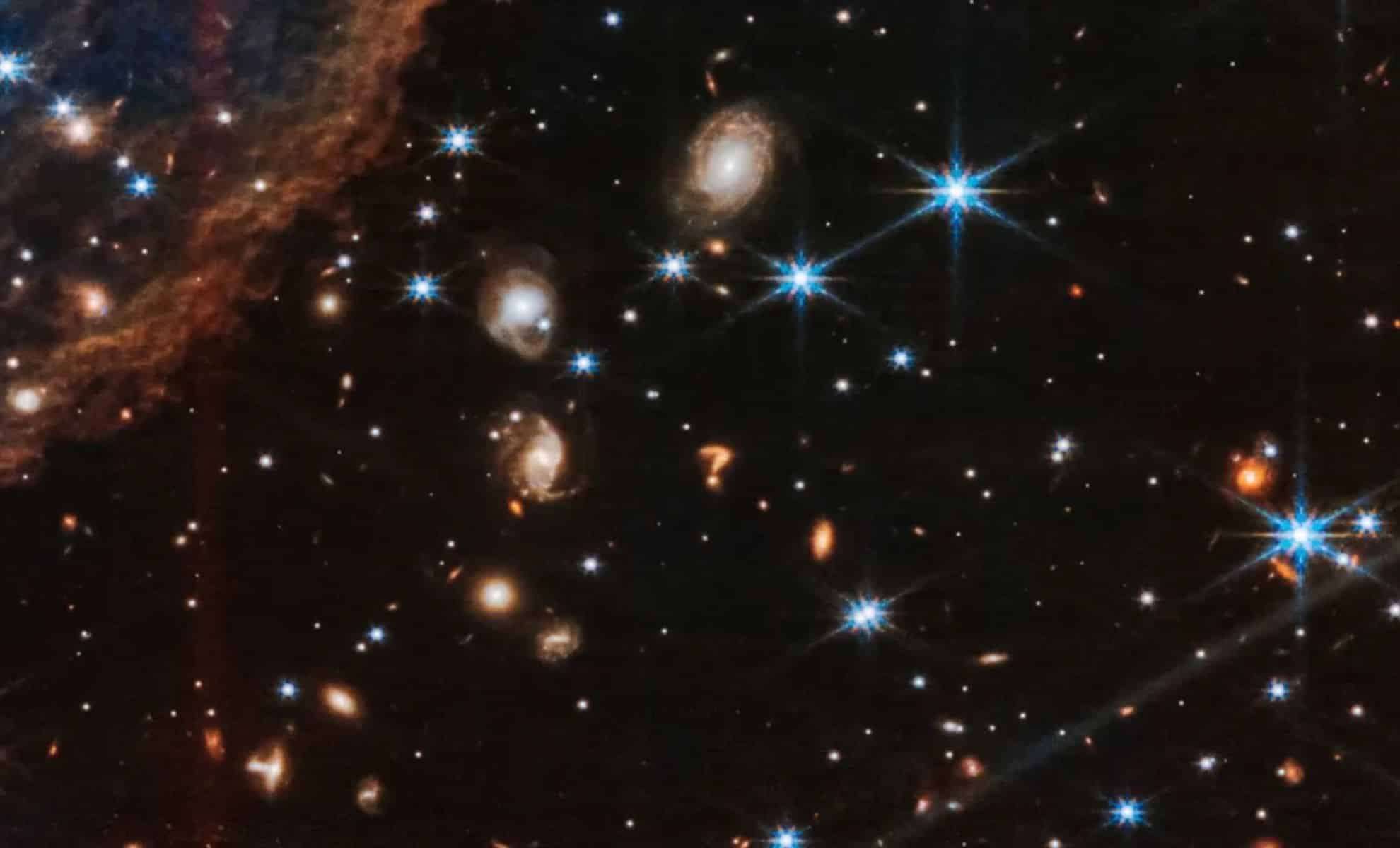
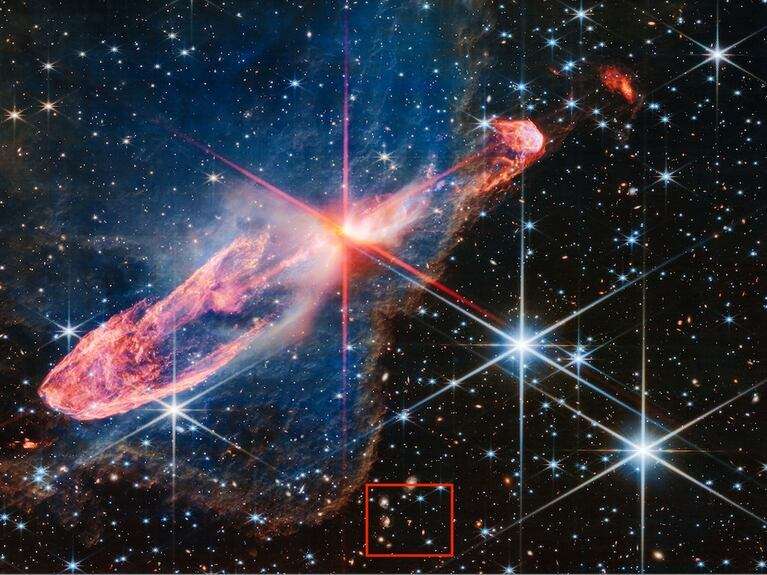
The James Webb Space Telescope (JWST) recently captured an image intended to showcase two nascent stars forming in a nearby stellar nursery. However, something unexpected appeared in the distant background: a striking, curved orange feature that eerily resembles a giant question mark suspended in space.
This unusual cosmic symbol quickly captivated online communities. Shared initially by the European Space Agency (ESA) and examined in greater detail by scientists at Saint Mary’s University, the image ignited widespread fascination. Beyond playful alien-themed humor, this curious shape points to a remarkable astronomical event.
Question Mark Pattern Emerges from Distant Galaxies
Though the primary focus was the youthful star system Herbig-Haro 46/47, observers’ attention was drawn to a mysterious, bright orange formation located deep in the background. This shape resembles a glowing question mark, formed by an unusual alignment of galactic structures.

Speculation ran rampant online, with users joking about extraterrestrial messages. Scientists, however, clarified that the phenomenon arises from natural cosmic dynamics rather than intentional communication.
The true explanation involves a galaxy—or possibly a cluster of galaxies—in the midst of merging. Their light is gravitationally warped and magnified to form the question mark-like outline, a consequence of a process called gravitational lensing.
The Cosmic Lens That Bends Light and Shapes Images
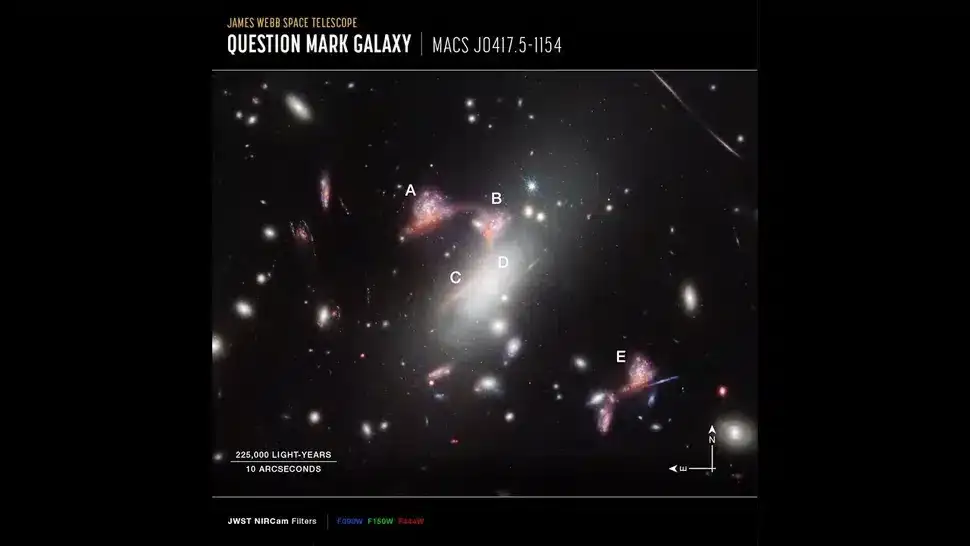
How does this effect occur? A massive galaxy cluster, specifically MACS-J0417.5-1154, lies between us and the far-off galaxies. Its strong gravitational influence bends light passing behind it, acting much like a cosmic magnifying lens. This distortion results in multiple, warped images of the background galaxies.
In this case, a duo of galaxies about 7 billion light-years distant are bent and replicated fivefold. As detailed by Live Science, four of the lensed images form the sweeping curve of the question mark, while the dot at the bottom likely represents a separate galaxy that just happens to be aligned perfectly.
This phenomenon, known as a "hyperbolic umbilic gravitational lens," is extremely rare in cosmic observations.
Implications for Understanding Galactic History
Beyond its visual intrigue, this serendipitous find provides astronomers invaluable insights into galaxy formation and evolution. The lensed galaxies stem from an era roughly 7 billion years ago, a critical epoch when the universe was about half its current age and galactic development was rapid.
Studying these magnified galaxies offers a glimpse into what mature galaxies like the Milky Way might have resembled during their formative, "teenage" phase.
Marcin Sawicki, a research co-author, explains, “These galaxies, observed at a time when star formation was at its highest, have masses comparable to what the Milky Way would have had back then.”
Decoding Visual Familiarity in Astronomical Images
Macarena Garcia Marin, a Webb project scientist at the Space Telescope Science Institute, reflected on the discovery, noting how Webb’s capabilities often uncover unexpected background phenomena regardless of the primary target.
“We all enjoy spotting recognizable shapes in the cosmos,” she said. “It creates a special link between our human experience and the vast beauty of the universe.” According to Garcia Marin, this example beautifully illustrates how projection effects can lead the mind to perceive distant cosmic interactions as familiar symbols.
She also pointed out that although the merging galaxies are far behind the young star system Herbig-Haro 46/47, interactions in the universe like these can trigger star formation bursts, potentially contributing to regions where stars are born.
- Categories:
- News





0 comments
Sign in to Comment