
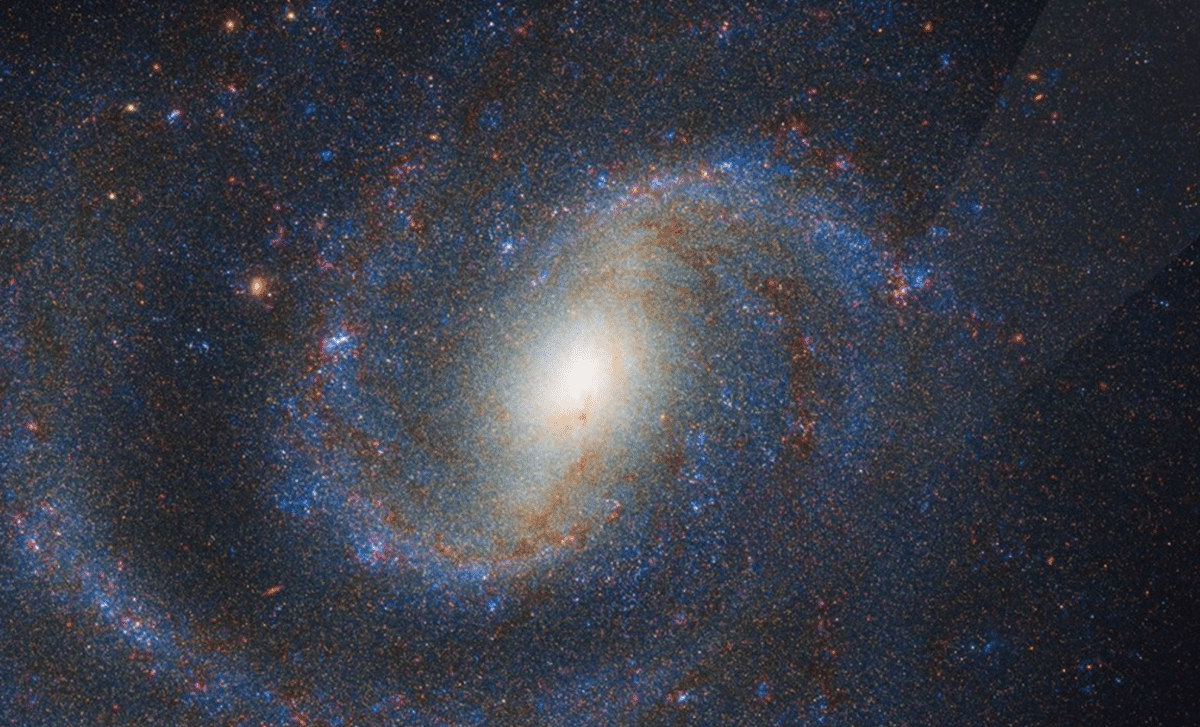
Astronomers utilizing the James Webb Space Telescope (JWST) have successfully identified the original star that detonated as supernova 2025pht roughly 40 million years ago in the spiral galaxy NGC 1637. Featured in a paper in Astrophysical Journal Letters, this finding represents the first occasion where Webb has directly observed the progenitor of a supernova.
Webb Makes Breakthrough by Identifying Supernova 2025pht's Origin Star
Tracking down the progenitors of supernovae has posed a formidable challenge for astronomers, due to the difficulty of capturing stars just prior to their explosive ends, especially beyond the Milky Way. Leveraging JWST’s unprecedented capabilities, researchers achieved a breakthrough by pinpointing the particular star that culminated as supernova 2025pht within NGC 1637.
This remarkable achievement, documented in Astrophysical Journal Letters, is noteworthy as it represents Webb’s inaugural success in capturing a supernova progenitor. Charlie Kilpatrick, the study’s lead researcher from Northwestern University, remarked, “We anticipated this moment—when a supernova would erupt in a galaxy Webb had previously surveyed. By integrating datasets from both Hubble and Webb, we thoroughly profiled this star pre- and post-explosion.”

Webb’s ability to detect in the infrared spectrum was pivotal, enabling it to see through cosmic dust obscuring the progenitor star—a limitation for the Hubble Space Telescope, which primarily operates in visible light. This capability unveiled critical details previously hidden, unlocking new avenues for studying stellar life cycles.
A Red Supergiant Unveiled as the Star Behind Supernova 2025pht
The precursor to supernova 2025pht has been identified as a red supergiant, among the largest and brightest stars known. These massive stars eventually end their lives in powerful supernova explosions. Discovering the identity of this particular star sheds light on the evolutionary stages that lead up to such cosmic events.
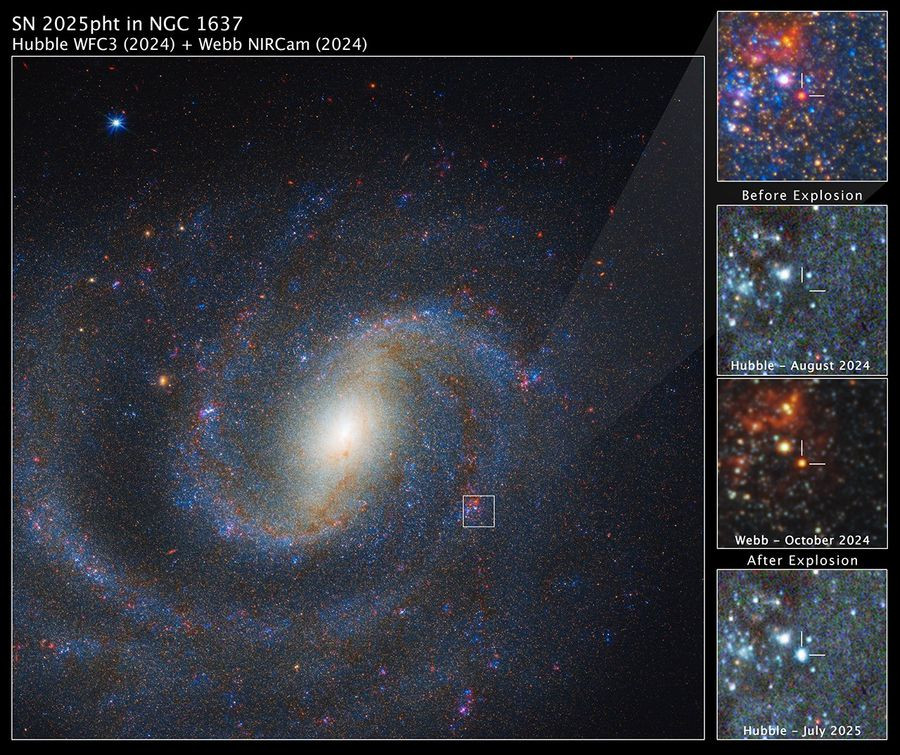
One unexpected discovery was the star’s extreme redness and dusty environment. Aswin Suresh, a graduate student and co-author, stated, “This is the reddest and most dust-enshrouded red supergiant observed to explode as a supernova.” The star’s intense coloration indicates a thick cocoon of dust, which had previously concealed it from optical telescopes like Hubble.
Uncovering Dust’s Role in Masking Supernova Progenitors
The research also highlights the substantial dust enveloping the progenitor star, a crucial factor in why astronomers have missed such massive stars before their explosive outbursts. This dusty shroud not only attenuated the star’s brightness but also influenced its observed characteristics. By examining Webb’s mid-infrared observations, scientists concluded that the dust was likely enriched with carbon, a surprising insight.
Kilpatrick commented on this finding:
“I’ve been arguing in favor of that interpretation, but even I didn’t expect to see it as extreme as it was for supernova 2025pht. It would explain why these more massive supergiants are missing because they tend to be more dusty.”
The abundance of dust may be a key reason why detecting the most massive supernova progenitors has historically been so difficult.
Webb’s success in peering through this dust demonstrates the importance of its mid-infrared instruments. “Access to mid-infrared data was critical to determine the dust’s nature,” said Suresh. This discovery not only clarifies why red supergiants have remained elusive but also paves the way for studying similar stars in the future.
- Categories:
- Space


0 comments
Sign in to Comment