
Astronomers utilizing the James Webb Space Telescope (JWST) have spotted an extraordinarily remote Type II supernova that detonated mere 1 billion years post-Big Bang. Dubbed SN Eos after the Greek deity of dawn, this remarkable event became visible thanks to an exceptional gravitational lensing phenomenon that boosted its faint light across the cosmos.
Caught between September 1 and October 8, 2025, this discovery represents one of the earliest stellar explosions ever recorded. Gravitational lensing not only enhanced the brightness of SN Eos but also created two separate images, enabling astronomers to analyze the supernova from dual vantage points within the same observation.
Gravitational Lens: A Time-Traveling Telescope
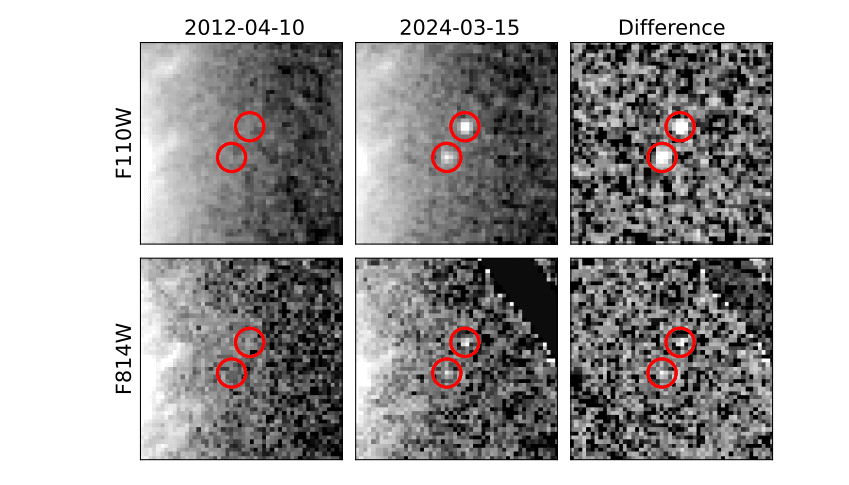
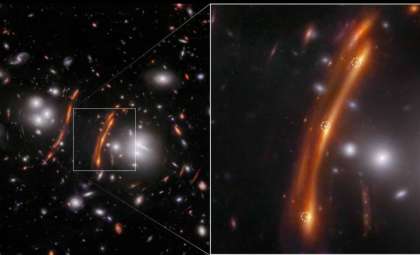
The supernova was detected in the galaxy cluster MACS J1931.8-2635, where the immense gravity stretches and magnifies distant light sources, permitting JWST to observe an object situated over 13 billion light-years away. This lensing event generated twin images identified as 101.1 and 101.2, confirming SN Eos’s characteristics and facilitating a detailed study.

Thanks to this cosmic magnifier, the team revealed SN Eos. Published on January 7 via the arXiv preprint server, the findings highlight JWST’s capability to probe the universe’s infancy. Gravitational lensing occurs when light from distant sources traverses a warped spacetime region caused by a massive foreground object’s gravity.
In this scenario, the effect was powerful enough to both brighten and produce two distinct visual occurrences, granting astronomers an unprecedented view of this ancient explosion. Combining this method with JWST’s infrared sensitivity is becoming a powerful approach to study dim, remote phenomena from the early cosmos.
A Hydrogen-Rich Blast in a Primordial Universe
The light signature from SN Eos identifies it as a Type II-P supernova, characterized by a period of steady brightness prior to fading. Ultraviolet data revealed the star that exploded was hydrogen-rich and existed within an environment containing a significantly low amount of heavy elements, or metals, by astronomers’ standards.
It is estimated that the progenitor star had less than one-tenth the metal abundance of the sun, suggesting it formed in one of the universe’s earliest, chemically pristine regions. This reduced metallicity level is a strong marker of the star’s ancient heritage and agrees with models that the universe’s first stars primarily consisted of hydrogen and helium, the lightest and most common elements after the Big Bang.
Supporting JWST’s Quest to Unravel Cosmic History
This finding aligns closely with JWST’s core scientific aims, which include revealing the life cycles of the earliest stars and their influence on galactic growth. Researchers, cited in Live Science, note that this event enriches the telescope’s efforts to explore the birth of elements and chart the formation of nascent galaxies.
Although based on a single observation, SN Eos is a crucial benchmark illustrating what early massive supernovae might have looked like. Continued observations will determine if Eos exemplifies typical early stellar explosions or stands as a rare exception.
- Categories:
- Space




0 comments
Sign in to Comment