
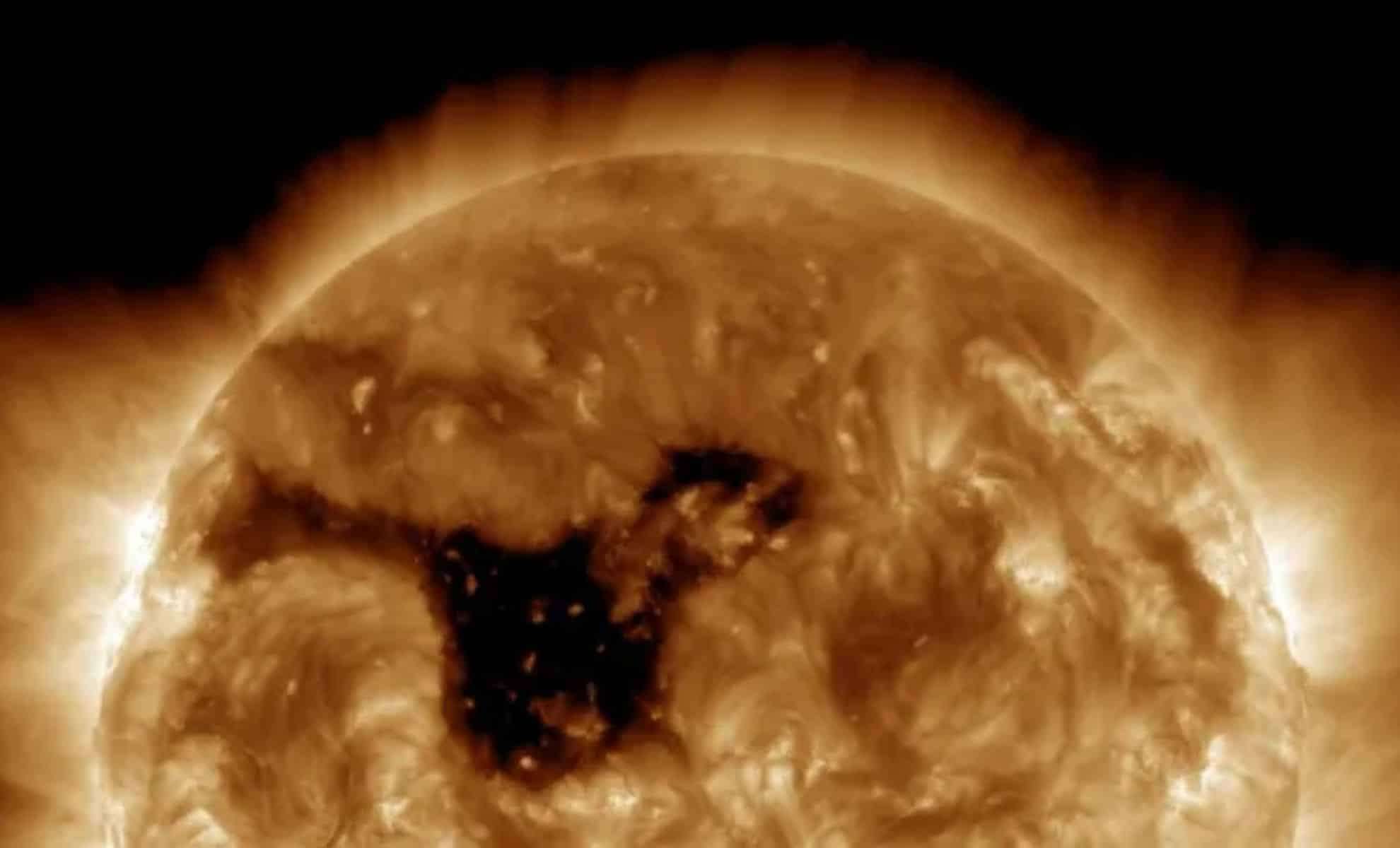
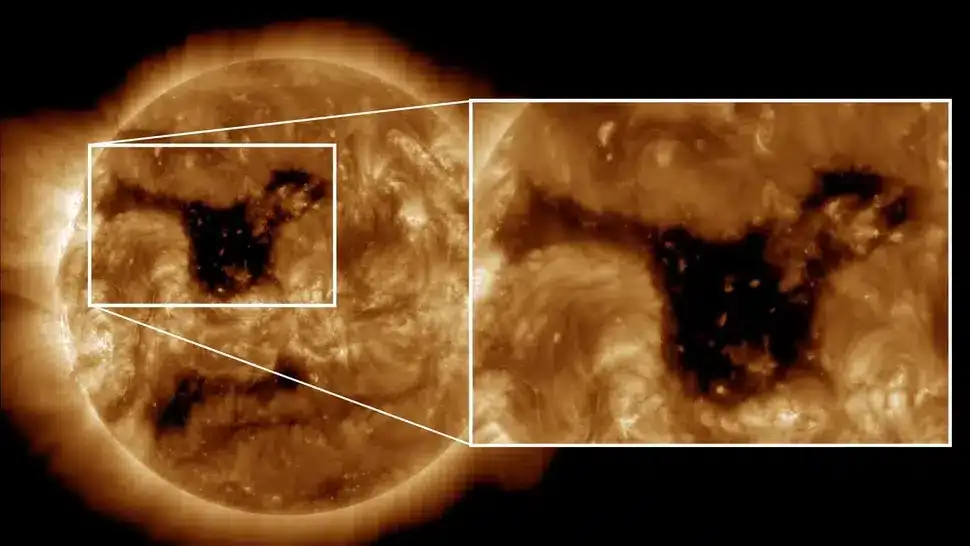
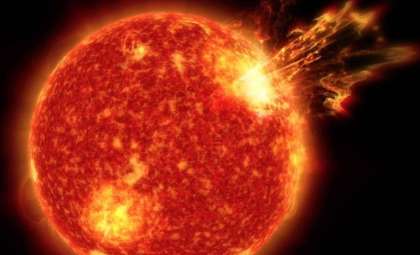
The Solar Dynamics Observatory (SDO) operated by NASA has identified an immense coronal hole on the Sun’s surface, extending roughly 500,000 miles wide—which is about the size of 62 Earths aligned side by side. This vast feature appears as a dark region in ultraviolet and X-ray images but isn’t a physical hole; instead, it marks an area where the Sun’s magnetic field has opened, letting high-velocity solar wind stream out into space freely.
This particular coronal hole is of special interest since it lies directly facing our planet. Currently, charged particles from this region are racing toward Earth at speeds surpassing 1.8 million mph (2.9 million km/h). Experts predict this solar wind will impact Earth between January 31 and February 1, with possible disruptions to satellites, GPS navigation, power grids, and more due to geomagnetic storms.
Although coronal holes regularly appear on the Sun, this one’s enormous scale and Earth-directed position make it especially significant. As solar activity intensifies approaching the peak of the Sun’s 11-year cycle, such phenomena may occur more often and with greater intensity, highlighting the Sun’s powerful effects on near-Earth space.

Understanding Coronal Holes and Their Impact
Coronal holes form in the Sun’s outer atmosphere, known as the corona, when magnetic field lines open widely, allowing solar wind to escape faster than usual. These magnetically open regions can persist for weeks or months, rotating with the Sun and periodically sending streams of solar particles toward Earth. Unlike sudden bursts from solar flares, coronal holes produce a continuous flux of energetic particles that can influence the space environment over longer periods.
The effects on Earth hinge greatly on a coronal hole’s size and location. When situated near the solar equator and directly Earth-facing, as is the case here, the resulting geomagnetic disturbances tend to be more pronounced. Such storms happen when charged solar particles interact with Earth’s magnetic shield, causing shifts in the planet’s magnetosphere.
Possible consequences include:
- Geomagnetic storms that may disrupt electrical grids and cause voltage irregularities.
- Interference with satellite functions, impacting communication, GPS accuracy, and weather data collection.
- Enhanced and more visible auroras, increasing the reach of the Northern and Southern Lights.
- Radio communication disruptions, especially in higher latitudes, affecting aviation and emergency services.
The NOAA Space Weather Prediction Center anticipates this solar wind could generate G1-level geomagnetic storm conditions—relatively mild, yet capable of causing technological impacts.
Looking Ahead: Preparing for Solar Wind Arrival
Space weather researchers will be vigilantly tracking the effects of this rapid solar wind as it nears Earth, monitoring how the planet’s magnetosphere absorbs the incoming energy. While G1 storms are generally minor, a stronger influx of particles could escalate conditions to G2 or G3 levels, potentially impacting power grids, satellite operations, and navigation systems.
For those who appreciate celestial displays, this event could mean spectacular auroras. Increased solar particle activity often leads to vibrant Northern and Southern Lights, viewable farther from the poles, such as in northern parts of the U.S. and Europe.
Approaching the solar cycle’s apex expected in 2025, the frequency and intensity of space weather events like this are projected to rise. Ongoing solar observations continue enhancing our understanding of solar-terrestrial interactions and assist in developing safeguards for modern technological systems.
A Sobering Reminder of Solar Influence
Although this massive coronal hole does not pose an immediate threat, it underscores the Sun’s profound effect on Earth. Our world remains under constant exposure to solar radiation, and when these energetic particle streams arrive, they can cause unexpected technology disruptions.
Missions like NASA’s Parker Solar Probe and ESA’s Solar Orbiter aim to deepen knowledge of solar activity, improving forecasting abilities for space weather events and enhancing protection measures.
For now, attention stays focused on the swift-moving solar wind as Earth braces for another dynamic encounter with solar power.
- Categories:
- News






0 comments
Sign in to Comment