
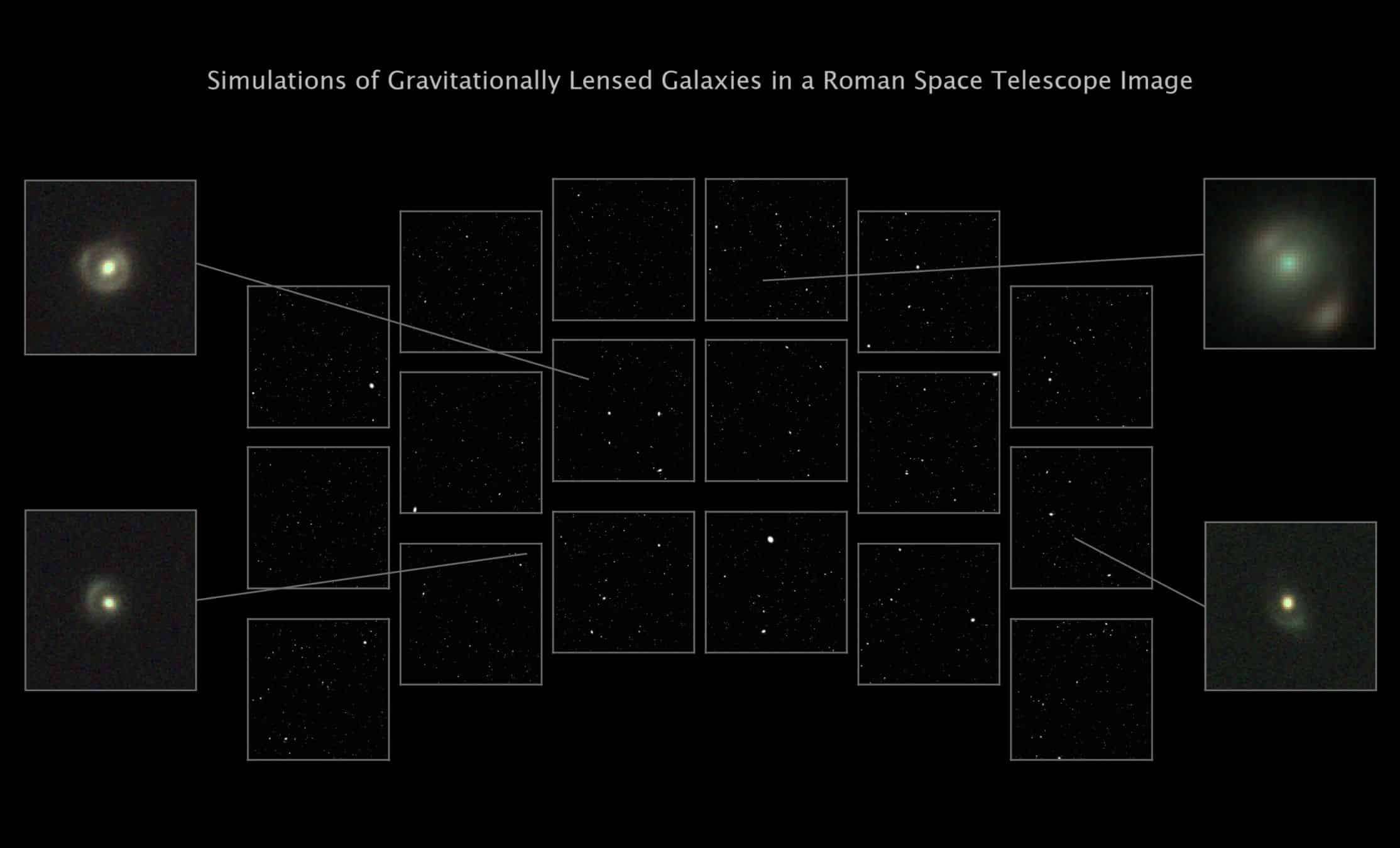
Launching in 2027, NASA’s Nancy Grace Roman Space Telescope promises to transform dark matter research by leveraging the power of gravitational lensing. This technique, grounded in Einstein’s theory, focuses on how massive galaxies warp light from objects behind them, enabling Roman to map mass distributions with remarkable detail. By capturing these lensing effects, the telescope will provide deeper insights into dark matter, the unseen material comprising much of the universe’s mass. A recent study in The Astrophysical Journal titled The Roman View of Strong Gravitational Lenses (2025) examines how Roman’s capabilities will enhance our understanding of this elusive cosmic component.
Exploring Dark Matter Through Gravitational Lens Effects
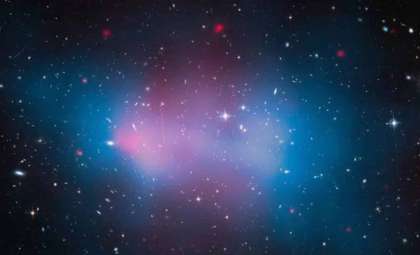
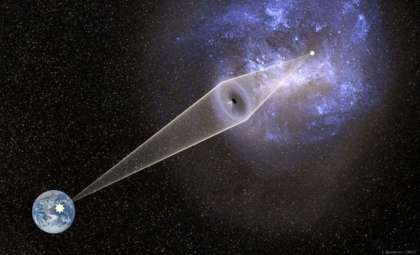
Gravitational lensing takes place when the gravity of a nearer galaxy bends and magnifies the light from a more distant galaxy positioned behind it. The resulting distortions, such as arcs and rings, reveal critical information about the mass layout of the foreground galaxy and any dark matter present. Predicted by Einstein, this gravitational bending of light stands as one of the most effective strategies to analyze dark matter indirectly since it illustrates how visible and invisible mass bends space.
Roman’s Wide Field Instrument, featuring a 300-megapixel camera, will survey extensive parts of the sky with unprecedented precision. Unlike older observatories like Hubble, which had restricted views and resolution, Roman’s advanced technology can detect thousands of gravitational lenses, significantly expanding opportunities to study dark matter and the cosmic architecture.

Enhancing Gravitational Lens Detection
Bryce Wedig, a graduate student at Washington University in St. Louis and lead author of the study, explains, “Due to the need for near-perfect alignment of two galaxies, previous telescopes have only discovered limited numbers of gravitational lenses. Limitations in field of view and resolution restrict detection.” Roman’s broad survey approach will identify over 160,000 lenses, with approximately 500 suitable for in-depth dark matter analysis.
Increasing the sample size is crucial because gravitational lenses open an observational window into how mass—including dark matter—is distributed in galaxies. Small distortions in background galaxy images help astronomers track dark matter’s influence across the cosmos, shedding light on its distribution and properties.
High-Definition Imagery to Deepen Dark Matter Insights
Tansu Daylan, assistant professor and principal investigator, emphasizes, “Roman’s high-resolution images will allow us to uncover gravitational lenses smaller than previously detectable.” This improved resolution will provide valuable data on dark matter’s structure and its impact on galactic and cosmic formation.
Studying these smaller lenses will help researchers explore dark matter’s arrangement at fine scales within lensing galaxies. This could reveal clues about the fundamental nature of dark matter particles, addressing longstanding astrophysical mysteries.
- Categories:
- News





0 comments
Sign in to Comment