
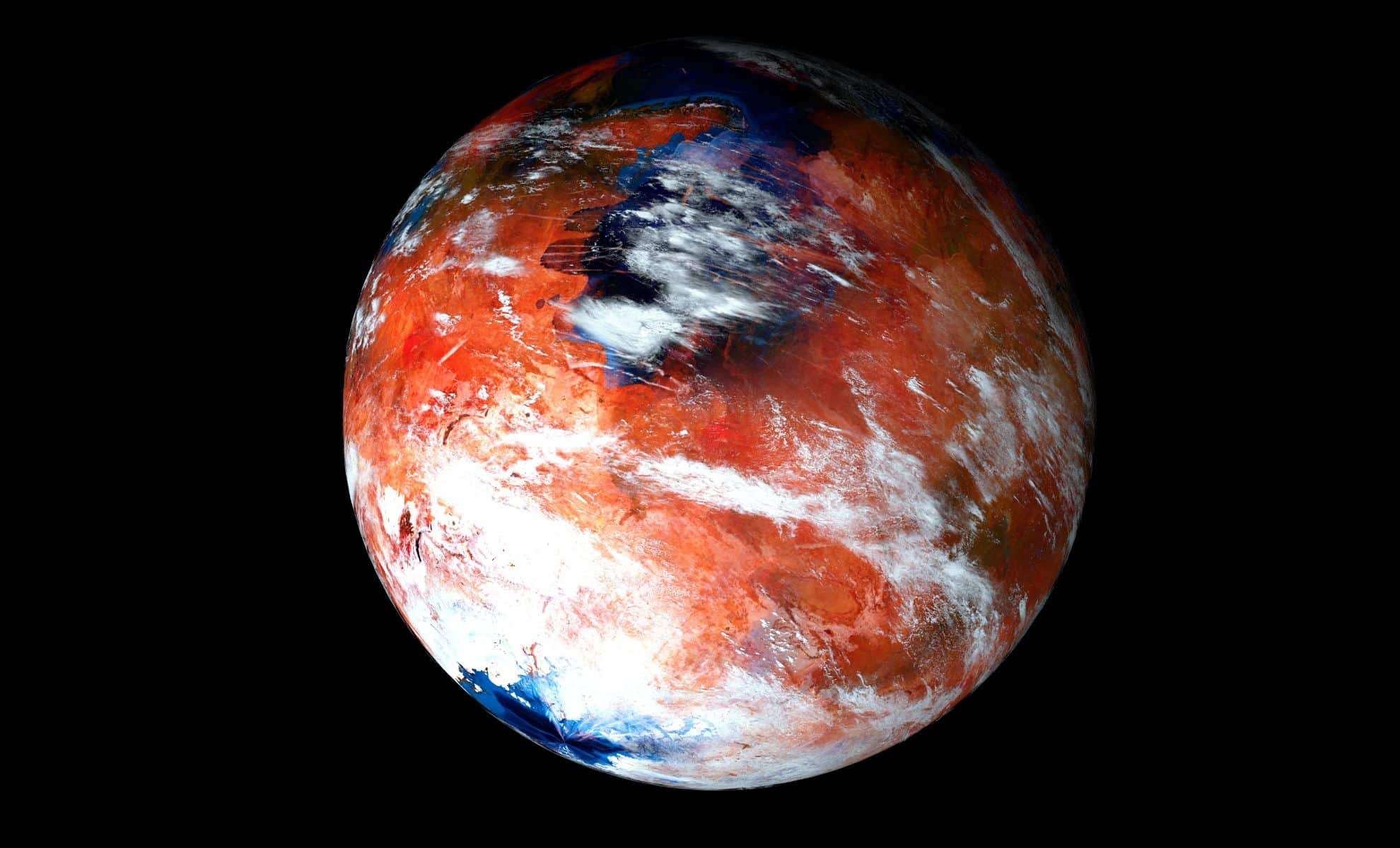
For years, researchers have recognized ancient Martian rivers that sculpted the planet’s surface, yet the mechanism linking surface water and subterranean reservoirs remained unclear. A recent investigation from The University of Texas at Austin’s graduate team unveils a vital link between rainfall-fed surface lakes and a deep groundwater system nearly a mile beneath Mars’ ancient terrain.
Tracking the Subsurface Water Flow Over Time
The findings, detailed in Geophysical Research Letters, reveal that scientists Mohammad Afzal Shadab and Eric Hiatt developed a computer simulation to estimate how fast water permeated early Martian soils. Their calculations indicate water took between 50 and 200 years to migrate from surface lakes down to an extensive underground aquifer. This slow pace contrasts starkly with Earth, where such migration occurs in days, due to Mars’ deeper water table, reduced gravity, and lower temperatures impacting infiltration rates.
This timeline offers the first explicit quantification of groundwater movement during Mars’ wetter epoch nearly three to four billion years ago. The model approximates that subterranean water storage equals at least 90 meters (or 300 feet) when averaged globally, representing a significant fraction of Mars’ primordial water. With early Mars hypothesized to have oceans several hundred meters deep, this reservoir likely accounts for much of the planet’s missing water.

@itsbiggerthenyouthinnkNasa shows possible water on mars #foryoupage #mars #water #space
♬ After dark – xervic.sounds
Water’s One-Way Journey Beneath the Surface
Earth’s water cycle involves continuous evaporation, condensation, and precipitation that sustains aquatic environments long term. Mars appears to lack this balance.
Eric Hiatt explains, “Once water entered the Martian subsurface, it essentially disappeared from the surface cycle.” The team’s findings suggest surface water flowed downward, seeping into crustal pores or bonding with minerals, while Mars’ thin atmosphere allowed water vapor to escape into space. This irreversible downward flow contrasts with Earth’s cyclical water movement and is key to understanding why Mars lost much of its surface water.
As Mars’ atmosphere thinned and surface bodies vanished, subsurface water either froze or chemically assimilated into rocks as hydrated minerals. This vast underground water cache reveals vital clues about the planet’s past and offers potential water sources for upcoming missions.
Simulating Early Martian Soil and Water Permeation
To build their model, researchers viewed ancient Martian regolith as a permeable layer atop basalt bedrock, integrating temperature, gravity, and soil permeability data from meteorite studies and rover analyses. They applied probabilistic algorithms considering rainfall rates, porosity, and thermal profiles, estimating infiltration times from 50 to 200 years. Mars’ weaker gravity means pore pressure rises more slowly, and its chilly surface conditions slow evaporation, resulting in a water descent roughly 100 times slower than on Earth.
The research coincides with orbital data confirming widespread hydrated minerals and radar detections of buried ice at mid-latitudes. Atmospheric readings show over half of Mars' original water escaped, but this study advances understanding by quantifying how much water became trapped underground.
Exploring Mars’ Buried Water Reserves
Mohammad Afzal Shadab, now a postdoctoral scholar at Princeton University, intends to combine this infiltration model with planetary climate simulations accounting for rain, surface runoff, and volcanic events. Such integrations could test hypotheses ranging from enduring northern oceans to brief flooding from asteroid impacts or volcanic eruptions.
Planned missions may drill near one kilometer deep to sample these hidden aquifers directly. Isotopic studies could differentiate water still locked beneath the surface from water chemically bound within rocks.
Eric Hiatt summarizes, “The Red Planet lacked the recycling water cycle Earth enjoys.” These insights refine our view of Mars’ aqueous history and inform exploration strategies targeting its concealed reservoirs.
- Categories:
- Space






0 comments
Sign in to Comment