
Imagine a dinosaur parting its jaws. What noise do you envision? For years, movies and TV shows portrayed a fierce, roaring sound, borrowing from lions and amplifying it for prehistoric behemoths. However, a fossil discovered in the reddish sandstone of northern China tells a very different tale—one of subtle vocalizations supported by throat bones smaller than a finger joint.
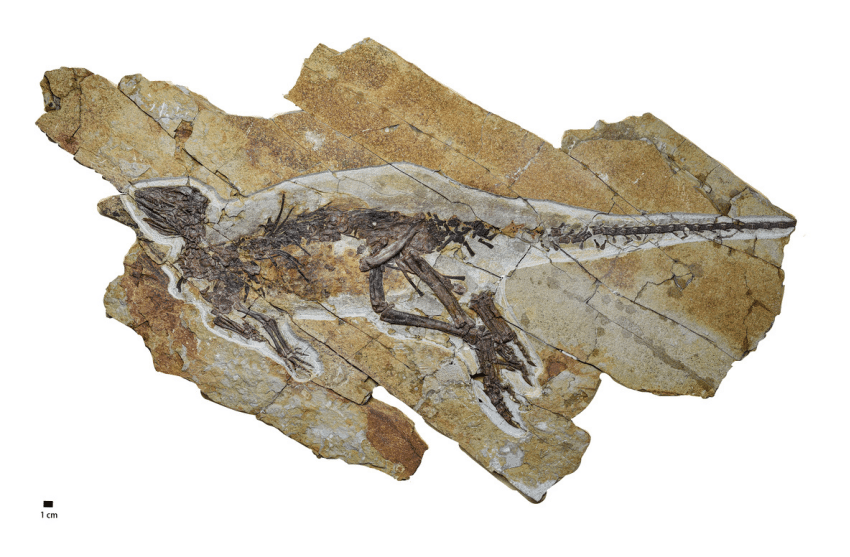
The creature was modest in size. Pulaosaurus qinglong measured approximately 72 centimeters from nose to tail, a small, two-legged herbivore that roamed Jurassic forests around 163 million years ago. Most intriguingly, within its throat was an exceptionally rare find in non-avian dinosaurs: an ossified larynx, a bony voice box framework, clearly preserved to provide insight into how this dinosaur produced sound.
Scientists at the Chinese Academy of Sciences analyzing this vocal structure discovered it was designed for sound modulation rather than loud, forceful calls. This dinosaur likely emitted chirps, coos, and intricate vocal patterns, sounding more birdlike than monstrous.

The Rare Fossilization of Voice Bones
Vocal apparatuses seldom fossilize because in most vertebrates, cartilage forms the larynx, which typically decomposes before fossilization can occur. Capturing an ossified larynx requires a rare combination of rapid sediment coverage, low-oxygen conditions, and ideal geochemical processes to turn soft tissue into stone.
That rarity explains why the Pulaosaurus fossil, documented in July 2025 in the journal PeerJ, represents only the second non-avian dinosaur found with preserved vocal bones. The first discovery occurred in 2023 when Junki Yoshida and colleagues described the ossified larynx of Pinacosaurus grangeri, a heavily armored ankylosaur from the Late Cretaceous Mongolia deposits, reported in Communications Biology.
Despite being separated by approximately 90 million years and distant branches on the dinosaur family tree, both species exhibit birdlike laryngeal characteristics: elongated arytenoid bones, enlarged cricoid structures, and robust joints capable of precise airway control.
Sound Shapers, Not Roar Makers
To interpret these fossils, it helps to understand sound production in living animals. In crocodilians and many reptiles, the larynx is the primary sound source, where vocal tissue near the glottis vibrates as air passes through, generating calls.
In contrast, birds use their larynx differently. The dinosaurian larynx in birds functions largely as a sound modifier, while the actual vocalization arises deeper in the chest via the syrinx, an organ located where the trachea meets the lungs. The larynx then fine-tunes the noise by adjusting airway size to change pitch, tone, and loudness.
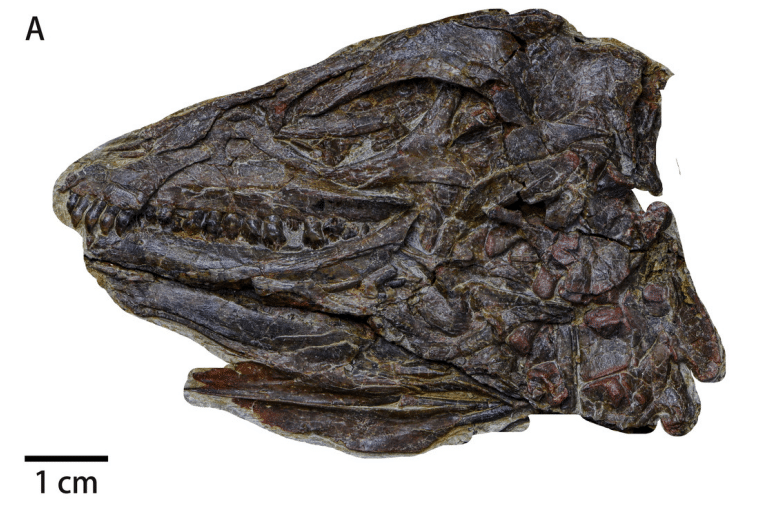
The arytenoid bones in Pulaosaurus appear elongated and shaped like leaves, providing extensive muscle attachment points and leverage to control glottal opening. Researchers interpret this design as consistent with a sound-modifying larynx rather than a primary sound generator. The fossil’s authors concluded that this find “represents the second known dinosaur to preserve ossified laryngeal elements, thus suggesting that a bird-like vocalization evolved early in non-avian dinosaur evolution.”
A Young Dinosaur’s Voice
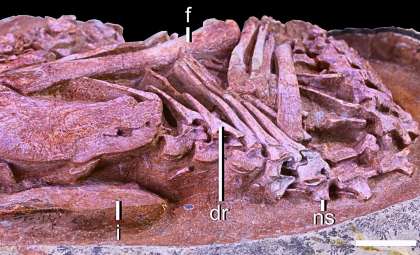
The fossil was excavated from the Tiaojishan Formation in Qinglong County, Hebei Province, and is now housed at Beijing’s Institute of Vertebrate Paleontology and Paleoanthropology, catalogued as specimen IVPP V30936. The nearly complete skeleton includes the skull, limbs, hyoid bones (supporting the tongue), and even stomach contents, offering a rare glimpse of the dinosaur’s last meal.
Scientists named the genus after Qinglong County and Pulao, a mythical Chinese dragon known for its thunderous voice. The name, however, is somewhat ironic given the creature likely produced subtle calls rather than booming roars, communicating through the forest in frequencies allowing discreet interactions without alerting predators.
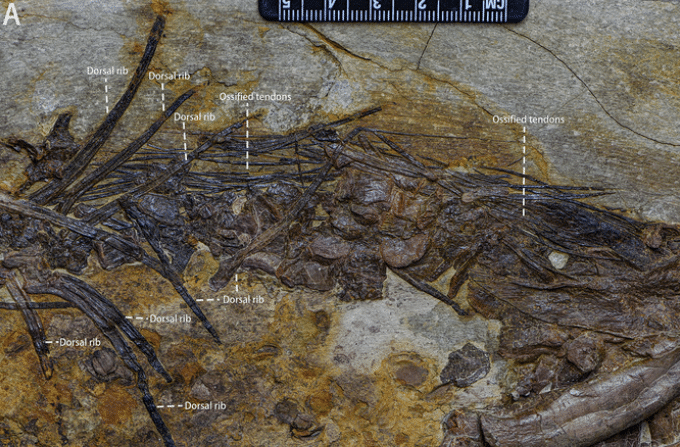
Evidence including unfused vertebral sutures and proportionally large eye sockets suggests the fossil represents a juvenile. In many species, young animals are highly vocal, using calls to communicate with family or group members. If Pulaosaurus formed social groups—as some similar small herbivores likely did—bird-like vocalizations could have been essential for maintaining contact, signaling danger, or coordinating movement.
Revising Dinosaur Vocal Evolution
Pinacosaurus and Pulaosaurus differ greatly in form. Pinacosaurus was a bulky, armored ankylosaur from the Late Cretaceous of China and Mongolia, while Pulaosaurus was a nimble, early member of the neornithischian lineage, a group that eventually spawned duck-billed hadrosaurs and horned ceratopsians. Their shared presence of bird-type larynx structures suggests these vocal capabilities were inherited from a common ancestor, evolving early and persisting throughout dinosaur evolution rather than emerging in just specialized groups.
The study identifies Pulaosaurus as one of the earliest neornithischians yet described. Phylogenetic tests place it close to Agilisaurus and Hexinlusaurus, two small bipedal herbivores from roughly the same geological period in southwestern China. Characteristics such as five teeth in the front jaw, a small structured area on the cheekbone, and unfused ankle bones distinguish Pulaosaurus from its relatives.
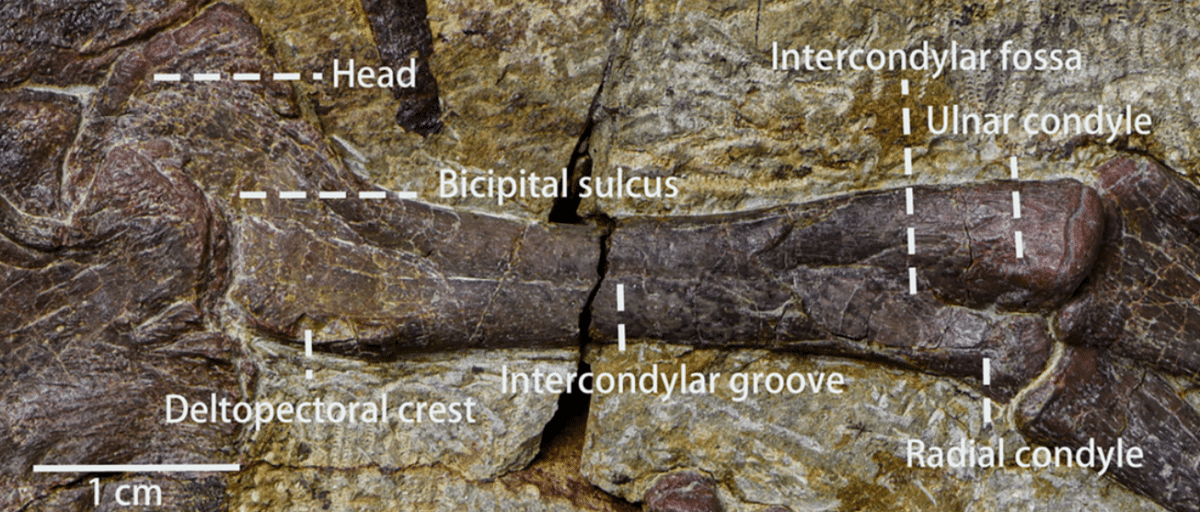
James Napoli, a vertebrate paleontologist at Stony Brook University, commented to Smithsonian Magazine that fossilized vocal organs remain “one of those persistent unknowns” in dinosaur research. He explained, “Without fossilized vocal organs, which are extremely rare, it’s really hard to even begin to estimate the limits of dinosaur vocal behavior, much less what they really sounded like.”
Secrets Hidden in the Sandstone
The Tiaojishan Formation is part of the Yanliao Biota, a Middle-to-Late Jurassic ecosystem known for yielding feathered theropods, early mammals, and pterosaurs. Before this find, neornithischians were notably scarce in this rich fossil record. Pulaosaurus fills an important gap and adds vocal structure insights to the rare soft-tissue traits found among these fossils.
Local fossil collector Yong Wang uncovered the slab prior to scientific preparation and CT scanning, which revealed internal pelvic structures obscured by overlapping bones and confirmed the fossil’s integrity. The ossified voice bones are located ventrally next to the displaced jawbone, matching their original anatomical position.
- Categories:
- Science









0 comments
Sign in to Comment