

For decades, scientists have been intrigued by the intricate evolution of planetary systems, a process unfolding over hundreds of millions of years. Until now, observations have mainly captured systems either at their origin or after they have fully matured. A recent paper in Nature Astronomy sheds light on a seldom-seen intermediate stage: the adolescence of planetary systems. The investigation centers on TOI-2076, a youthful system caught in the midst of its transformative phase.
TOI-2076’s Transitional Phase: A Remarkable Find
TOI-2076 is a system orbiting a K-type dwarf star, estimated to be around 210 million years old—considered adolescent in astronomical terms. Unlike well-characterized mature planetary systems like our Solar System, TOI-2076 provides a rare window into the rapid evolutionary changes occurring as a system moves from infancy towards maturity. According to Howard Chen, assistant professor at the Florida Institute of Technology and co-author of the study published in Nature Astronomy:
“The transformative period is so short compared to the entire lifespan of the system. That period is really the key in determining how it turns out at its mature state.”
Add Cosmo Herald as a Preferred Source

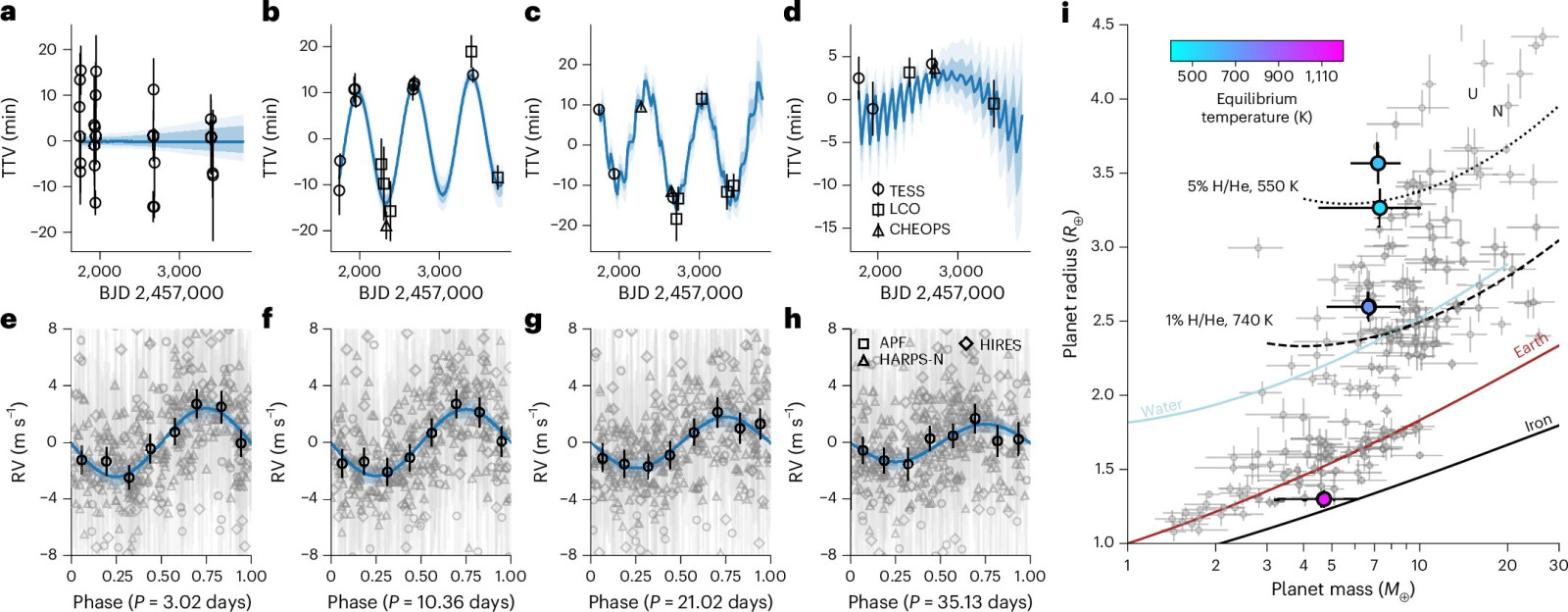
The system comprises four planets exhibiting distinct features. Initially compact, their orbits are gradually spreading apart, while the innermost planets have suffered considerable atmospheric erosion from intense stellar radiation. Observations gathered from the NASA Transiting Exoplanet Survey Satellite (TESS) along with terrestrial telescopes have allowed precise measurements of the planets’ masses, sizes, and orbital behavior. This wealth of data has helped researchers examine how atmospheric erosion evolves under the host star’s energetic influence.
Photoevaporation: The Driving Force Behind Atmospheric Changes
Central to TOI-2076’s evolution is photoevaporation, wherein stellar radiation strips planets of their atmospheres. Atmospheric loss intensity correlates with each planet’s proximity to the star—those closer lose substantial gaseous layers, exposing rocky cores, while distant planets preserve thicker gaseous envelopes. This mechanism shapes TOI-2076’s distinctive composition, with the innermost planet fully denuded of its atmosphere and outer planets retaining various atmospheric amounts.
Chen’s computational simulations were key in modeling these atmospheric changes. Applying his models to TOI-2076’s data, he demonstrated that atmospheric erosion follows predictable patterns based on planets’ locations and radiation exposure. This confirmation represented a significant breakthrough for Chen and his colleagues.
“For me, the whole point of going into modeling is to be able to connect with observations. You want your models to say something about the real world, but that’s not necessarily the case every time,” Chen said. “To see the model work in the real world and explain what’s happening is pretty powerful.”
Charting the Timeline of Planetary Adolescence
A major contribution of this research is establishing a timescale for planetary systems undergoing adolescence. Chen’s simulations indicate that the majority of atmospheric stripping in TOI-2076-like systems occurs within the first 100 million years. Following this intense period, systems stabilize and planets settle into mature orbits. This brief but intense phase plays a critical role in shaping the system’s future development. The framework formulated by Chen offers astronomers a deeper understanding of planetary evolution and the influences of variables such as mass and star distance.
The study’s revelations about photoevaporation and orbital dispersion provide a valuable tool for forecasting the future transformations of other youthful planetary systems. Being able to model these transitions will help scientists predict how newly discovered exoplanets might evolve as they age.
Opening New Frontiers in Planetary Science
Identifying TOI-2076’s adolescent stage represents a milestone in planetary system research. Observing a system at this fleeting phase grants astronomers a rare opportunity to explore a largely undocumented epoch in planetary development. These insights bridge significant knowledge gaps, enhancing our comprehension of how systems progress from formation to stable maturity.
The findings promise far-reaching effects on exoplanet studies. As new planetary systems are found, researchers can apply these models to unravel the complexities of their evolution. Ultimately, this work advances our grasp of planetary lifecycles and sheds light on the potential futures facing Earth and our Solar System.
- Categories:
- News








0 comments
Sign in to Comment