
A pioneering investigation Communications Earth & Environment reports that scientists from the University of Manchester have identified extraordinary geological formations beneath the North Sea. This breakthrough challenges established geological concepts and could transform our comprehension of subterranean processes, impacting future approaches to energy storage and carbon sequestration. The research, spearheaded by Professor Mads Huuse, reveals the existence of extensive structures termed “sinkites,” which invert the typical geological layering. This discovery paves the way for fresh insights into how fluids move through Earth’s crust, influencing evaluations of underground reservoirs critical to energy and environmental applications.
Unraveling the Phenomenon of Sinkites
“Sinkites” describe giant sand mounds that have paradoxically sunk, generating a reversal of the usual geological sequence. Normally, younger strata lie above older ones, but here, heavier sand has submerged into lighter, softer sediments beneath, reversing the traditional stratigraphic order. This inversion occurs at a scale never witnessed before, with some sand mounds extending across several kilometers under the North Sea.
Professor Mads Huuse, the study’s lead, emphasized the importance of this finding: “We’re witnessing a geological process unlike anything seen previously at such magnitude. Dense sands have descended into lighter sediments, which have floated upwards, turning the expected layering upside down and forming massive underwater mounds.” This surprising behavior challenges long-standing sediment movement theories and marks one of the decade’s most significant geological breakthroughs.

How Sinkites Came to Be: A Detailed Geological Explanation
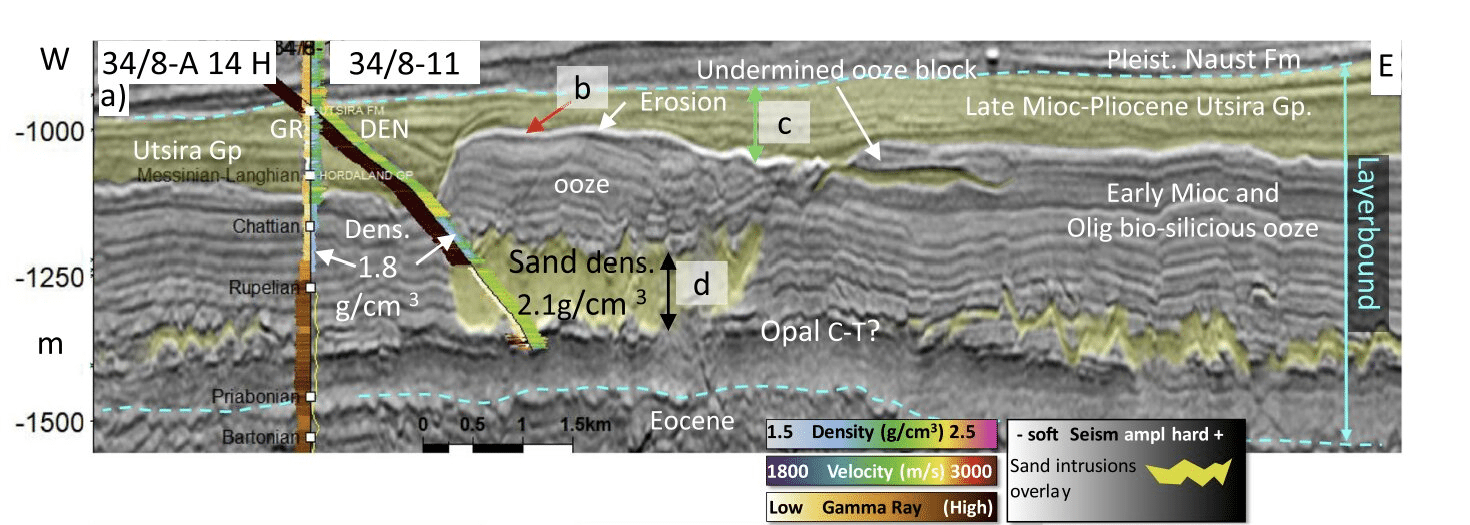
The formation of these sinkites is traced back to the Late Miocene to Pliocene epochs. During this period, seismic activities or pressure alterations likely liquefied sand layers, causing them to descend through fractures in the seabed. This sinking displaced lighter, porous sediments below, primarily composed of microscopic marine fossils, which then ascended in a process named “floatites.” This mechanism unexpectedly flips the typical layering, with heavier materials sinking and lighter ones rising.
Though stratigraphic inversions are known to occur, the immense scale of this event is unparalleled. Professor Huuse noted, “Our findings shed light on the surprising mobility of fluids and sediments in Earth’s crust. Deciphering sinkite formation could revolutionize our understanding of underground fluid flow, critical for enhancing carbon storage and reservoir integrity.” This discovery compels the scientific community to rethink conventional geological models and sheds light on complex Earth dynamics.
Impact on Future Carbon Storage and Energy Applications
The discovery of sinkites holds profound significance for the energy and environmental sectors. Gaining deeper insights into sediment and fluid movements underground is essential for optimizing oil and gas extraction as well as for carbon capture and storage (CCS) initiatives. This breakthrough could improve predictions of hydrocarbon reservoirs and identify safer sites for carbon dioxide sequestration.
Understanding that sediment and fluid migration can deviate from traditional models carries critical implications for CCS. Current reservoir assessments assume predictable sediment behavior, but sinkites show the need to refine these models. Researchers aim to leverage sinkite insights to design more reliable carbon storage methods and prevent accidental carbon leakage into the atmosphere in forthcoming studies.
- Categories:
- News











0 comments
Sign in to Comment