

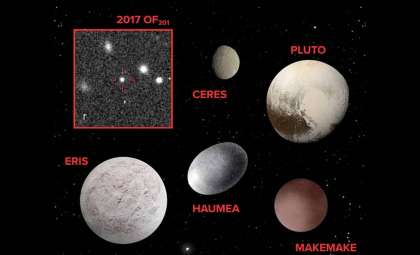
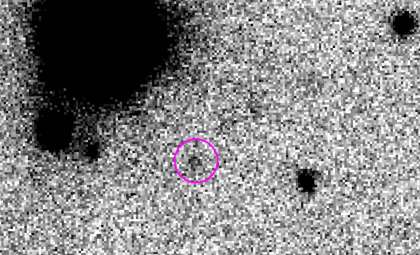
Researchers have unveiled a remarkable find in the farthest reaches of the solar system—a peculiar celestial body known as 2020 VN40 that moves in a synchronized orbit with Neptune. Classified among the distant trans-Neptunian objects (TNOs), this discovery highlights unexpected complexity in our solar system's outer limit.
A Distinctive Orbital Pattern
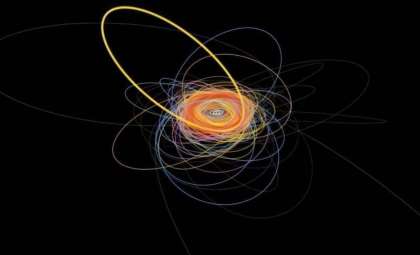
The asteroid 2020 VN40 follows a highly unusual trajectory, completing one revolution around the Sun for every ten orbits Neptune makes. Given that Neptune’s orbital period spans roughly 164.8 Earth years, 2020 VN40 takes approximately 1,648 years to circle the Sun once, equivalent to 19,776 months.
Findings reported in The Planetary Science Journal on July 7 suggest that 2020 VN40’s coordinated orbit may result from a period of gravitational capture by Neptune. Rosemary Pike, lead astrophysicist at the Center for Astrophysics | Harvard & Smithsonian, remarked, “This discovery represents a major advancement in our comprehension of the solar system’s distant frontier.” Such insights are crucial for piecing together the solar system’s formation history and evolution.

The Discovery Method
The orbital characteristics of 2020 VN40 emerged through observations made by the Large inclination Distant Objects (LiDO) survey. This initiative employs the Canada-France-Hawaii Telescope, alongside the Gemini Observatory and Walter Baade Telescope, to explore celestial bodies with steeply inclined orbits extending well above and below Earth’s orbital plane—regions that remain largely uncharted.
Samantha Lawler from the University of Regina, part of the LiDO collaboration, emphasized, “Our studies reveal a surprising number of small bodies on these tilted orbits.” The ongoing survey continues to bring new discoveries, challenging previous solar system models.
What Makes 2020 VN40’s Orbit So Peculiar?
A defining feature of 2020 VN40 is its orbital resonance with Neptune. Unlike most objects in a similar resonance that reach their closest solar approach when Neptune is furthest from the Sun (aphelion), 2020 VN40 comes closest at the same time Neptune approaches its perihelion, creating an unexpected orbital synchronicity.
This object’s orbit is highly inclined, positioning it roughly 140 times farther from the Sun than Earth on average. Situated far below the ecliptic plane, it occupies an unusual niche within the solar system's structure, enhancing its intriguing relationship with Neptune.
Rather than following a path confined to the solar system’s plane like comparable resonant objects, 2020 VN40 ventures well outside it. Ruth Murray-Clay of the University of California Santa Cruz described this behavior as “discovering a hidden rhythm within a familiar cosmic melody.”
Continuing the Quest
The identification of 2020 VN40 has renewed enthusiasm for locating additional distant objects sharing similar traits. Upcoming surveys, particularly through the Vera C. Rubin Observatory, are expected to broaden our inventory of outer solar system inhabitants.
According to Kathryn Volk from the Planetary Science Institute, “We are just beginning to probe a new window into our solar system’s ancient past.” As this effort intensifies, astronomers anticipate uncovering more TNOs, deepening our understanding of these remote cosmic territories.
- Categories:
- News







0 comments
Sign in to Comment