
Researchers have introduced an extraordinary concept that could transform the Sun itself into an enormous telescope, enabling unprecedented views of remote celestial bodies. By deploying a spacecraft along the Sun’s gravitational focal line, scientists aim to harness the natural lensing effect to magnify images of faraway stars, exoplanets, and potentially alien landscapes. This idea leverages Einstein’s general relativity but presents formidable technical hurdles likely requiring decades of development.
Scientists at NASA are now examining if cutting-edge propulsion technology could make this mission viable. To utilize the Sun’s gravitational lens, a spacecraft must reach approximately 650 astronomical units (AU), about 650 times the distance between Earth and the Sun. Although the plan is audacious, its implications for deep space observation are immense.
Harnessing the Sun’s Gravitational Lens for Astronomy
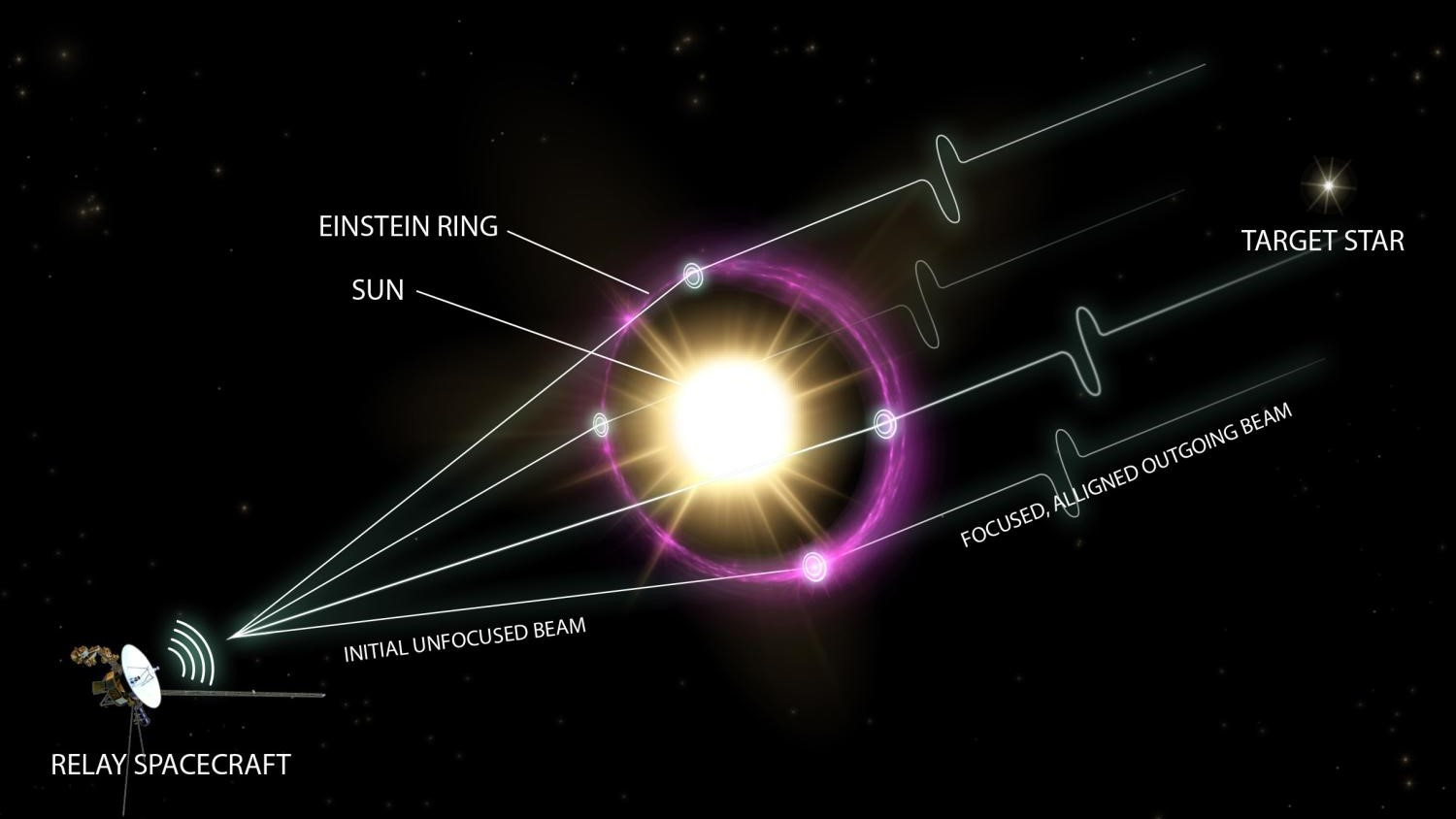
The foundation of using the Sun as a telescope lies in Einstein’s general relativity theory. Massive celestial bodies like stars warp spacetime, causing the path of light passing near them to bend. This effect, termed gravitational lensing, has been recorded when galaxies or black holes amplify the light of objects far behind them. To exploit the Sun as a lens, a spacecraft would need to be situated along a certain focal line, a region in space where light from distant sources is naturally intensified.

This magnification could enable astronomers to study cosmic features with unprecedented clarity. According to Von Russel Eshleman, the concept was initially introduced in a 1979 scientific article. He observed that:
“The gravitational field of the Sun acts as a spherical lens to magnify the intensity of radiation from a distant source along a semi-infinite focal line,” he noted. “A spacecraft anywhere on that line in principle could observe, eavesdrop, and communicate over interstellar distances, using equipment comparable in size and power with what is now used for interplanetary distances.”
He further estimated that the Sun’s gravitational lens could boost radiation at a wavelength of one millimeter by a factor of up to 100 million.
Overcoming the Vast Distances to Reach the Focal Zone
Although the theory is groundbreaking, positioning a spacecraft at the Sun’s gravitational focal line demands traveling to about 650 AU, significantly beyond Pluto’s orbit. This poses a tremendous challenge: Voyager 1, the farthest spacecraft to date, is just under 170 AU from the Sun after nearly five decades of flight. Maintaining this pace means journeying to the gravitational focus would require centuries.
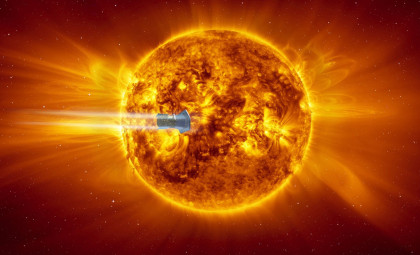
NASA experts, including Slava G. Turyshev, are exploring innovative propulsion methods to shorten travel time. Conventional chemical rockets lack the power for this expedition. Instead, research is focusing on solar sails and nuclear electric propulsion (NEP).
Solar sails harness solar radiation pressure to push spacecraft and could reach the target distance in 25 to 40 years, though payload capacity is limited. Nuclear electric propulsion, generating thrust via nuclear-powered electricity, promises heavier payloads and transit times under 20 years. However, NEP technology remains in early phases, demanding substantial advancements before these missions can proceed.
- Categories:
- Nasa






0 comments
Sign in to Comment