
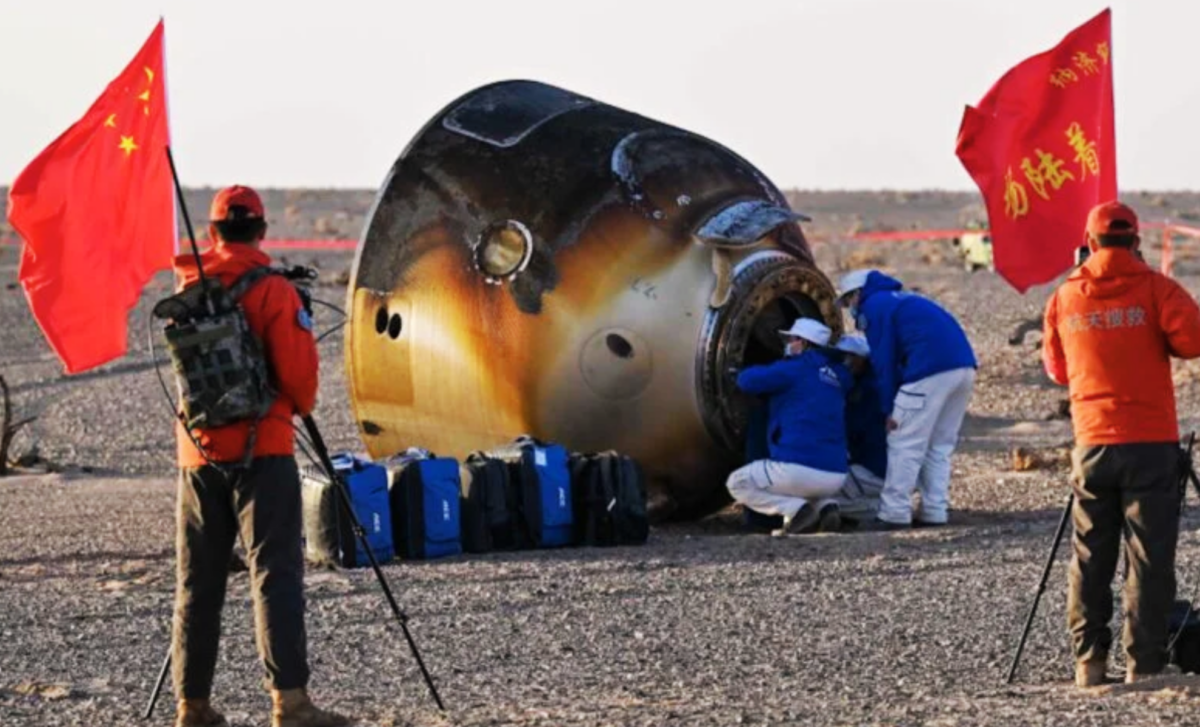
In November 2025, astronauts on China's Tiangong space station uncovered distressing damage that could have compromised their mission. Early official reports implied that the harm to the spacecraft’s window was minor, likely from debris in orbit. However, later information revealed that the cracks were significantly more extensive, raising serious concerns. This led to postponing the crew’s return and dispatching a replacement vehicle to guarantee their safety.
Disturbing Findings
During routine inspections, the Shenzhou-20 crew encountered an alarming sight. According to Space.com, mission leader Chen Dong shared his initial reaction:
“I spotted something like a triangular on the viewport,” he said. Upon closer inspection, Chen initially thought a small object, such as a leaf, might have stuck to the outside of the window. But the reality quickly set in. “My first thought was whether a small leaf had somehow stuck to the outside of the window,” Chen said. “But then I quickly realized that couldn’t happen because we were in space. How could there possibly be a fallen leaf there?”
Add Cosmo Herald as a Preferred Source

Further analysis showed the cracks weren’t superficial; they actually penetrated through the spacecraft window, exposing it to hazards from space debris. Using precision instruments, astronauts confirmed the damage demanded urgent attention. The team’s detailed evaluation of the spacecraft’s condition was critical to deciding whether a safe return to Earth was possible.
Crew’s Composure Amid Crisis
Despite the troubling discovery, the astronauts remained composed and practical. Aerospace technician Wang Jie expressed assurance about their safety.
“I wasn’t really nervous, actually,” Wang explained. “The outermost layer of the viewport is a protective layer, and inside it there are two pressure-bearing layers, and we are safe as long as the cabin pressure doesn’t change.”
This understanding of the spacecraft’s construction, combined with support from mission control, gave the crew confidence in managing the situation.
Wang added, highlighting their ground team's expertise:
“I also know well about our ground team that no matter what happens, they will go through analysis and experiments to determine whether we can return safely,” he said. “So I wasn’t too worried.”
The crew’s calm highlighted the challenges inherent in space operations, especially with unexpected threats like debris. Their trust in their training and ground support played a vital role in navigating the emergency.
The crew of China's Shenzhou-20 mission shared details of how they detected and responded to a suspected window crack struck by space debris on their return capsule, which has inspired many with the courages and composure of the astronauts in coping with space emergency.… pic.twitter.com/hOosK3mMCD
— CCTV+ (@CCTV_Plus) February 17, 2026
Rapid Response and Innovative Fixes
The China National Space Administration (CNSA) reacted promptly by launching an uncrewed emergency capsule to bring the astronauts home securely. To protect the Shenzhou-20 spacecraft during re-entry, engineers equipped it with a custom “porthole crack repair device” installed by the crew. This device strengthened the window’s sealing and heat resistance, allowing a safe return despite the damage. This quick innovation demonstrated CNSA’s problem-solving ability under pressure.
However, another challenge emerged during landing. With no astronaut present to manually release the parachute, the main chute failed to detach automatically, risking the capsule being dragged by strong winds. Xu Peng, commander at the Dongfeng Landing Site, explained:
“As a result, the main parachute did not automatically detach upon landing, and in strong winds, it could have dragged the return capsule along the ground.”
The ground team promptly arrived at the site and cut the parachute to prevent further issues, ensuring a secure landing for the spacecraft.
- Categories:
- News









0 comments
Sign in to Comment