
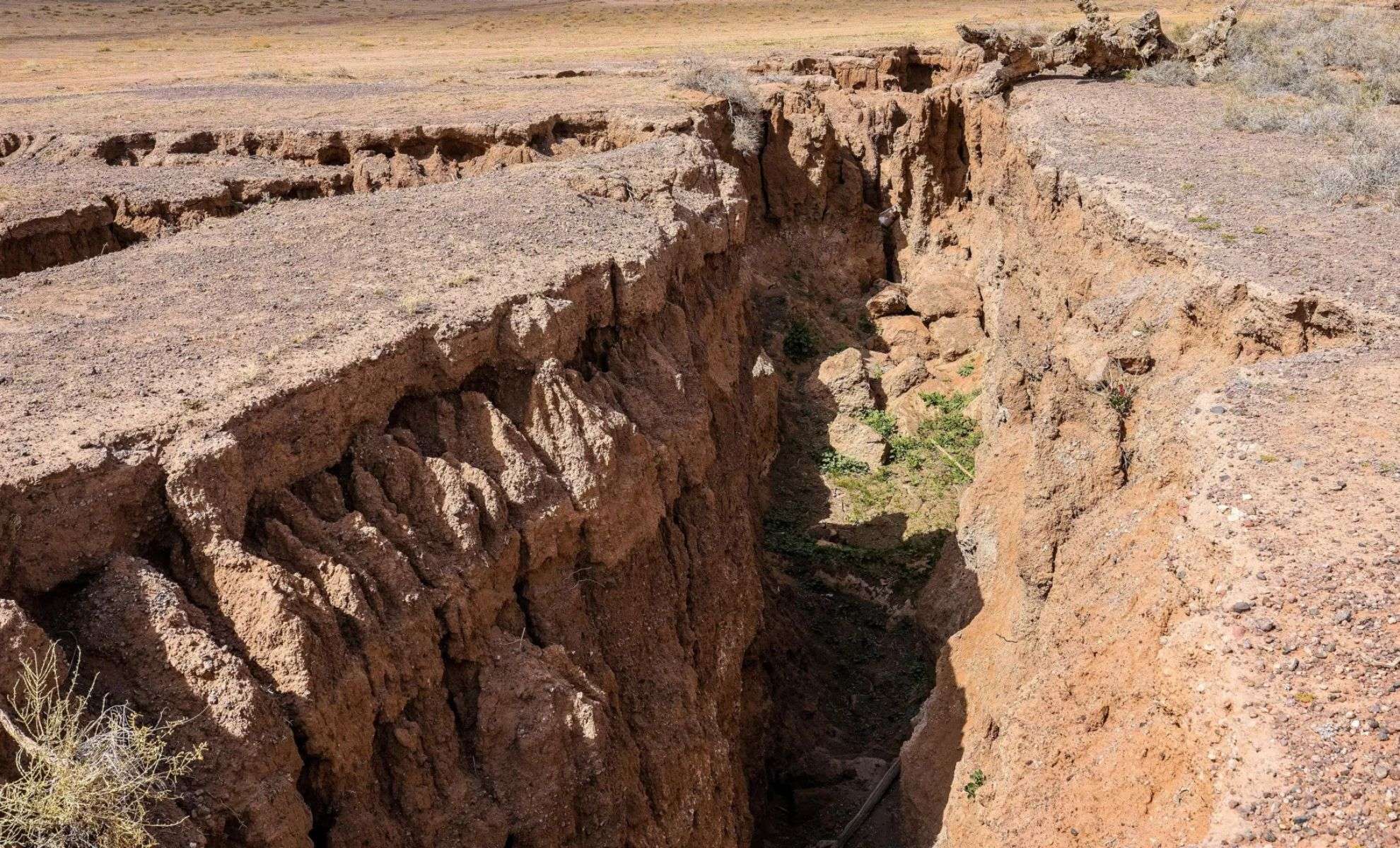
On March 28, 2025, central Myanmar experienced a powerful 7.7 magnitude earthquake near the Sagaing Fault, marking one of the strongest seismic events the area has seen in more than a century. The quake originated close to Mandalay, the country’s second-largest city, and became the second most fatal earthquake in Myanmar's recent history.
Live footage captures fault slip acceleration
During the quake, a CCTV camera recorded the fault’s movement as it happened, providing an extraordinary chance for scientists to examine fault dynamics with unprecedented clarity. Researchers from Kyoto University employed pixel cross-correlation techniques to analyze the video frame-by-frame.
Their work uncovered that the fault shifted 2.5 meters within a mere 1.3 seconds, reaching peak velocities of up to 3.2 meters per second. This rapid displacement confirmed a pulse-like rupture, whereby the fault slip occurred abruptly and intensely, comparable to a ripple passing through a rug when flicked.
Groundbreaking insights into earthquake mechanics
This landmark observation offered fresh perspectives on how earthquakes unfold. Although earlier models proposed that faults could rupture in concentrated bursts, these were mostly inferred from distant seismic data. The newly obtained video evidence provided detailed direct observations.

Lead researcher Jesse Kearse explained in the published paper, “The short-lived motion points to a pulse-like rupture, where slip concentrates into a sharp burst moving along the fault, much like a ripple traveling across a rug flicked at one edge.”
Fault displacement follows a curved trajectory
An unexpected observation from the footage was the fault’s slip path, which curved rather than running in a straight line. This finding echoes previous studies of fault zones worldwide and indicates that fault movement may generally involve curved patterns, challenging the conventional assumption of linear displacement.
This insight introduces new questions and possibilities for understanding how faults operate during seismic events.
Advancing seismology with video-based observation
The study highlights the transformative potential of video monitoring to revolutionize earthquake research. Real-time, high-detail recordings allow scientists to observe fault dynamics more precisely than traditional seismic tools permit. This approach promises to deepen our grasp of earthquake mechanics and improve predictions, ultimately aiding in earthquake preparedness and mitigating risks in seismically vulnerable areas.
Kearse emphasized, “We didn’t expect this video evidence would offer such diverse, detailed observations. Accurate kinematic data like this is vital for progressing our understanding of earthquake source physics.”
- Categories:
- News









0 comments
Sign in to Comment