
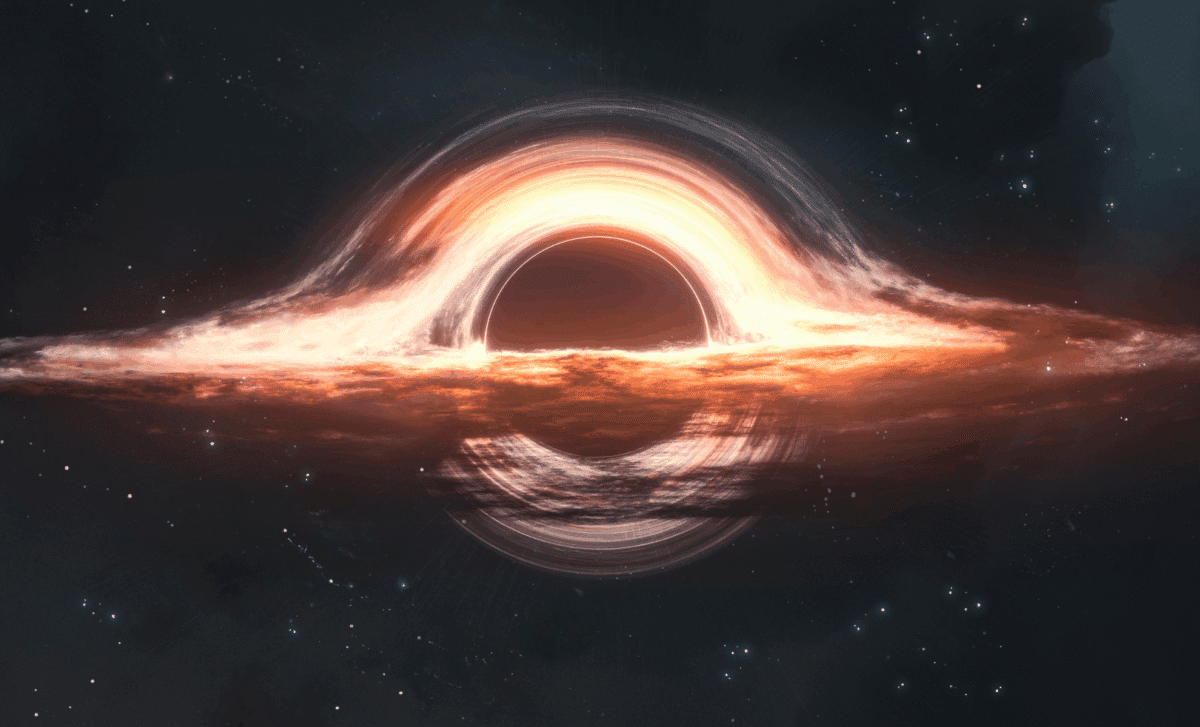
Located about 650 million light-years from Earth, a newly observed black hole challenges established astrophysical theories by exhibiting unusual behavior. While tidal disruption events (TDEs)—where stars are ripped apart by black holes—have been studied for decades, this particular incident displayed unforeseen delayed bursts of powerful radio waves. Such findings compel scientists to revisit current black hole models and their dynamic roles within distant galaxies.
An Uncommon Black Hole Discovery
Tidal disruption events (TDEs) have captivated astronomers due to the extreme forces involved when a star ventures too close to a black hole, resulting in its destruction and the formation of a swirling debris disk. These violent occurrences emit intense energy detectable across great distances. Yet the TDE named AT 2024tvd, observed in early 2024, defies expectations since it erupted 2,600 light-years from the center of its galaxy, far from the usual crowded galactic core where such events typically take place.
Astronomers initially detected AT 2024tvd using the Zwicky Transient Facility at Palomar Observatory. Continued monitoring with radio telescopes uncovered enigmatic delayed high-energy radio bursts appearing months after the initial star's demise. This stray black hole’s activity diverges notably from conventional TDE patterns.

“Never before have we seen such bright radio emission from a black hole tearing apart a star, away from a galaxy’s center, and evolving this fast,” says Itai Sfaradi, a leading astrophysicist from the University of California, Berkeley.
The Enigma of Late-Arriving Radio Bursts
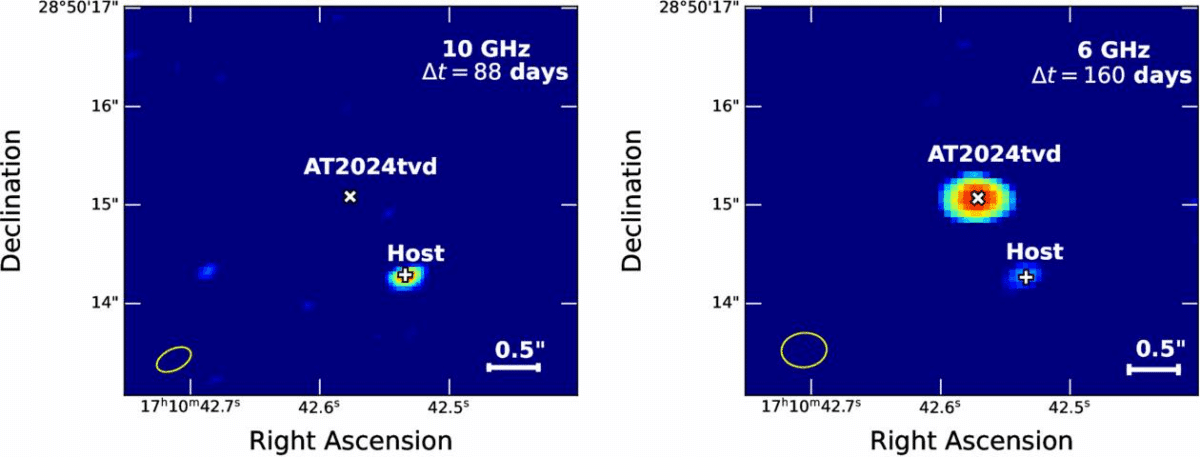
The intriguing aspect of AT 2024tvd is its two separate radio flares emerging long after the initial star disruption. Normally, radio signals from TDEs occur promptly as stellar debris interacts with surrounding matter. Here, the first burst surfaced roughly 80 days post-event, followed by a second, even stronger flare after 194 days. These delayed and intensified radio emissions hint at a novel mechanism driving the black hole’s response.
Although the exact process behind the postponed radio flares remains unclear, Sfaradi's team proposes that the black hole’s magnetic fields could be influencing how the stellar material behaves. The initial flare coincided with X-ray detections, indicating the possibility that material accreted onto the black hole was then expelled via magnetically powered outflows. This magnetic interaction scenario, while known, has never before been linked to such temporally delayed TDE emissions.
Could This Be an Intermediate-Mass Rogue Black Hole?
A further unexpected element of AT 2024tvd lies in the black hole’s mass and location. Instead of residing at the galactic center like most supermassive black holes, it is situated far outwards, suggesting it may belong to the lighter category of intermediate-mass black holes, estimated between 1,000 to 100,000 solar masses.
This idea stems from theoretical models where intermediate-mass black holes can be gravitationally ejected from galactic cores during complex interactions. The team led by Sfaradi and Raffaella Margutti hypothesizes this black hole might have been expelled during a triple-black-hole encounter, or that it originated as a central black hole from a smaller galaxy later absorbed by a larger one. In either case, this displaced black hole now roams its host galaxy, capable of disrupting stars it encounters and expanding our understanding of black hole dynamics beyond galactic centers.
Challenging Established Black Hole Paradigms
Traditionally, black holes were regarded as cosmic phenomena with relatively predictable behaviors regarding tidal disruptions. Yet the AT 2024tvd episode demonstrates that black holes can operate under less familiar and more complex conditions. “This is truly extraordinary,” remarks Sfaradi, highlighting how the event’s timing, distinct location, and unusual radio flare characteristics call for a reassessment of black hole models.
These findings, detailed in The Astrophysical Journal Letters, mark a pivotal advancement in black hole astrophysics. For years, the consensus regarded black holes as gravitational entities that follow predictable TDE patterns. However, AT 2024tvd compels the scientific community to reconsider the fundamental processes shaping black hole behavior and their cosmic roles.
“It changes how we think about black holes and their behavior,” said Sfaradi, underlining the importance of these unexpected discoveries.
Ongoing observations from global telescopes will continue to unravel AT 2024tvd’s mysteries, potentially transforming our comprehension of black holes and the galaxies they inhabit.
- Categories:
- News








0 comments
Sign in to Comment