
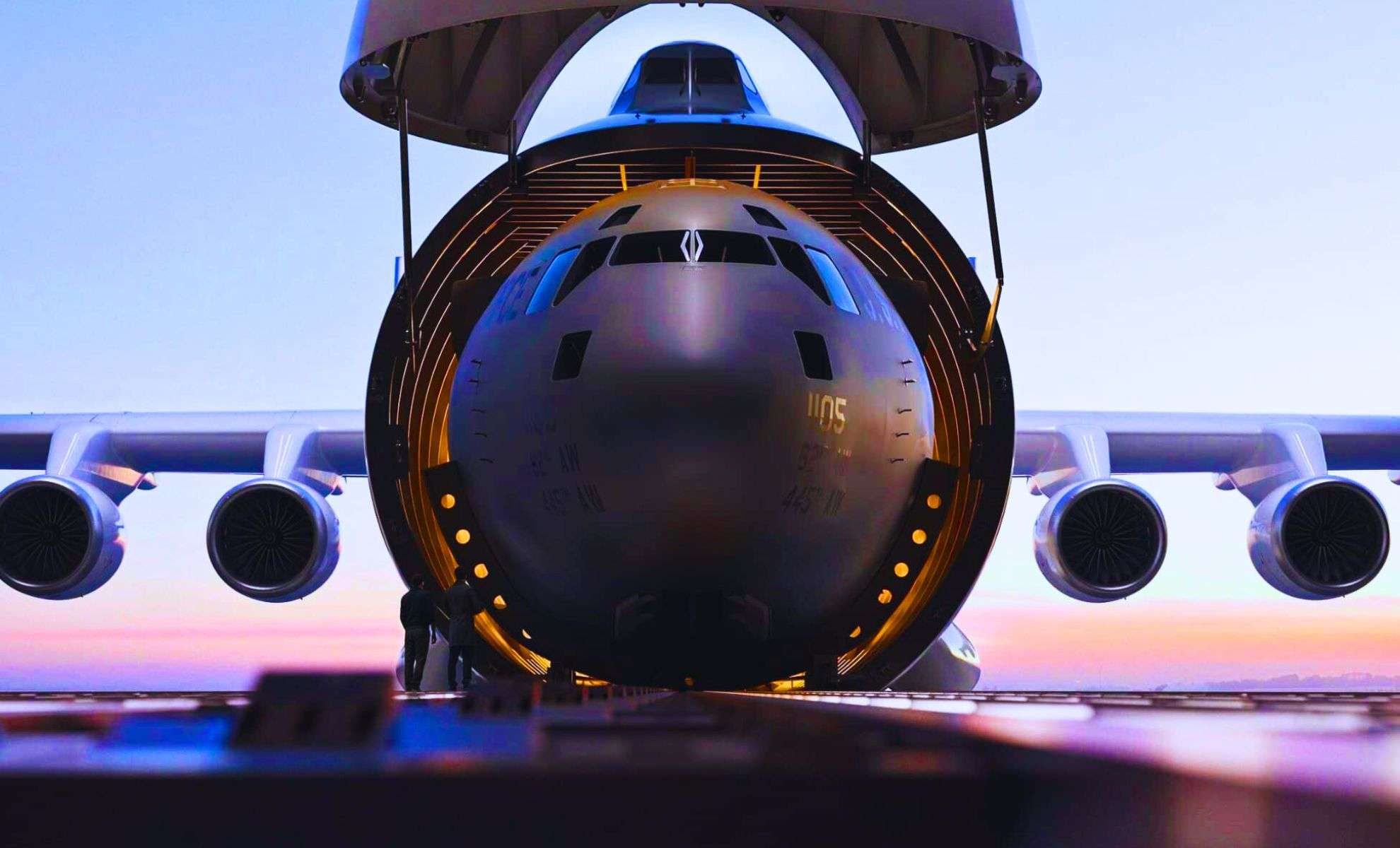
As global tensions escalate and military supply lines extend across vast and challenging terrains, the longstanding challenge of swiftly transporting fully operational systems to remote or infrastructure-poor regions has gained renewed significance.
The aerospace company Radia has introduced the WindRunner, a groundbreaking cargo aircraft unveiled at the 2025 Air, Space & Cyber Conference. Unlike traditional airlifters that emphasize payload mass, WindRunner is engineered primarily around volume, focusing on delivering entire mission-ready platforms in a single flight.
Specifically Engineered for Transporting Complete Systems
While aircraft such as the C-5 Galaxy and Antonov An-124 were designed to move heavy armored vehicles, WindRunner redefines priorities by maximizing interior cargo space rather than weight capacity. Offering an immense 6,800 cubic meters of space — approximately seven times larger than that of the C-5 — it can carry up to 12 AH-64 Apache helicopters, six CH-47 Chinook helicopters, or four F-35C fighter jets without the need for disassembly.

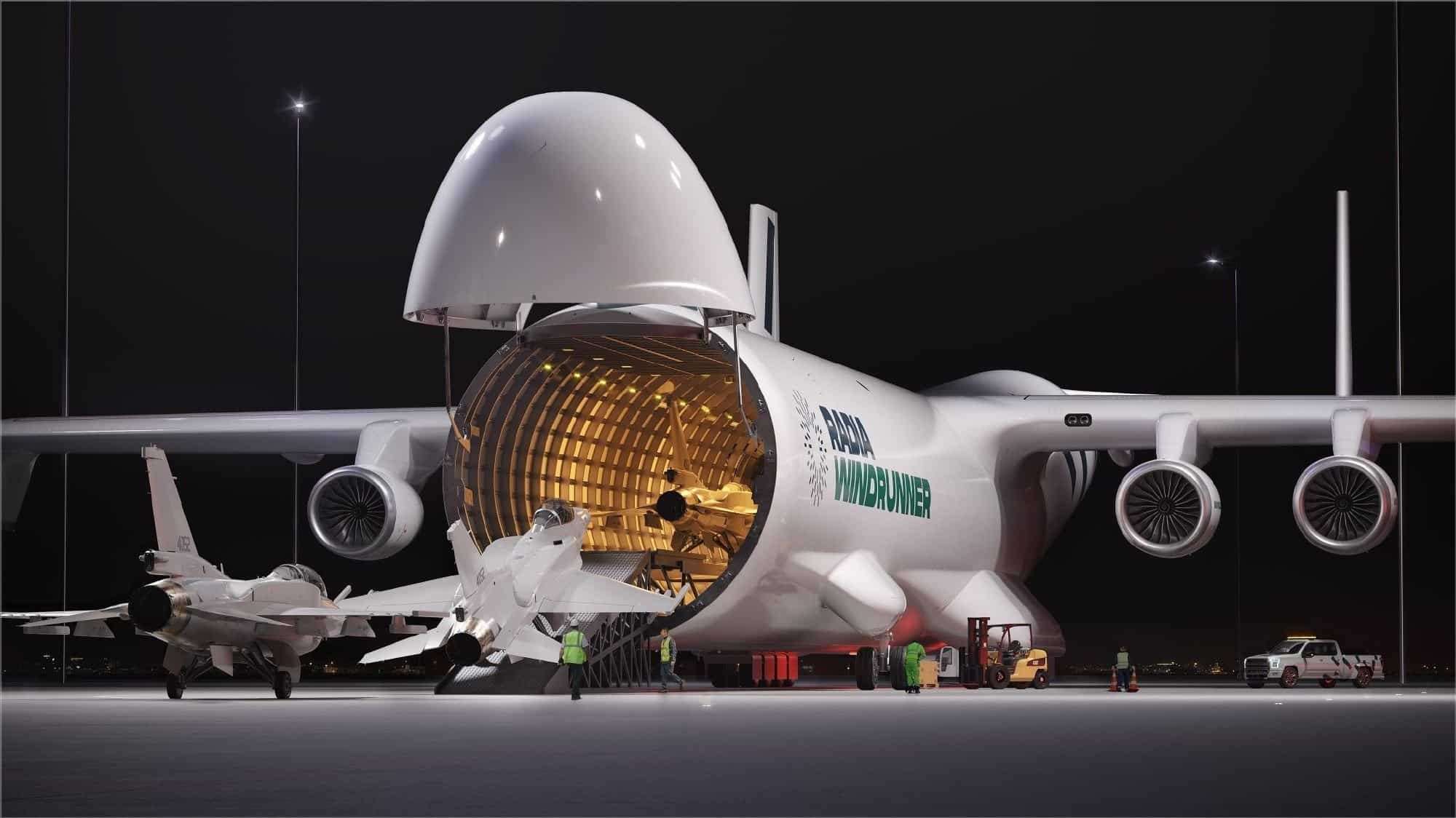
A standout feature of WindRunner is its capability to operate from short, unprepared runways as brief as 1,800 meters, granting access to locations typically unreachable by aircraft of comparable size. This aligns closely with the U.S. military’s Agile Combat Employment (ACE) doctrine, which emphasizes fast, flexible deployment across dispersed, hard-to-target bases requiring minimal logistical support.
A 2023 RAND Corporation study identified the intact transport of outsized equipment as a major obstacle in future warfare scenarios — a challenge WindRunner aims to overcome.
Simplifying Deployment Without Disassembly
Traditional military transport often involves dismantling helicopters and other vehicles into components to fit inside cargo holds, a method that prolongs deployment and risks equipment damage. WindRunner’s architecture sidesteps this issue entirely.
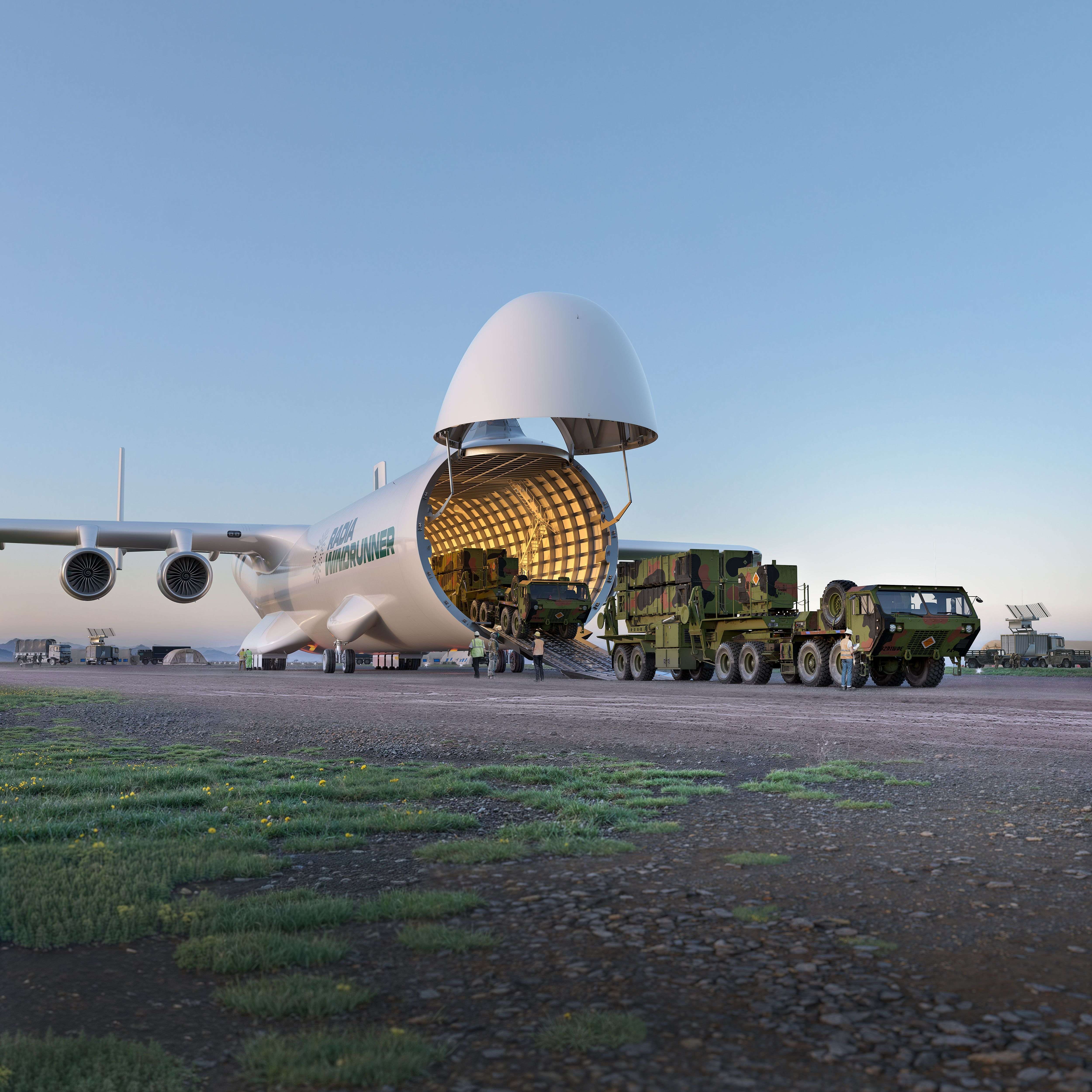
Adopting a roll-on, roll-off loading system, the aircraft streamlines ground operations and minimizes the need for extensive ground crew. This ensures delivered equipment arrives fully assembled, mission-ready, and operational immediately — an advantage not only in combat but also during disaster relief efforts where infrastructure has been compromised.
Radia is also exploring WindRunner’s role in space logistical support, including rapid transport of rocket stages and return vehicles. As commercial and military spaceflight activities expand, this capability could fill critical gaps unaddressed by current fleets.
Complementing Existing Airlift Fleets
WindRunner is being positioned not as a replacement for proven transports like the C-17 Globemaster III or C-130J Super Hercules, but as a complementary asset that handles volume-intensive cargo missions, allowing other aircraft to focus on quicker, more flexible tasks.
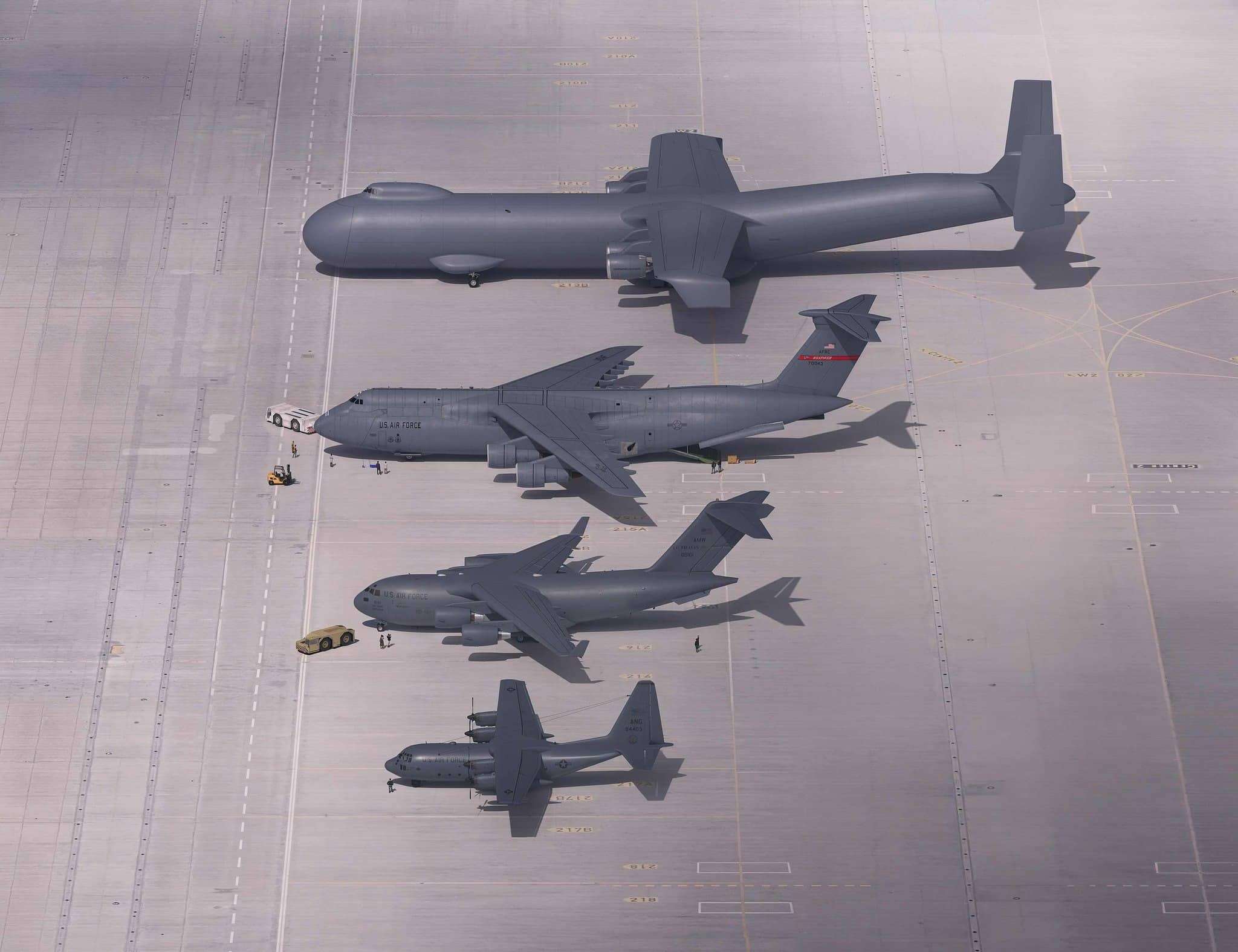
This strategic approach addresses a growing need amid an aging global airlift fleet: Most key transport models like the C-5M Super Galaxy and the Antonov An-124 are decades old, while China’s Y-20 Kunpeng — currently their largest military cargo plane — offers far less cargo space than WindRunner.
A 2021 GAO report has pointed out significant air mobility capacity gaps for the U.S., especially during contested or degraded operational conditions. As geopolitical pressures intensify in Eastern Europe and the Indo-Pacific region, the demand for adaptable airlift capabilities becomes a key national security concern.
Development Progress and Future Prospects
Radia is aiming for WindRunner’s inaugural flight in 2030, leveraging certified commercial components and a market-driven development strategy to accelerate progress. The program enjoys support from multiple aerospace partners and ongoing collaborations with the U.S. Department of Defense.
Despite this momentum, no formal procurement contracts exist yet. Military decision-makers may proceed cautiously due to the aircraft’s innovative emphasis on spatial capacity over traditional weight metrics. Ultimately, widespread adoption may depend more on doctrinal shifts than purely technical merits.
Dr. Ian MacLaren, a senior analyst at the Royal United Services Institute, acknowledges the aircraft’s potential and the challenges ahead: “This effectively addresses a critical logistical gap, particularly for deployments in the Indo-Pacific. However, procurement processes are inherently slow, and understanding new aircraft types requires time before trust is established.”
Driven by robust data, WindRunner embodies the emerging concept of volume-optimized air mobility tailored to complex, uncertain operational environments. Its future influence will rely not only on proving reliability but also on the defense sector’s readiness to rethink strategic airlift altogether.
- Categories:
- News






0 comments
Sign in to Comment