
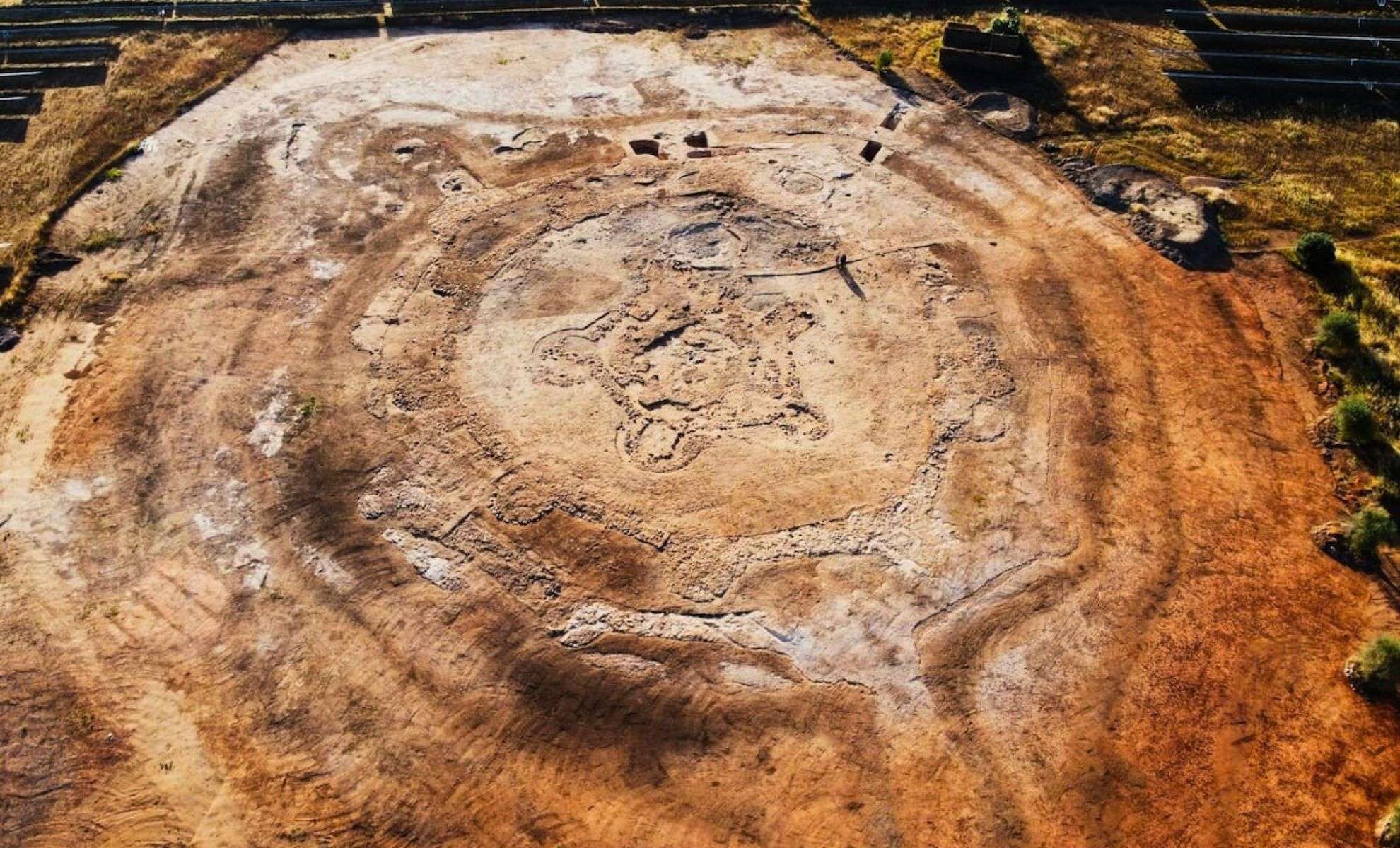
During the development of a solar energy facility in Almendralejo, Spain, construction crews stumbled upon an extraordinary archaeological site dating back 5,000 years. Since its discovery in 2021, experts have been carefully excavating what has turned out to be an impressive Chalcolithic fortress revealing evidence of warfare, destruction, and a peculiar burial from Roman times.
An Ancient Stronghold from the Copper Age
This remarkable find emerged amid the building of a solar power plant managed by Acciona Energia. Following the identification of archaeological remains, a team of archaeologists was brought in to explore the site.
They uncovered the remains of a 140,000-square-foot fortress atop a hill, constructed using stone and adobe walls, encircled by three deep defensive ditches measuring over six feet in depth, and featuring a narrow 27-inch-wide gateway, as detailed in a report by El Pais.

Named Cortijo Lobato, this pentagonal fortress was fortified with three concentric walls and 25 towers, showcasing sophisticated defensive architecture for that era. Despite its formidable design, it met a violent end when invaders breached its defenses and razed the structure.
Evidence of Deliberate Destruction by Fire
The fortress’s downfall is marked by severe fire damage, which archaeologists interpret as intentional destruction. César Pérez, the lead researcher, noted that although wooden doors embedded in the adobe walls were scorched, adjacent materials were too distant to have ignited the blaze naturally.
This indicates that the fire was likely set on purpose during a hostile attack. Pérez stated, “the settlement was assaulted, defenses overwhelmed, and the entire complex set on fire.”
These findings challenge earlier assumptions about the Copper Age (Chalcolithic period), pointing to more frequent instances of organized violence and territorial disputes than previously recognized.
Purpose and Significance of Cortijo Lobato
Researchers believe the fortress served a critical role within a broader community network. Alicia Lizarraga, the environmental manager at Acciona Energia, remarked that fortifications like this were essential for protection against both predators and rival human groups.
Pérez added that the fortress’s impressive construction and intricate defenses imply the presence of a well-coordinated society capable of mobilizing substantial labor resources.
The combination of moat-like ditches with fortified walls was exceptional for the Chalcolithic era. According to Victoria Bazaga, the region’s culture minister, Cortijo Lobato is twice as large as any comparable fortress identified in Spain to date.
Radiocarbon dating of animal bones found in the ash layers established that the fortress met its demise around 2450 B.C.. Following this catastrophic event, the location lay abandoned for more than 2,700 years until activities resumed during the Late Roman Empire.
An Unsettling Burial from Roman Times
Subsequent digs revealed evidence of Roman-era occupation, but one find stood out: a strange grave by one of the defensive ditches. This shallow grave contained the remains of an adult male aged 25 to 35, who was buried face down. Intriguingly, his feet had been amputated, and a sheathed Roman dagger (pugio) was placed atop his back.
Pérez theorizes that the dagger symbolized the man’s military status, as the pugio was a common weapon among Roman legionnaires. The hurried and shallow nature of the burial suggests he was likely denied an honorable interment.
Links to the Legio VII Gemina Legion
During the period of this burial, only one Roman legion was stationed on the Iberian Peninsula: Legio VII Gemina, established in 74 A.D. with headquarters in present-day León, Spain. This legion primarily managed road security and regional control, raising questions about whether this individual died in combat or was subjected to internal disciplinary measures.
Additional Archaeological Sites in the Vicinity
The excavation of Cortijo Lobato is part of a broader survey across the region, in which scientists have documented 11 distinct locations reflecting diverse historical epochs:
- Six settlements dating from the late 4th millennium B.C. through the early 3rd millennium B.C. (Copper Age).
- Five sites spanning the Bronze Age, Iron Age, and Late Roman period.
These discoveries are reshaping our understanding of the area’s ancient cultures and revealing a far more turbulent past than previously appreciated.
- Categories:
- Science












0 comments
Sign in to Comment