
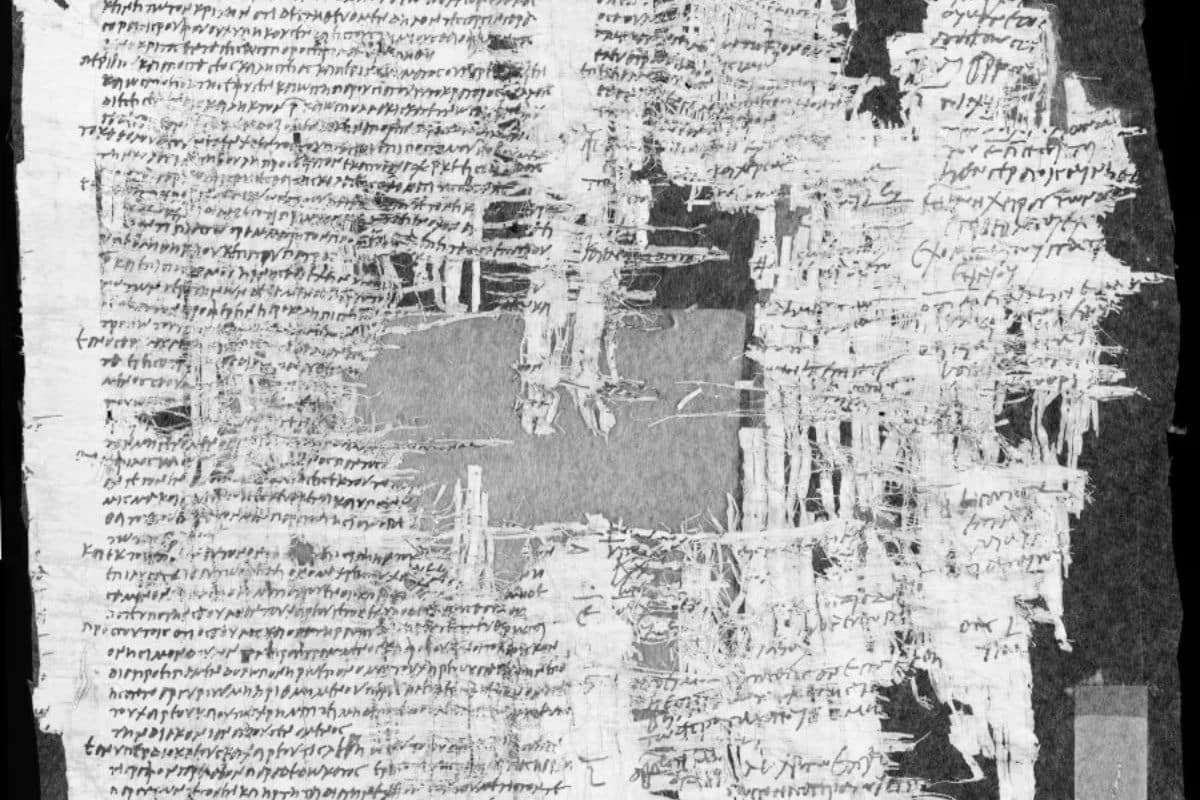
An extraordinary find in the Judean Desert has uncovered a tax evasion and forgery scandal dating back nearly two millennia. This ancient Greek papyrus offers historians an invaluable window into the courtroom practices of the Roman Empire, exposing a bold financial crime carried out just before the Bar Kokhba revolt.
Unearthing a Long-Lost Manuscript
The scroll, recognized as the longest Greek legal document ever discovered in the Judean Desert, was initially mistaken for a Nabataean text—originating from an ancient society located in northern Arabia and the Levant. For many years, it remained overlooked within the archives of the Israel Antiquities Authority.
The true significance of the document came to light in 2014, when Hannah Cotton Paltiel from the Hebrew University of Jerusalem identified it as a Roman court record. Collaborating with experts from the Austrian Academy of Sciences and the University of Vienna, they thoroughly studied the manuscript, later publishing their findings in Tyche.

Exposing a Complex Fraud Scheme in Roman Iudaea
The papyrus details an elaborate tax fraud orchestrated by two individuals named Gadalias and Saulos. Their scam involved fraudulent slave sales intended to evade tax payments. They employed fake documents to validate sham sales and manumissions, deceiving Roman tax officials.
Gadalias, noted to be the son of a notary, had a notorious reputation involving violence, extortion, counterfeiting, and even rebellious activity. His partner Saulos assisted in orchestrating these fraudulent transactions, masking the actual status of the slaves through a complex facade.
Besides outlining the financial fraud, the document offers a unique glimpse into Roman courtroom preparation, containing what appear to be prosecutors’ notes elaborating on case strategy and anticipating legal defenses.
An Ancient Legal Drama Brought to Light
Providing a rare and vivid perspective on judicial procedures in Roman provinces of Iudaea and Arabia—which roughly correspond to present-day Israel and Jordan—this scroll was likely written shortly before the outbreak of the Bar Kokhba revolt (132–136 CE), during the last years of Emperor Hadrian’s rule.
The prosecutorial notes reveal intense deliberations over evidence strength, procedural objections, and legal tactics, a depth of detail rarely preserved in ancient legal documents.
Anna Dolganov from the Austrian Academy of Sciences, co-author of the study, described the papyrus as “extraordinary because it provides direct insight into trial preparations in this part of the Roman Empire.”
The Most Complete Roman Court Document from Iudaea
This finding is celebrated as the most thoroughly documented Roman legal case from Iudaea, second only to the trial of Jesus. It allows historians to reconstruct not just the tax fraud crime but also the broader legal framework of that period.
Avner Ecker of the Hebrew University of Jerusalem, another author of the research, emphasized its significance by calling it “the best-documented Roman court case from Iudaea apart from the trial of Jesus.”
Historical Importance and Implications
Beyond its captivating narrative of ancient courtroom drama, this discovery enriches historical understanding. It challenges long-standing ideas about Roman administration, taxation policies, and judicial processes in the Near East.
The presence of detailed trial materials indicates that Roman authorities treated financial crimes with great gravity, particularly in unrest-prone provinces like Iudaea, where relations between rulers and locals were often strained.
This case also adds a human dimension to ancient criminal activity, showing how far individuals like Gadalias and Saulos would go to evade taxes—a theme that continues to resonate in modern times.
- Categories:
- News











0 comments
Sign in to Comment