
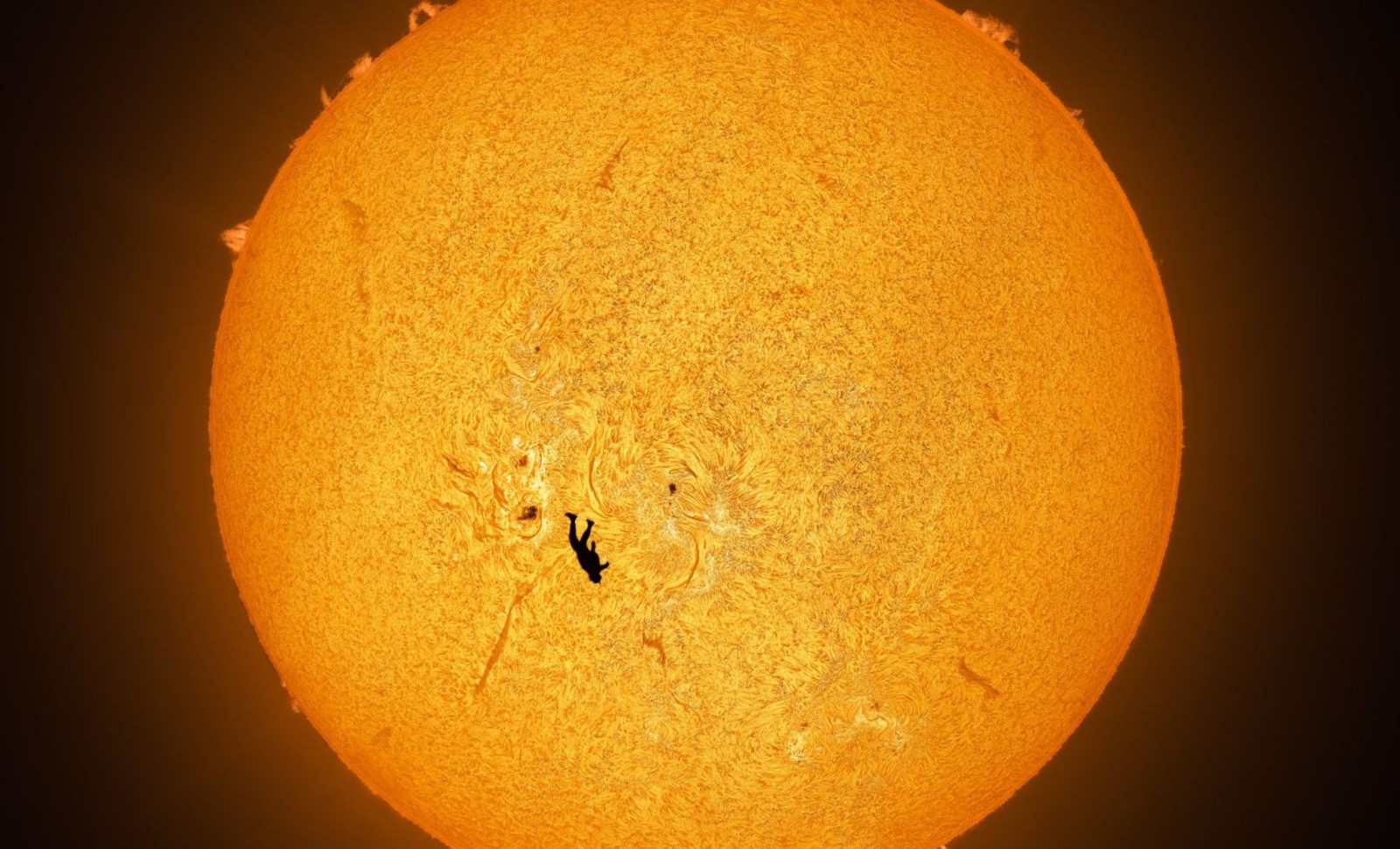
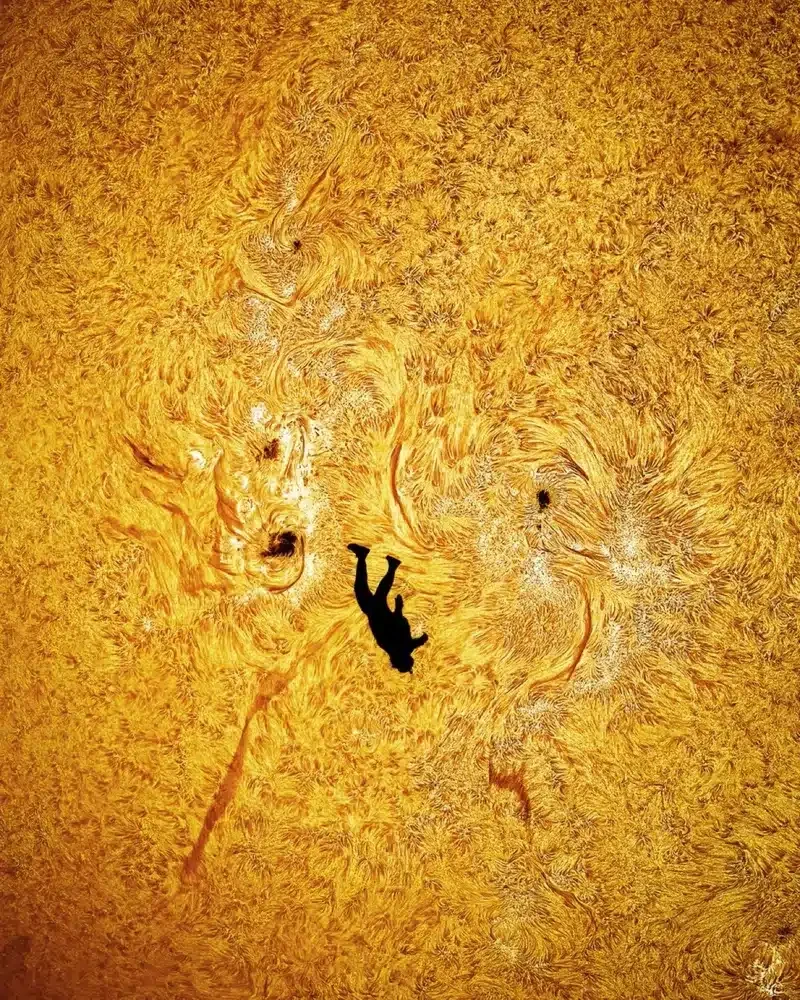
An extraordinary image showcases a skydiver in free fall, outlined in a sharp silhouette set against the vivid backdrop of the Sun’s blazing surface. This striking photograph, named The Descent of Icarus, emerged from a creative partnership between astrophotographer Andrew McCarthy and skydiver Gabriel C. Brown, and is authentically captured. The story behind this remarkable shot was initially shared by the science news platform IFLScience.
The photograph has captivated not only astrophotography enthusiasts but also a broader audience. Utilizing a hydrogen-alpha filter, the image reveals the Sun’s dynamic surface coupled with visible sunspots, perfectly framing Brown’s falling silhouette.
A Perfect Frame After Multiple Trials
This incredible shot demanded persistence. It took six jumps before McCarthy successfully captured Brown positioned between active sunspots on the solar disc. In a conversation with IFLScience, Andrew McCarthy explained the coordination involved, including multiple cameras and a live three-way communication among himself, the paramotor pilot, and Brown.

The execution, while conceptually straightforward, required exact timing. The pilot monitored his shadow during the aircraft’s ascent and maintained a precise flight trajectory while McCarthy guided from the ground. The jump was triggered only when Brown’s silhouette aligned perfectly. “This demanded strict timing and coordination,” McCarthy noted.
“It was a narrow field of view, so it took several attempts to line up the shot,” he added. “We only had one shot at the jump, as repacking the parachute safely would take too long for another.”
The challenge became clear during the first five jumps, marred by technical problems, as Brown recounted on Instagram. Nevertheless, the crew fine-tuned their approach with each attempt until total synchronization was achieved.
“You can see the excitement on my face in the videos,” McCarthy told Live Science. “Seeing it perfectly captured on my monitors was exhilarating.”
Understanding the Science of the Photograph
The striking picture was created using a hydrogen-alpha filter, capable of isolating a specific wavelength of light emitted by the Sun. This filter enables photographers to capture details of the Sun’s volatile hydrogen layer, including striking features like solar prominences and sunspots.
Although this filter is a staple in solar photography, rarely is it used to frame a human figure descending. The surface of the Sun in the image displays intricate granulation, highlighting the Sun’s textured plasma layer, which contrasts impressively with Brown’s dark outline. Sunspots visible here are magnetically active regions appearing as cooler, darker areas.
Redefining Creative Boundaries in Astrophotography
The Descent of Icarus could signify a fresh chapter in astrophotography, blending stunning cosmic imagery with human drama. Traditionally celebrated for its precision and celestial beauty, this domain is now embracing a more narrative, performance-oriented approach.
McCarthy shared that the concept evolved naturally after brainstorming with Brown to merge skydiving with astrophotography. This innovative angle treats the night sky as a dramatic stage instead of merely a subject to observe.
“Gabe and I met up to skydive a few months ago, and afterwards we had breakfast and were talking about how we could incorporate skydiving into astrophotography,” he said.
The image now enjoys widespread acclaim and is available as limited edition prints through McCarthy’s official website.
- Categories:
- News






0 comments
Sign in to Comment