
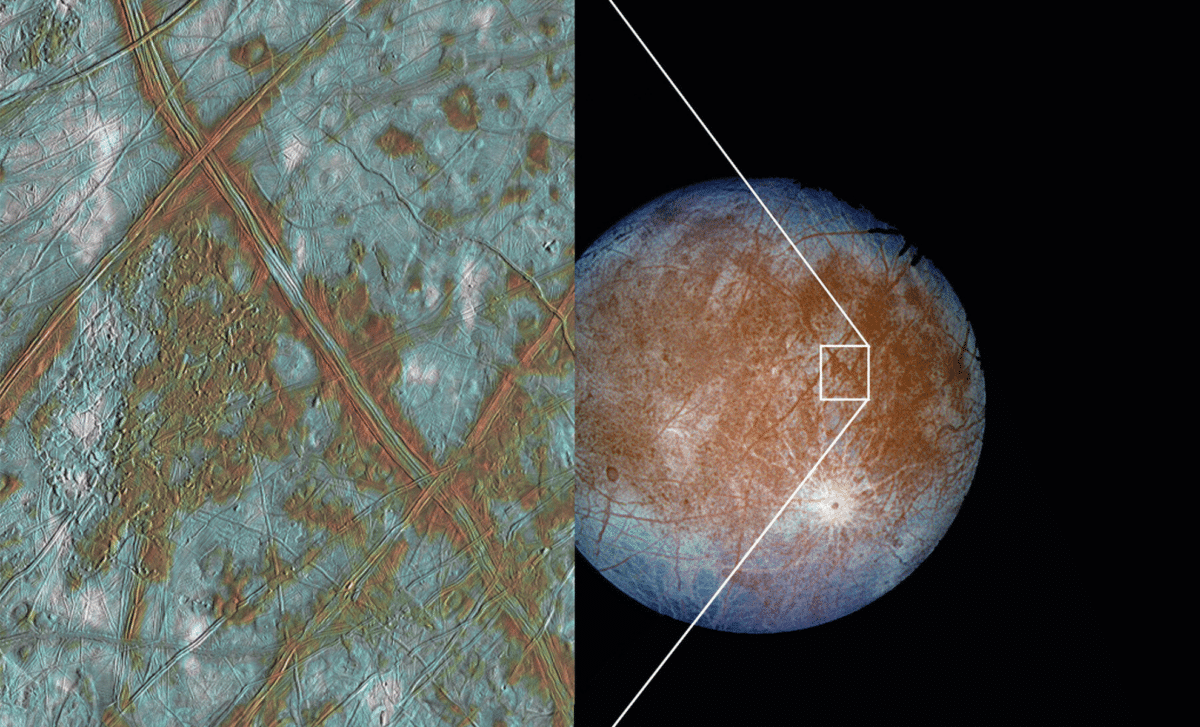
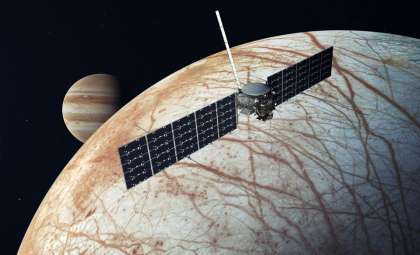
An extensive review of fourteen years’ worth of Hubble Space Telescope observations has raised uncertainties about earlier claims that Jupiter’s frozen moon Europa releases intermittent streams of water vapor. Published in Astronomy & Astrophysics, this new investigation suggests that previous evidence for these elusive plumes may have been overinterpreted, leaving the question open for further research.
Reevaluating Europa’s Faint Atmosphere
Europa has captivated scientists for nearly 15 years due to its icy exterior and possible underlying ocean. Initial observations from Hubble in 2012 indicated that the moon might sporadically emit subtle vapor plumes, fueling excitement over studying its ocean without surface landing. If verified, these emissions could provide crucial insights into Europa’s potential for supporting life.
“Our proof of water vapor plumes on Europa is not as conclusive as previously thought,” remarked SwRI’s Dr. Kurt Retherford, a contributor to the 2014 study that first announced the plume detections. Retherford and his team’s recent paper reexamines the dataset and offers a more measured interpretation of Europa’s sparse atmosphere.

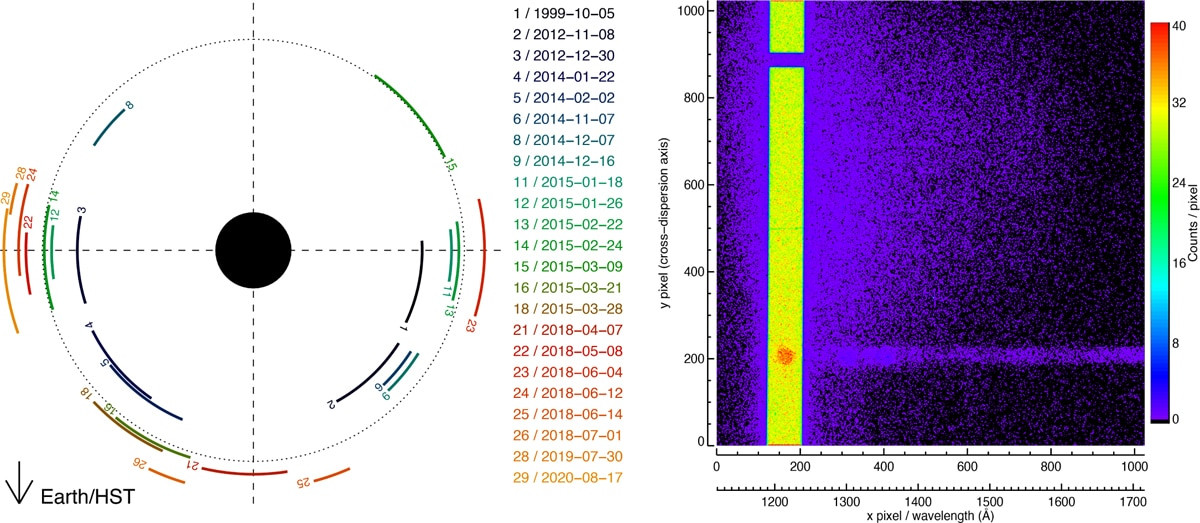
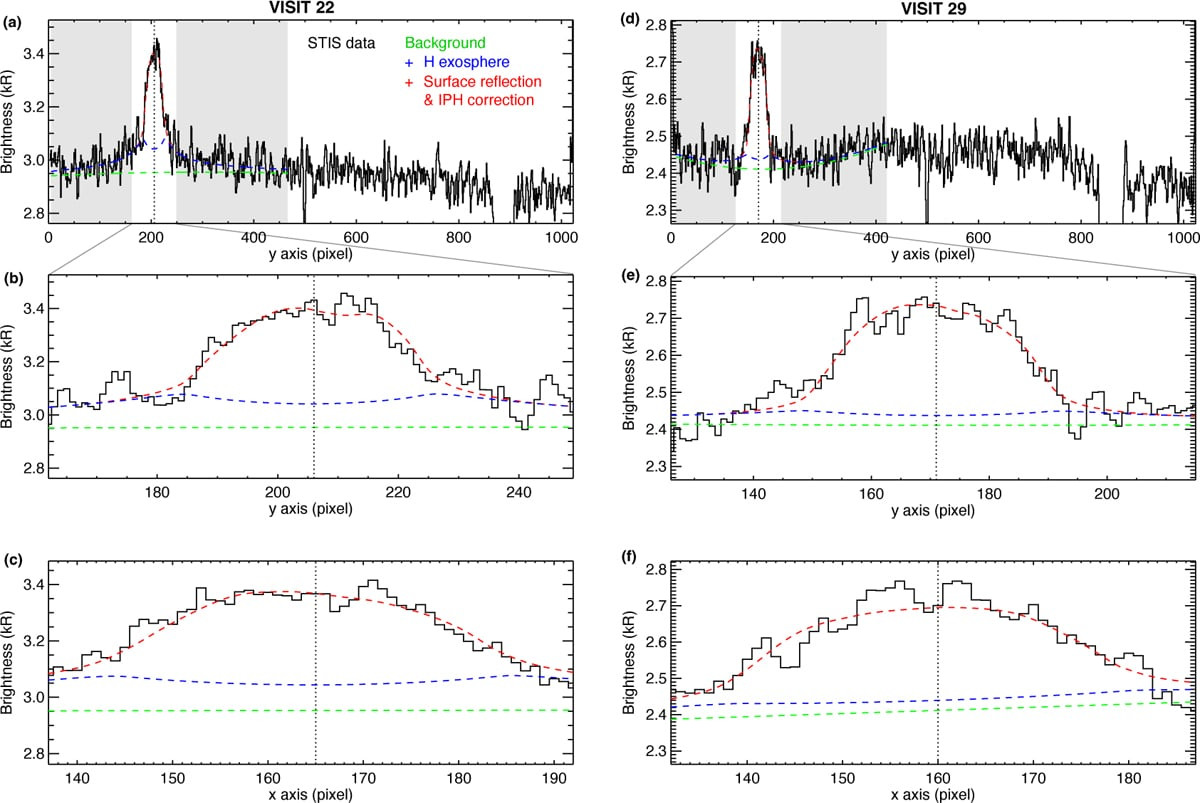
The investigation concentrated on Lyman-alpha radiation, ultraviolet light scattered by hydrogen atoms that can signify escaping water molecules. By refining Hubble’s spatial positioning and instrument calibration, the researchers identified uncertainties that may have skewed earlier data interpretations.
“One of the difficulties in interpreting the data back then was determining where to place Europa within its context,” Retherford explained. “The way Hubble works left some uncertainty in terms of placement relative to the center of the image. If Europa’s placement was off even by just a pixel or two, it could affect how the data gets interpreted.”
Lower Confidence Sparks New Questions
The initial research asserted a near-perfect 99.9% certainty that water vapor plumes were present. The recent evaluation, as published in Astronomy & Astrophysics, lowered this confidence to under 90%, a level deemed insufficient to claim firm proof.
“Our reanalysis took our original 99.9% confidence in the plumes’ existence and reduced it to less than 90% confidence,” said Dr. Lorenz Roth of the Royal Technical Institute, Sweden, and lead author of the reanalysis. “That’s simply not enough evidence to support the certainty of claims we made at the time.”
While the possibility of plume activity is not excluded, the findings highlight that previous interpretations may have been overly optimistic. Retherford added,
“The description of the phenomena just doesn’t hold up the same way anymore. The new data has made us reconsider the strength of the previous paper’s conclusion regarding water vapor plumes. The recent analysis also provides improved information about the neutral hydrogen atom component of Europa’s escaping atmosphere, originating from its water ice surface.”
Context From Icy Worlds with Confirmed Activity
Europa is one of several moons displaying possible geological phenomena. Saturn’s moon Enceladus has confirmed water vapor jets, while Jupiter’s Io releases sulfur dioxide gas. These examples provide comparative cases showing plumes may arise in differing chemical contexts.
Interest in Europa remains strong due to its expansive saltwater ocean concealed beneath ice. Cracks along the icy surface might offer a route for water escape, but definitive verification depends on direct measurements. NASA’s forthcoming Europa Clipper mission, aiming to reach the moon in 2030, promises critical data to resolve enduring mysteries about Europa’s atmosphere and potential plume activity.
- Categories:
- Space







0 comments
Sign in to Comment