

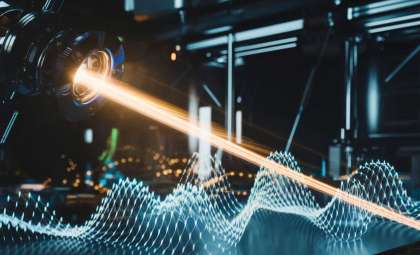
Scientists have successfully demonstrated the reversal of electromagnetic waves in time, confirming a hypothesis that has intrigued physicists for decades. This phenomenon, termed time reflection, enables waves to travel backward along their temporal path instead of through space.
The groundbreaking study, featured in Nature Physics, was led by Hady Moussa at the City University of New York’s Advanced Science Research Center (CUNY ASRC). Their work delivered the first consistent, verifiable observations of time-reflected waves.
This reversal is not a manipulation of time itself, but results from an abrupt alteration in the wave's surrounding environment. When these changes are precisely controlled, a segment of the wave reflects in time, recreating a reversed version of the original signal.

Engineering a Temporal Boundary
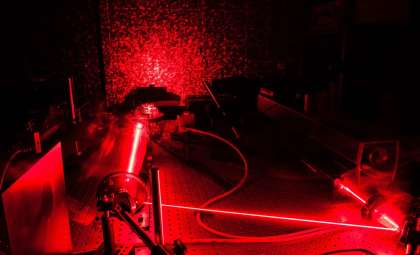
The researchers constructed a transmission-line metamaterial composed of a metallic strip integrated with fast electronic switches. These switches interfaced with capacitor arrays to enable rapid modulations in the material’s electromagnetic characteristics.
At a carefully chosen instant, the team induced a swift doubling of the material's impedance, which measures resistance against electrical current. This event generated what is called a temporal boundary. Upon encountering this sudden change, a portion of the wave reversed direction through time.
Unlike conventional mirrors that reflect waves spatially, this process is driven by a controlled temporal variation in the medium’s properties rather than physical reflection off a surface.
The published research highlights the critical role of synchronized switching across the metamaterial to establish a uniform temporal interface. A complementary summary on Earth.com describes how the implementation relies on programmable circuitry to deliver the precise energy burst necessary, proving that accessible technology can reproduce this effect.
Validating a Long-Standing Prediction
The concept of time reflection has been a theoretical fixture in physics for over fifty years. Previous models predicted that a wave encountering a sudden medium change could reverse in time, yet experimental proof remained elusive.
The foremost challenge involved generating an abrupt, uniform temporal change to produce clean wave reflections. The CUNY team overcame this by precisely coordinating the switches, enabling reproducible conditions for time reversal to manifest.
Besides reversing in time, the setup also enabled frequency translation, shifting signals to different spectral regions. Such a capability offers promising advances in spectrum engineering, adaptive filtering, and specialized frequency-selective devices.
The results build upon theoretical research on time-variant photonic materials and concepts related to spacetime metamaterials, providing the first solid experimental foundation in the electromagnetic realm.
Unlocking New Horizons in Temporal Wave Manipulation
Current investigations focus on practical uses of time reflection, including the idea of temporal cavities, which trap waves between two time boundaries, producing unique temporal interferences.
Potential adaptations also include controlling other wave modalities like acoustic, mechanical, or spin-wave systems. Enhancing the precision of switching mechanisms remains key, particularly for higher-frequency applications.
This research is a collaboration involving the CUNY Graduate Center and the Advanced Science Research Center, institutions well-versed in photonics, circuit engineering, and wave physics. Their design utilizes compact, programmable hardware adaptable for diverse experimental frameworks.
This innovation also ties into ongoing developments in dynamic photonic devices that harness mutable material properties to regulate energy and signals in real time, promising impacts across quantum and optical technology sectors.
Demonstrating Wave Reversal Without Altering Time’s Flow
The study does not imply reversing the flow of time itself. Instead, the wave’s backward motion arises within the engineered medium while external time progresses normally. This breakthrough highlights how temporal modulation can direct wave propagation in novel ways.
This approach enriches the toolkit for controlling energy transport, enabling dynamic manipulation of waves, and building reconfigurable electromagnetic systems. Time reflection broadens the spectrum of wave behaviors that researchers can engineer.
Future efforts aim to refine temporal switching, enhance wave integrity, and explore layering temporal boundaries with spatial interfaces. Advancements in hardware will likely pave the way for new time-based computational and communication architectures.
- Categories:
- Science







0 comments
Sign in to Comment