
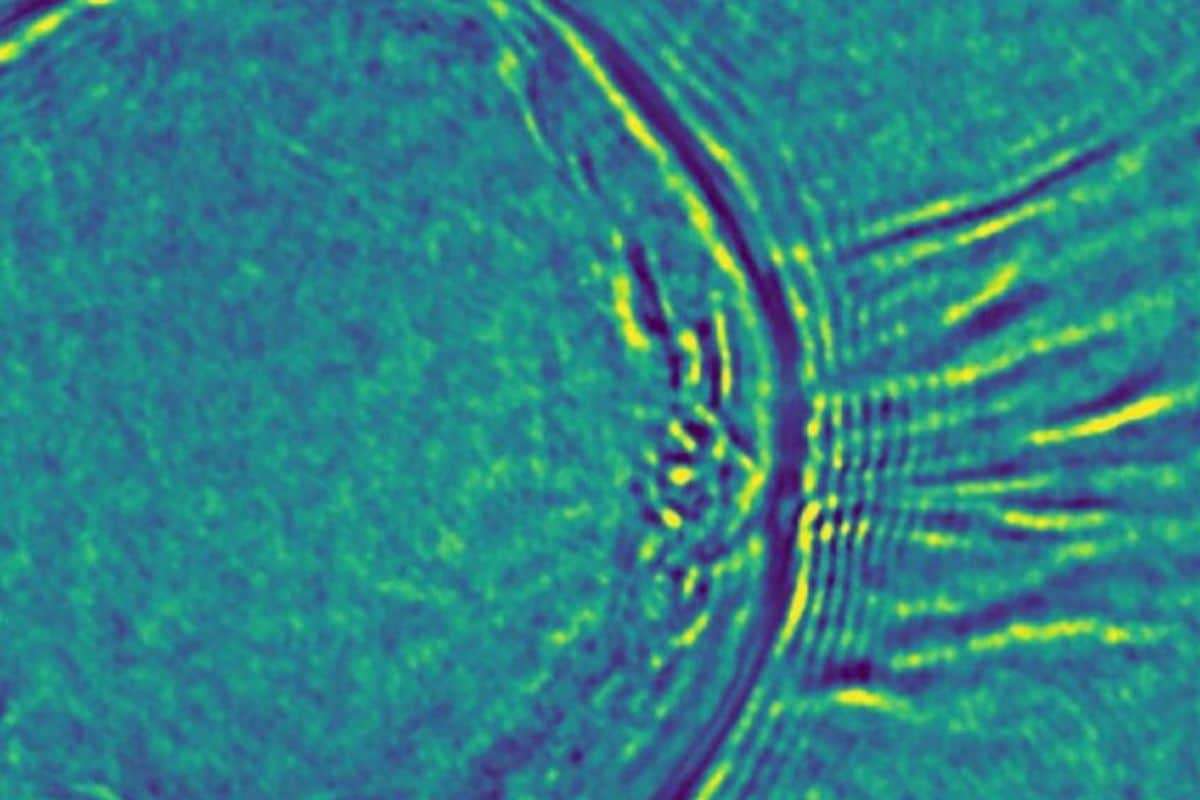
Researchers have, for the first time ever, managed to photograph a complex plasma phenomenon known as filamentation instability. This milestone could significantly impact innovations in plasma technology, especially concerning particle acceleration and nuclear fusion energy.
Understanding Plasma Filamentation Instability
Plasma, an extremely hot state of matter containing free ions and electrons, is characterized by its conductivity and interaction with magnetic fields. Disturbances within plasma can lead to instabilities that create zones where plasma behaves differently from its environment.
These disruptions often cause particles to gather into elongated, thread-like forms that resemble strands of spaghetti, known as filaments. Filamentation instability happens when energetic electron beams agitate the plasma, causing these slender structures to emerge.
Not only do these filaments create visually fascinating patterns, but they are also tied to a Weibel-type current instability, which induces self-strengthening magnetic fields that further disrupt the plasma state.

Landmark Experimental Discovery
This novel visualization was attained through combined efforts by teams from Imperial College London, Stony Brook University, and Brookhaven National Laboratory.
In a stable plasma, an electron beam passes through without major interference; however, the laser-induced instability triggered variations in electron densities within the plasma, leading to the formation of the characteristic filamentary patterns.
The Escalating Nature of Instability
Dr. Nicholas Dover of Imperial College London described the self-reinforcing cycle of the magnetic fields:
“The more magnetic fields you generate, the more the instability grows, and then the more magnetic field generates. It’s kind of like a snowball effect.”
This ever-growing instability presents significant hurdles for applications demanding plasma stability, particularly in fusion energy research, where precise plasma control is vital for sustained reactions.
Opening a New Frontier in Plasma Visualization
Although previous studies have inferred filamentation instability through indirect measurements, direct laboratory imaging of this process has never been achieved until now.
The breakthrough used a high-powered long-wave infrared laser to initiate the electron beam and instability, while a shorter-wavelength optical probe laser captured the intricate filament structures.
Cutting-edge Laser and Plasma Technologies
This success was enabled by technological advances since conventional lasers struggle with penetrating dense plasma, limiting visibility of internal formations.
Dr. Dover acknowledged the extraordinary clarity of the images, stating, "We were really amazed by how good the photographs were because with optical lasers, it’s really hard to take nice photographs of the plasma."
Future Prospects and Wider Impact
The findings have implications far beyond plasma physics. Professor Zulfikar Najmudin, Deputy Director at the John Adams Institute for Accelerator Science, highlighted potential breakthroughs in radiobiology and cancer radiotherapy.
Najmudin illustrated that generating high energies within compact gas targets could transform radiotherapy treatments. "If we can actually crack that, then it can have really big applications, especially in radiotherapy," he said.
- Categories:
- Science








0 comments
Sign in to Comment