

Gold has traditionally been seen as an exceptionally unreactive element, widely valued for its stability in both scientific instruments and commercial uses. In high-pressure experiments, it serves as a reliable, non-reactive component that retains its shape and effectively conducts energy, making it ideal for isolating phenomena without interference from chemical reactions.
However, the extraordinary environments found throughout the cosmos—inside gas giant cores, stars, and fusion reactors—differ drastically from Earth's familiar conditions. Here, pressures and temperatures soar far beyond typical terrestrial levels, challenging established assumptions about element behavior. Under such severe extremes, even elements considered inert can combine and form unique compounds, creating unfamiliar phases of matter essential to understanding high-energy physics and planetary interiors.
At the end of 2025, scientists successfully synthesized a stable compound of gold and hydrogen, known as gold hydride, by replicating conditions akin to those deep within massive planets. This reaction took place at pressures exceeding 40 gigapascals and temperatures above 2,200 kelvin, marking the first verified formation of a solid gold-hydrogen compound.

The Shift in Gold’s Chemistry Amid Extreme Pressure
Details of the gold hydride creation were published in Angewandte Chemie in 2025. This compound, designated Au₂Hx, emerged when pressures hit 40 GPa and incorporated more hydrogen as pressures rose to 80 GPa. Because hydrogen atoms scatter X-rays weakly, their presence was inferred indirectly from variations in gold’s crystal lattice structure.
The experiment employed the European XFEL near Hamburg, utilizing powerful X-ray laser pulses to induce localized heating inside a diamond anvil cell. The gold foil, once thought chemically inert, acted as the thermal transfer medium, while hydrogen was introduced by breaking down hydrocarbons included within the sample.
Under these harsh settings, hydrogen entered a superionic phase, freely flowing through an otherwise solid gold lattice arranged in a hexagonal pattern—an arrangement never before linked with gold. When cooled to room temperature, the material reverted to its original face-centered cubic structure, indicating a reversible phase change.
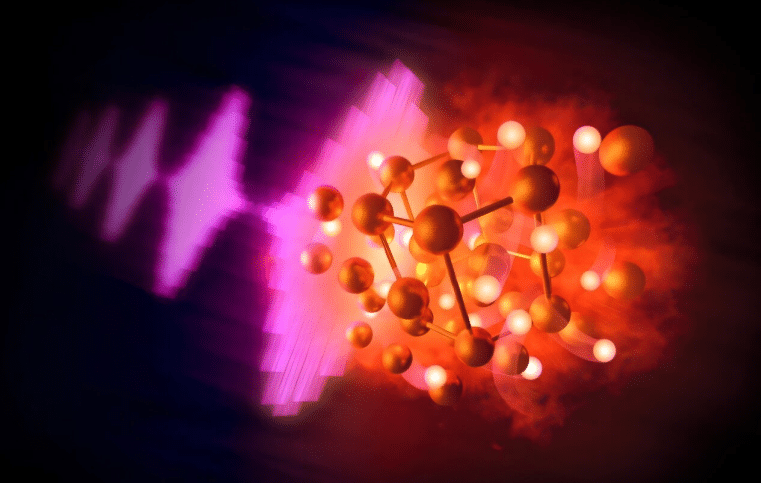
Lead researcher Mungo Frost from the SLAC National Accelerator Laboratory highlighted, “This is the first confirmed example of a binary solid compound involving gold and hydrogen.” The collaboration spanned multiple European and American institutions dedicated to high-energy-density and planetary science.
Implications for Experimental Methods and Theoretical Frameworks
This breakthrough complicates the widespread use of gold as a chemically neutral component in high-pressure studies. Gold’s newfound reactivity under extreme conditions means some previous experiments may need reassessment, particularly those studying phase changes, shock compression, or fusion reactions where chemical inertness was presumed.
The European XFEL’s advanced beamlines, designed for femtosecond-scale analysis, were essential for observing the subtle structural effects of hydrogen insertion. The pressure and temperature range achieved matched those relevant for understanding planetary formation and fusion confinement, highlighting the cross-disciplinary significance of the findings.
Moreover, updated theoretical models are required. Ab initio molecular dynamics simulations showed hydrogen moving rapidly within the gold lattice, behaving more fluidly than in gaseous form. This parallels behaviors seen in superionic water and metallic hydrogen, substances of great interest for giant planet interiors and exotic ice phases.
While hydrides of metals like platinum and palladium have been documented, this gold hydride discovery pushes the boundaries of noble metal chemistry and alters existing notions about planet core compositions where hydrogen integrates into densely packed metallic materials.
Future Directions as Gold's Inert Status is Reevaluated
The discovery aligns with ongoing studies simulating hydrogen-metal interactions under immense planetary pressures. A 2024 investigation in JGR Planets demonstrated that molten iron hydrides become less viscous and more diffusive with rising hydrogen concentration—a factor essential for understanding planetary interior convection.
In fusion research, gold hydride might serve as a valuable reference compound for modeling hydrogen behavior under confinement. Accurately predicting hydrogen’s phase transitions at extreme densities is crucial for devices recreating fusion processes, and gold’s structural shifts upon hydrogen absorption offer a promising system for benchmarking these models and evaluating deviations from ideal plasma physics.
Researchers are also investigating if gold hydride shows practical properties beyond its scientific novelty. Metal hydrides in other systems have been noted for superconductivity and electrochemical activity under pressure. Although speculative, the gold-hydrogen compound may reveal similar unique traits under certain thermodynamic regimes, opening potential new explorations in high-pressure condensed matter physics.
- Categories:
- Science













0 comments
Sign in to Comment