
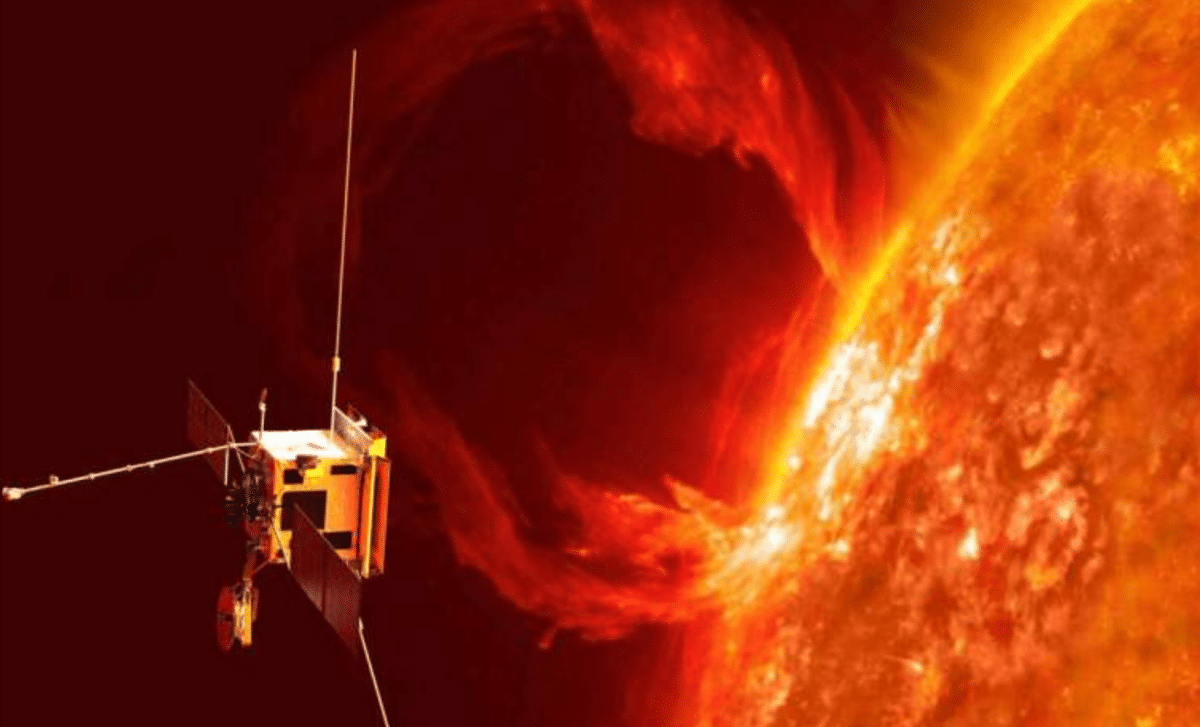
A recent publication in Astronomy & Astrophysics by an international group of researchers from ETH Zurich highlights the longest continuous monitoring of a solar active region ever achieved. Observed nonstop for 94 days across both visible and hidden sides of the Sun, the area named NOAA 13664 produced the most intense solar storm in over twenty years, advancing our grasp of space weather phenomena and their impacts on Earth.
Revealing the Sun’s Hidden Face Using Dual Spacecraft
Typically, solar active regions are only visible from Earth for about two weeks during the Sun’s 28-day rotation, after which they vanish behind the limb, limiting observational data.
This limitation was overcome with the combined efforts of the European Space Agency’s Solar Orbiter launched in 2020 and NASA’s Solar Dynamics Observatory (SDO). Positioned strategically—the Solar Orbiter in a tilted elliptical orbit and SDO near the Sun-Earth line—these space observatories enabled continuous tracking of both the near and far sides of the Sun.

“Fortunately, the Solar Orbiter mission, launched by the European Space Agency (ESA) in 2020, has broadened our perspective,” said Ioannis Kontogiannis, a solar physicist at ETH Zurich and IRSOL.
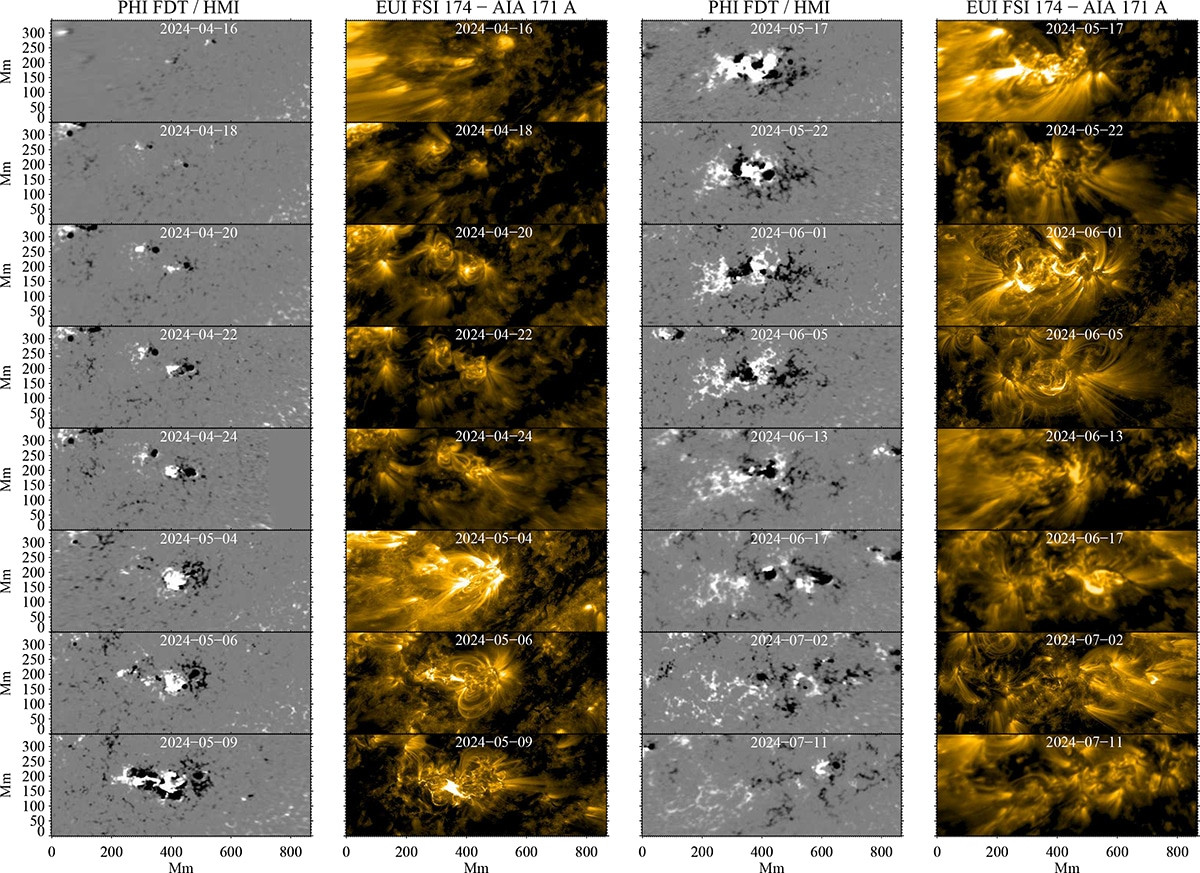
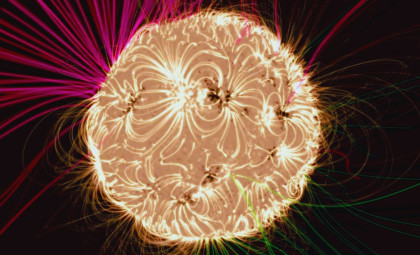
From April to July 2024, Solar Orbiter observed NOAA 13664 continuously through three full solar rotations, an unprecedented achievement. By integrating data from both spacecraft, scientists reconstructed a nearly complete view of this intensely active solar region. Detailed in Astronomy & Astrophysics, the study provides in-depth insights into the magnetic intricacies fueling solar eruptions.
Striking Auroras Greet the Southern Hemisphere
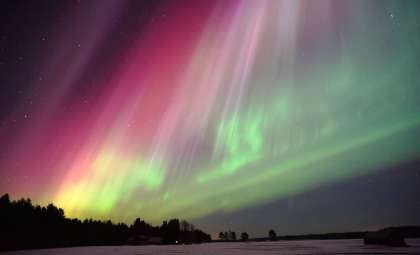
NOAA 13664 was not only a subject of solar study—it also manifested visibly on Earth. During May 2024, as it rotated into Earth’s perspective, it unleashed some of the most intense geomagnetic storms observed since 2003.
“This region caused the spectacular aurora borealis that was visible as far south as Switzerland,” said Louise Harra, professor at ETH Zurich and director of the Davos Physical Meteorological Observatory.
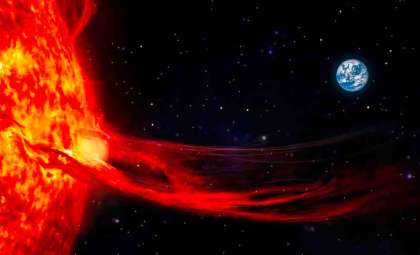
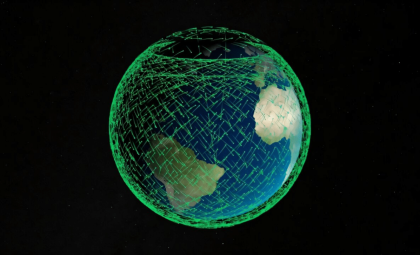
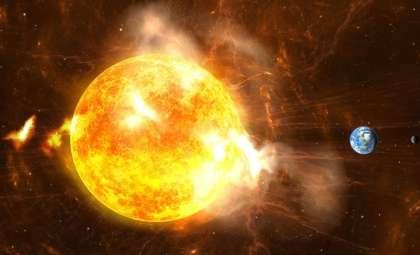
Beyond their beauty, such storms pose serious challenges. Solar eruptions release electromagnetic radiation, high-energy particles, and coronal mass ejections (CMEs) that can disrupt electric grids, satellite operations, and aviation systems. Harra highlighted, “Even railway signal systems can malfunction, flipping signals unexpectedly. That’s truly alarming.”
The Broader Impact of Solar Storms
While the vivid auroras often captivate public attention, the underlying disruptions affect critical infrastructures. The May 2024 event significantly interfered with modern agricultural technologies. “Digital farming methods suffered greatly,” Harra noted.
“Satellite signals, drones, and sensor networks were all compromised, causing delays in farming activities and leading to notable crop losses and economic damage.”
The financial ramifications of space weather disturbances remain underestimated. Power grid failures, GPS inaccuracies, and communication outages can impose multi-billion-dollar costs. As industries rely increasingly on precise data, enhancing predictive capabilities is essential. Kontogiannis remarked, “Since the Sun is the sole star influencing Earth’s environment, understanding its dynamics is vital for safeguarding our technological society.”
Captured Evolution: Tracking Magnetic Dynamics Over 94 Days
The exceptional value of NOAA 13664 lies not only in its intensity but in the extended observation period. From its emergence on April 16 to dissipation after July 18, scientists observed its magnetic fields becoming progressively complex and unstable.
“This is the longest continuous series of images ever created for a single active region: it’s a milestone in solar physics,” said Kontogiannis.
The 94-day window allowed researchers to monitor the magnetic evolution through multiple solar rotations. Ultimately, the tangled magnetic fields triggered a historic flare on May 20, occurring on the Sun’s far side, an event previously invisible to Earth-based observers. These insights pave the way for improved magnetic flux tracking, flare prediction, and mitigation of geomagnetic disturbances.
The Future: Enhanced Solar Storm Warnings with ESA’s Vigil Mission
Despite these advances, accurately forecasting the timing, size, and frequency of solar eruptions remains a challenge. Harra commented, “Complex magnetic regions signal a build-up of energy that will likely erupt, but predicting the exact parameters is difficult.”
To address this, ESA plans to launch Vigil in 2031, a dedicated space weather satellite aimed at refining early warning systems. “While still in development, Vigil represents a significant leap forward in monitoring and understanding solar activity,” Harra added.
Upon deployment, Vigil will enhance real-time alerts for aviation, energy grids, and communication networks, potentially preventing major disruptions from space weather events.
- Categories:
- Space


0 comments
Sign in to Comment