
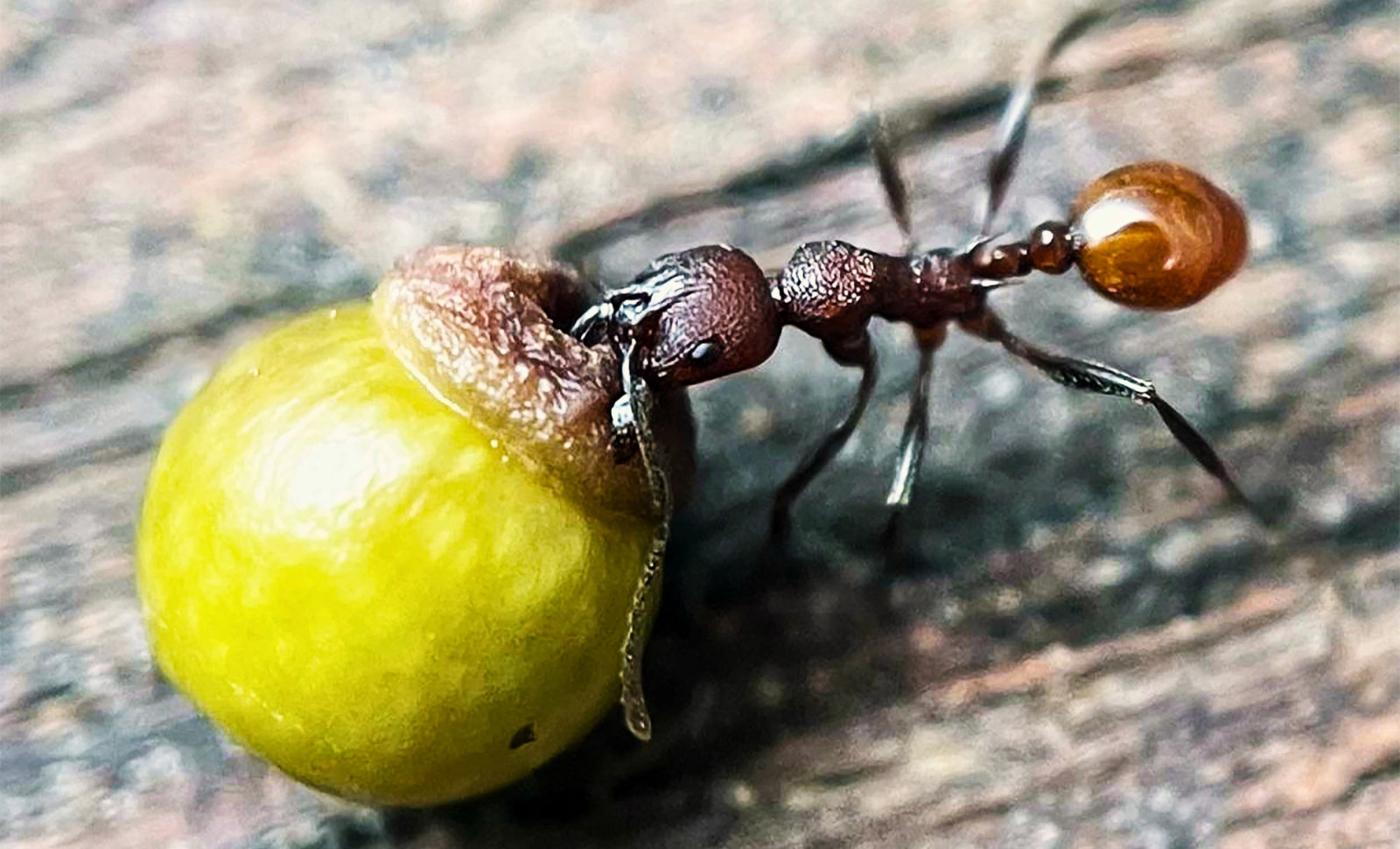
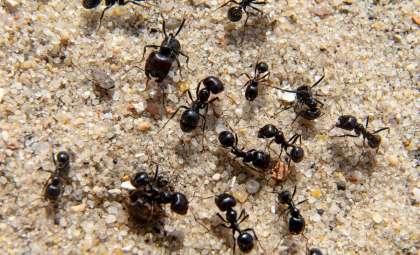
While exploring near a fallen log in his backyard, 8-year-old Hugo Deans noticed what appeared to be tiny seeds gathered near an ant colony. He alerted his father, Andrew Deans, an entomology professor at Penn State University. Andrew quickly realized these were not seeds but oak galls—small chambers the tree creates around developing wasp larvae—and that ants were transporting them back to their nest.
This observation challenged a long-standing biological assumption. Research published in The American Naturalist by scientists from Penn State and SUNY confirms that certain oak galls use chemical strategies similar to plants to manipulate ants into carrying them underground. The wasp larvae stay unharmed, ants obtain nourishment, and this covert relationship has likely persisted unnoticed on forest floors for ages.
An Established Mutual Exchange
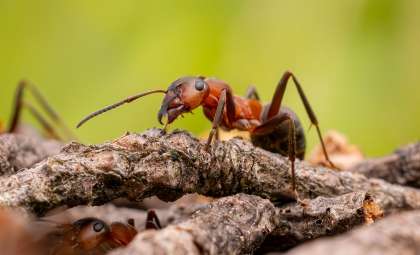
For over a century, biologists have recognized that many plants employ ants to disperse their seeds through a process called myrmecochory. This relies on an oily structure known as an elaiosome attached to the seed coat. Ants transport the seeds underground, consume the elaiosome, and effectively plant the seed in a safe, nutrient-rich environment — a tidy example of mutualism.

“Ants receive nutrition from eating the elaiosomes, while plants benefit from dispersal to enemy-free zones,” explained Andrew Deans. This classic interaction is commonly used to illustrate cooperative relationships between plants and insects. However, Hugo’s backyard discovery hinted at a parallel system operating under the radar.
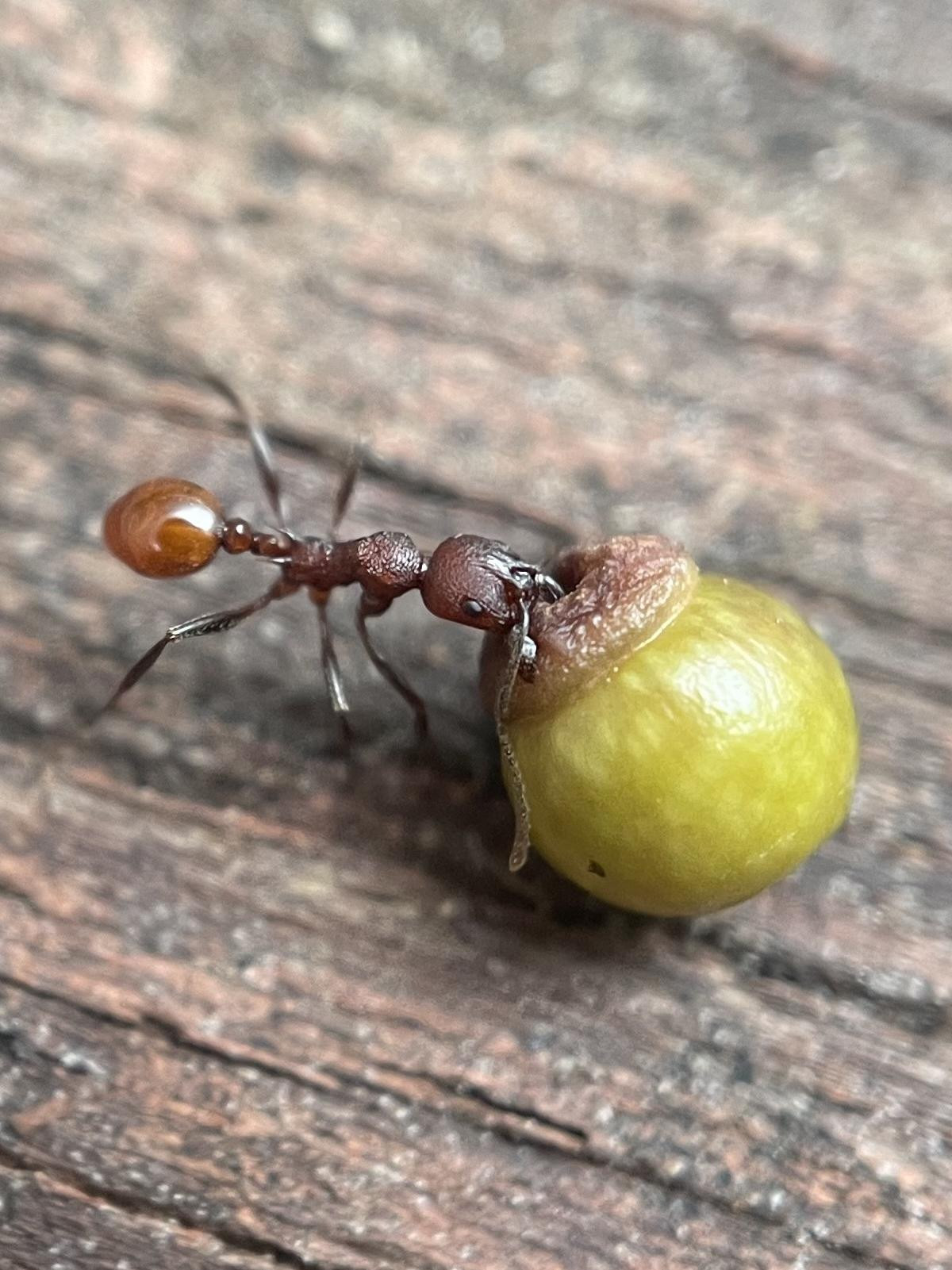
The galls are produced by two species of cynipid wasps, Kokkocynips rileyi and Kokkocynips decidua, which develop on the central veins of red oak leaves. Both species create a pale, detachable cap termed the “kapéllo,” derived from the Greek word for hat. This cap attracts the ants.
Wasp-Engineered Structures Within Oaks
Utilizing gas chromatography, researchers found that the kapéllo contains the same suite of free fatty acids—including lauric, palmitic, oleic, and stearic acids—found in traditional elaiosomes. Chemically, the kapéllo resembles an elaiosome much more closely than the rest of the gall, making them almost indistinguishable to ants relying on scent cues.
Anatomically, the boundary between the kapéllo and the main gall hardens and lignifies as the gall matures, allowing the cap to detach cleanly, similar to how elaiosomes separate from seeds. This structure isn’t directly produced by the wasp; rather, it manipulates the oak tree’s tissues as the gall forms, effectively crafting a detachable lure from the tree itself.
This is particularly unexpected because the wasp lacks any specialized glands or organs to produce this structure. Instead, it commandeers the oak’s growth processes to create an effective chemical decoy.
Ants React as Anticipated
Tests conducted in a New York woodland compared how ants treated bloodroot seeds and K. rileyi galls placed in separate trays. The ant species Aphaenogaster picea, known for dispersing most seeds in this ecosystem, removed both items at almost equal speeds over 90 minutes. In laboratory trials offering ants four choices simultaneously—intact galls, galls without the kapéllo, isolated kapéllos, and control galls from non-kapéllo species—the ants consistently chose the kapéllo, regardless of whether it was attached or loose.
The larvae concealed within intact galls were left untouched during these experiments, confirming that the chemical signals alone motivated ant behavior.
The experiments clarified that ant attraction was not triggered by the gall’s physical traits such as shape or color. Instead, the kapéllo’s fatty acid fingerprint was the sole factor driving ant collection.
Why Subterranean Transport Benefits Wasps
Since adult wasps are capable of flight, moving galls a few meters doesn’t aid in dispersal directly. Researchers suggest that shelter provided by ant nests may be the key advantage. Ant colonies produce antimicrobial chemicals that create hostile conditions for pathogens. Larvae stationed in nests gain protection from predators like birds, rodents, parasitic wasps, and mold prevalent in the leaf litter.
This situation exemplifies convergent evolution, where distinct organisms evolve similar strategies independently. While plants generate elaiosomes and stick insects have fatty egg coatings that co-opt ant behaviors, cynipid wasps achieve the effect uniquely by utilizing the oak's biological mechanisms rather than evolving new organs.
Despite differing origins, all cases revolve around small fatty structures triggering the same ant response. The simplicity of the signal facilitates complex ecological interactions.
Implications for Forest Ecosystems
Oak galls are prolific and conspicuous across forest floors during late summer and fall, formerly harvested as livestock feed. If ant-mediated transport of galls is widespread among multiple wasp species, it represents an unrecognized pathway influencing nutrient cycling, microbial movement, and pathogen distribution throughout forest environments annually.
“I was amazed ants would collect galls,” reflected Hugo, now 13. “Why would they do that?” The answer emerged through a combination of chemical analysis, field observations, and microscopic studies, revealing the wasps’ precise chemical strategy.
This groundbreaking research is the first to document this complex three-way interaction with comprehensive evidence. Whether other gall-formers employ similar tactics remains an open question for future investigation.

0 comments
Sign in to Comment