
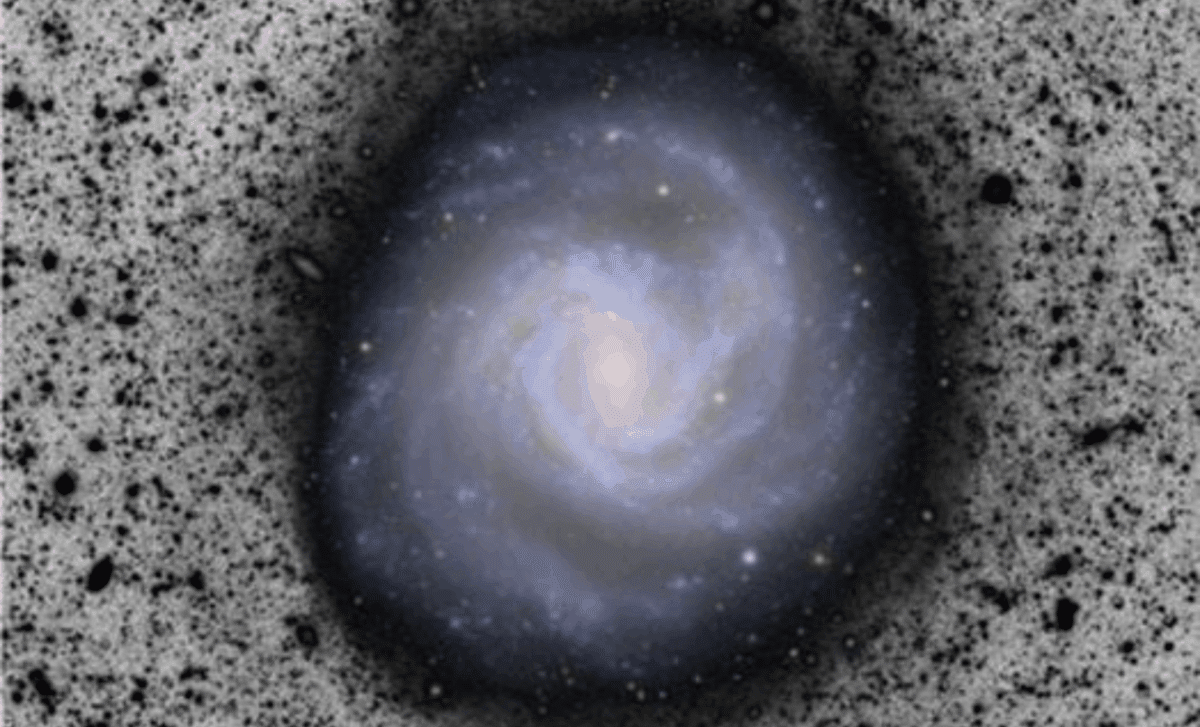
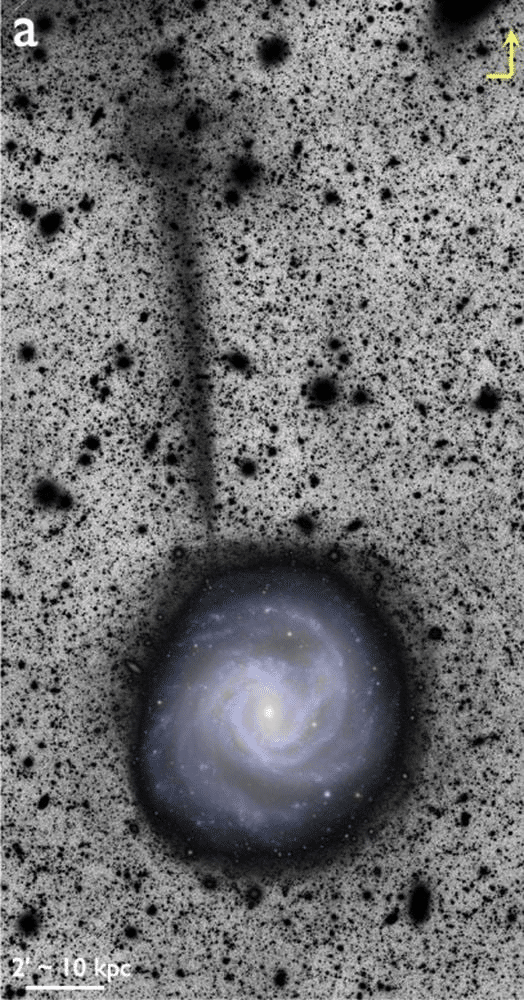
The Vera Rubin Observatory has made an impressive early discovery. During its inaugural Virgo First Look survey, the telescope captured a vast stellar stream extending around the spiral galaxy Messier 61 (M61). Spanning approximately 163,000 light-years, this extensive formation provides new insights into the tumultuous interactions shaping galaxies. This initial glimpse highlights the groundbreaking findings expected from VRO once it is fully operational.
A Hidden Stellar River Encircling M61
As reported by Universe Today, the discovery is documented in a recent research letter titled “A stellar stream around the spiral galaxy Messier 61 in Rubin First Look imaging.” Scheduled for publication in the Research Notes of the American Astronomical Society, the study is led by Aaron Romanowsky from the Department of Physics & Astronomy at San Jose State University. By analyzing VRO’s initial images of the Virgo Cluster, researchers identified an enormous, previously undetected ribbon of stars arcing above M61—one of the cluster's most scrutinized galaxies.
This revelation changes prior assumptions about the structure and history of M61. The researchers state,

“Giant spiral galaxies like the Milky Way (MW) constantly accrete dwarf galaxies that disrupt into stellar streams, as hallmarks of the hierarchical universe, useful for testing galaxy formation and dark matter theories.”
These stellar streams act as cosmic relics, mapping out ancient galactic mergers and gravitational encounters. In the case of M61, the enormous scale of its stream surpasses similar structures known around the Milky Way, highlighting a vibrant history of collisions and assimilations.
Tracing the Impact of a Galactic Merger
The detected stellar stream is believed to be the leftover trail from a smaller galaxy that was engulfed by M61. This event may have significantly influenced M61's current structure.
“Given an infall halo mass of ∼ 8 × 10¹⁰ M⊙ expected from its stellar mass, the stream progenitor galaxy could be responsible for the bar formation, starburst, and active galactic nucleus in M61, reminiscent of the Sgr impact on the MW,” the team notes.
Such galactic encounters are relatively common; our own Milky Way retains evidence of similar events caused by the Sagittarius Dwarf Galaxy, whose repeated interactions have triggered waves of new star formation.
This remarkable find provides an external example akin to these phenomena, giving astronomers an exceptional opportunity to study galaxy evolution through merger activity. The intricate plume extending from M61’s stream, measuring roughly 30,000 by 13,000 light-years, points to a complex past with potentially multiple phases of interaction. Each delicate filament tells part of the larger narrative of cosmic structure formation and transformation over time.
A Promising Future for the Vera Rubin Observatory
Although still in the commissioning stage, the Vera Rubin Observatory has already demonstrated remarkable sensitivity. Identifying such a faint structure around a prominent galaxy highlights the strength of its upcoming Legacy Survey of Space and Time (LSST). The researchers emphasize,
“It is remarkable that the stream went long unnoticed around a Messier galaxy. We expect a treasure trove of substructures to be unveiled around other galaxies with future Rubin data.”
When the LSST officially begins, the observatory will meticulously chart billions of celestial bodies with unmatched detail. This early discovery of a massive, previously overlooked structure suggests that the coming decade may reveal a wealth of new findings—from hidden stellar streams to rogue planets and distant transient events—reshaping our understanding of the universe.
- Categories:
- News





0 comments
Sign in to Comment