
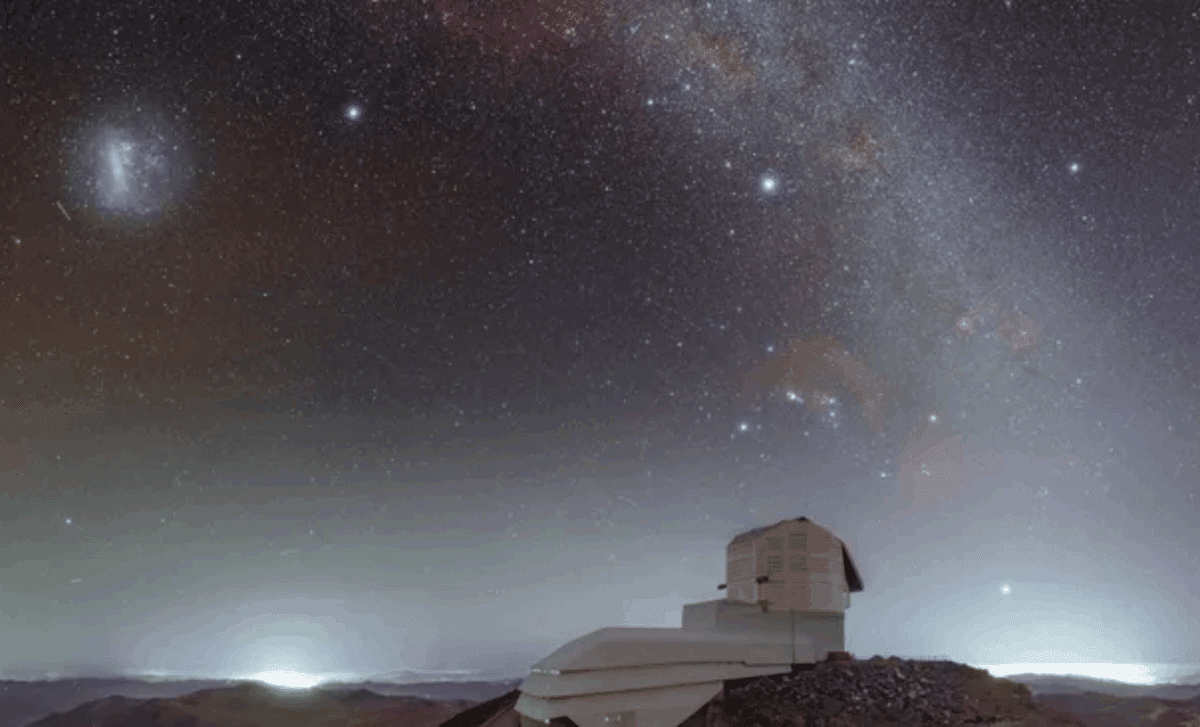
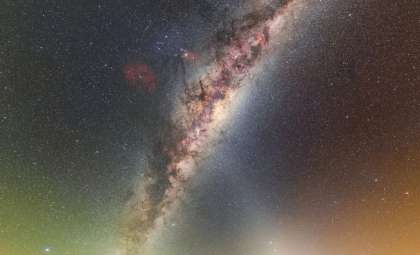
An awe-inspiring photo showcases the Milky Way gracefully arching above the Vera C. Rubin Observatory, perched high in the Chilean Andes. This captivating snapshot captures a tranquil instant before one of astronomy’s most groundbreaking ventures commences.
In the near future, the observatory will monitor millions of cosmic phenomena nightly, revolutionizing our perception of the ever-changing universe.
A Stunning View of a Telescope Poised for Breakthroughs
Silhouetted against the mountainous backdrop, the observatory stands beneath an elegant arc of stars. Positioned just above Cerro Pachón, the Vera Rubin Observatory lies in readiness. To the left of the radiant Milky Way, the subtle glow of the Large Magellanic Cloud — a neighboring dwarf galaxy — adds a cosmic depth to the scene.
While appearing serene and modest beneath the vast sky, this facility houses some of the most sophisticated astronomical technology ever created. Central to its design is the Simonyi Survey Telescope featuring an 8.4-meter mirror, coupled with the largest digital camera ever designed for space observation: the impressive 3.2-gigapixel LSST Camera. This telescope functions as a powerful cosmic chronicle.

Tracking the Universe’s Continuous Transformation
The Vera Rubin Observatory’s key endeavor is the Legacy Survey of Space and Time (LSST), a decade-spanning initiative scanning the southern hemisphere sky every three nights. It aims to monitor the brightness, location, and trajectories of billions of celestial bodies. Each clear night will reveal up to 10 million fluctuating objects, including newfound asteroids and dramatic supernovae.
Managing this enormous data stream demands exceptional engineering. A custom-built software system, known as the data butler, will efficiently organize, process, and store over 20 terabytes of data nightly. As reported by Space.com, this technology enables astronomers to focus on discovery rather than data overload, resulting in the most comprehensive, real-time map of our evolving cosmos yet.
A Tribute to Vera Rubin’s Groundbreaking Legacy
The observatory is a tribute to Vera C. Rubin, the astrophysicist whose influential research on galactic rotation curves provided pivotal evidence for dark matter — a mysterious substance comprising most of the universe’s mass. Her legacy revolutionized cosmological science, a mission this observatory carries onward.
Rubin’s quest to understand galaxy formation and evolution now advances with the facility named after her, which will chart billions of galaxies over time and help decipher how dark matter sculpts cosmic structures. This enormous trove of data aims to reveal the elusive nature and location of dark matter, propelling Rubin’s pioneering work into the future.
- Categories:
- News



0 comments
Sign in to Comment